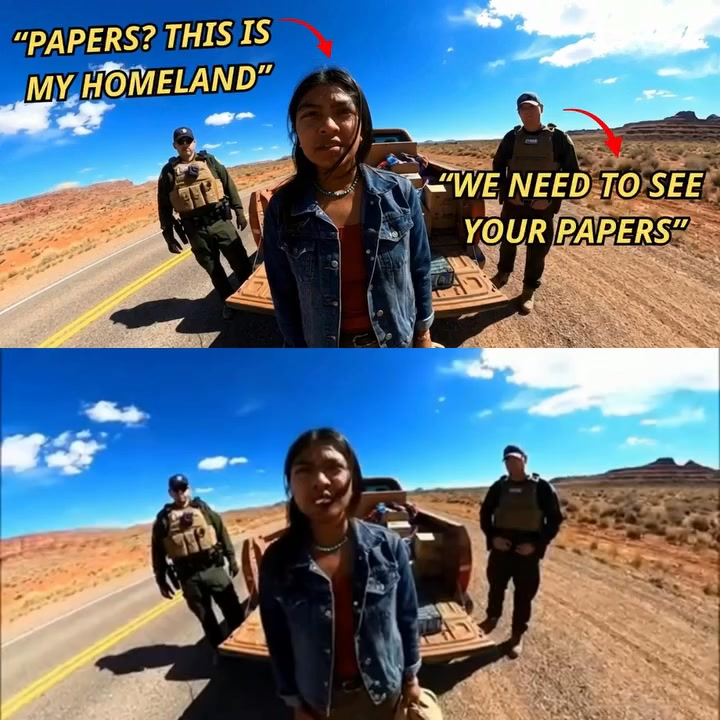
Three federal agents stepped out of a black SUV on Navajo Nation land and demanded that a Native American nurse prove she belonged in the United States.
Forty minutes later, she was in handcuffs.
Less than two years later, the federal government was writing a $22.4 million check, rewriting enforcement protocols on tribal land, and answering for a pattern it had quietly ignored for years.
The woman they detained had never crossed a border.
The border had crossed her.
A Tuesday Morning on Sovereign Land
It was a clear Tuesday in Shiprock, New Mexico. Highway 491 cut through Navajo Nation territory, red rock cliffs rising in the distance, the desert heat already radiating off asphalt by midmorning.
Sage Blackwater had just finished a 12-hour overnight shift at the Indian Health Service clinic. She worked as a nurse practitioner, treating elders with chronic conditions and families without reliable access to care. On her way home, she stopped at the Shiprock Trading Post for groceries—milk, bread, canned goods for her grandmother.
Routine. Ordinary. Unremarkable.
She loaded the last bag into the bed of her Ford F-150 when she noticed the SUV.
Federal vehicles were not unusual in the region. Bureau of Indian Affairs, Indian Health Service, tribal liaison officers—they came and went.
But the way the three individuals exited the SUV was different.
Purposeful. Focused. Already certain.
Agent Warren Foster led, body camera mounted to his chest. Agents Jessica Chin and Raymond Burke followed half a step behind.
“Ma’am,” Foster called out. “We need to speak with you.”
Sage turned, tired but composed. “Can I help you?”
“We’re with Immigration and Customs Enforcement,” Foster said. “We need to see your identification and proof of U.S. citizenship.”
The desert air felt heavier.
“I’m Navajo.”
Sage did not shout. She did not panic.
“I’m Navajo,” she said evenly. “My family has lived on this land for thousands of years.”
Agent Chin tapped at her tablet. “That’s not how immigration law works. We still need documentation proving citizenship.”
Sage understood instantly: this was not about law. This was about belief.
“You’re standing on Navajo Nation land,” she replied. “This is sovereign territory. You don’t have jurisdiction here without tribal authorization.”
Foster responded with procedural authority. Federal immigration powers, he claimed, superseded tribal jurisdiction in this matter.
That claim was legally complicated—and dangerously incomplete.
The Indian Citizenship Act of 1924 grants U.S. citizenship to Native Americans born in the United States. Tribal sovereignty overlays that citizenship with distinct jurisdictional frameworks, particularly on reservation land.
But in that parking lot, complexity gave way to assumption.
“Show me your papers,” Burke said.
Sage produced her New Mexico driver’s license.
“That doesn’t prove citizenship,” Foster said. “A license can be obtained illegally.”
The implication hung there.
Brown skin. Indigenous features. Suspicion.
Sage stated calmly that she was a registered member of the Navajo Nation and worked at the local clinic. Verification could be completed in minutes.
Foster did not attempt it.
Instead, he reached for her arm.
The Arrest
“Turn around. Hands behind your back.”
“For what?” Sage asked.
“You’re being uncooperative.”
A crowd began to form. An elderly Navajo man pulled out his phone and began recording. Others followed.
Sage raised her voice just enough to be heard.
“I’ve shown you my ID. I’ve told you who I am. You have no probable cause.”
The cuffs clicked shut.
The sound carried across the parking lot.
Witnesses shouted in Navajo. A store employee rushed outside. Phones captured every angle.
Sage was placed in the back of the SUV.
Forty minutes to Farmington.
Forty minutes in cuffs on land her ancestors had never left.
The “Glitch”
At the ICE field office, Sage demanded counsel and tribal notification.
Supervisory agent Sharon Gonzalez entered the room minutes later, visibly alarmed.
The justification for detention? “Failure to provide proof of citizenship during a lawful immigration inquiry.”
The reality?
Sage was born in Shiprock, New Mexico. A U.S. citizen by birth. A tribal member by enrollment.
There was no warrant. No ongoing investigation. No articulable suspicion beyond appearance.
When the detention was reviewed, the arrest collapsed instantly.
“You are free to go,” Gonzalez said. “There has been a misunderstanding.”
Sage did not accept that framing.
“That’s not a misunderstanding,” she replied. “That’s a civil rights violation.”
The Lawsuit
Within days, Sage Blackwater filed a federal civil rights lawsuit.
The complaint alleged:
• False arrest
• False imprisonment
• Racial profiling
• Violation of the Fourth Amendment
• Violation of tribal sovereignty
• Deprivation of rights under color of law
The defendants included the individual agents, ICE as an agency, the Department of Homeland Security, and the federal government.
The damages sought: $22.4 million.
Discovery revealed something worse than a single bad decision.
Agent Warren Foster had conducted 47 immigration-based detentions near tribal lands over 12 years.
Forty-two had resulted in no charges.
Forty-two.
Internal warnings existed. Training sessions had been documented. But no sustained discipline followed.
A pattern had been tolerated.
The Trial
The trial lasted three weeks.
Body camera footage was played repeatedly. Jurors watched Foster dismiss Sage’s statements, refuse verification, and escalate without probable cause.
When questioned under oath, Foster admitted he did not attempt to verify her tribal enrollment or employment before initiating detention.
“Did you rely on anything other than her appearance?” Sage’s attorney asked.
Objections followed. The question lingered.
Agent Chin testified that she knew the arrest felt wrong but deferred to Foster’s seniority.
Burke testified he was “just following orders.”
The jury saw a consistent theme: authority replacing inquiry.
They deliberated eight hours.
The verdict: liable on all counts.
$22.4 million in damages.
$8 million compensatory.
$14.4 million punitive.
The message was unmistakable.
Consequences
Foster was terminated and permanently barred from federal law enforcement. Federal prosecutors later pursued charges under 18 U.S.C. §242 for deprivation of rights under color of law.
Chin received probation and mandatory retraining. Burke was suspended without pay.
ICE implemented mandatory tribal sovereignty training. New protocols required verification of tribal enrollment before enforcement action on or near tribal lands.
Oversight systems were expanded to identify patterns of racial profiling.
Beyond the Settlement
Sage Blackwater did not disappear after the verdict.
She established a legal defense fund for Native Americans facing unlawful detention. She funded scholarships for Native law students.
Her case is now taught in law schools and federal training seminars.
The body camera footage is used as a cautionary example of how assumption escalates into constitutional violation.
She still shops at the Shiprock Trading Post.
The red cliffs still stand.
But something fundamental shifted.
Federal vehicles entering Navajo Nation territory now operate with heightened scrutiny.
Verification precedes enforcement.
Respect precedes assumption.
The Larger Question
Sage Blackwater had the education, resources, and support to fight back.
What about those who don’t?
How many similar detentions never reach federal court?
How many “misunderstandings” end without accountability?
The $22.4 million verdict did not just compensate harm.
It forced recognition.
You do not demand “papers” from people whose nations predate the one you represent.
On Navajo land, sovereignty is not symbolic.
It is legal.
And in that parking lot, federal authority learned that lesson the hard way.