What began as a tense doorstep confrontation quickly escalated into a police response that has since captured national attention.
A quiet suburban neighborhood became the backdrop for a viral confrontation after a woman refused to leave her ex-boyfriend’s property, despite repeated warnings and the arrival of law enforcement. The entire encounter, recorded by a doorbell camera and later supplemented by police bodycam footage, has sparked widespread debate about breakups, boundaries, and the legal consequences of ignoring both.
The footage — now circulating across social media platforms — shows an emotional standoff that many describe as uncomfortable, dramatic, and deeply cautionary.
But beneath the viral clips lies a more complex story about heartbreak, escalation, and the thin line between emotional vulnerability and unlawful behavior.
A Quiet Street Disrupted
Neighbors described the street as typically peaceful.
Tree-lined sidewalks. Well-kept lawns. Families who knew each other by name.
That calm atmosphere was disrupted one afternoon when a woman appeared at the front door of her former partner’s home and refused to leave.
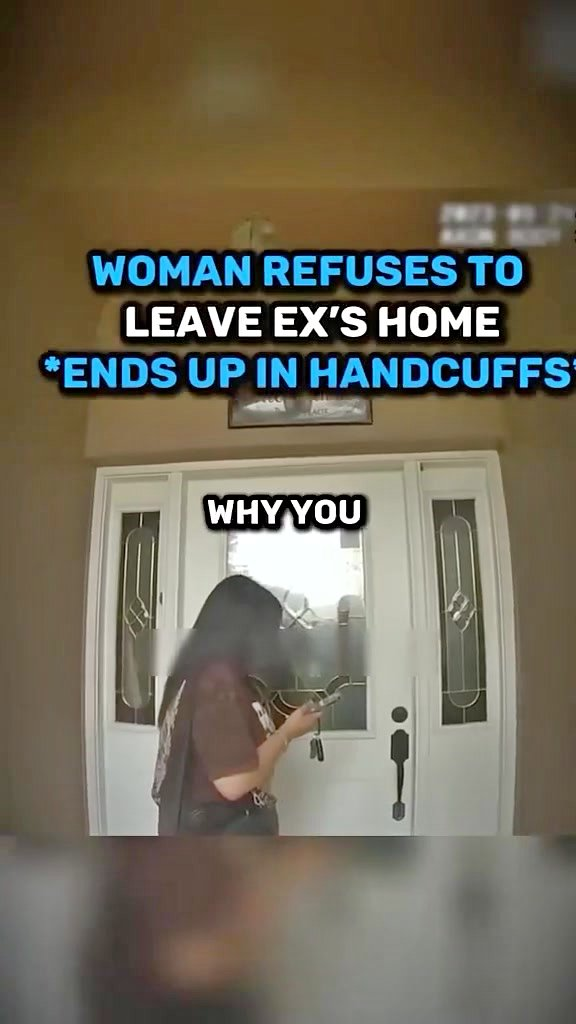
The doorbell camera footage begins with the woman standing squarely in front of the door. At first, she appears composed. She knocks firmly but not aggressively.
“Can we just talk?” she calls out.
There is no answer.
Seconds turn into minutes.
Her tone changes.
From Calm to Confrontational
As the footage continues, her voice becomes louder and more demanding.
“I know you’re in there!” she shouts, gripping her phone tightly. In her other hand, a keychain swings nervously.
Her pacing intensifies. She steps back from the door, looks directly into the doorbell camera, and shakes her head in frustration.
According to later police reports, the relationship had ended several weeks prior. The homeowner had allegedly asked her not to return to the property.
Still, she remained.
Her words grew sharper.
“You can’t just ignore me!”
The 911 Call
Inside the home, the ex-boyfriend was reportedly monitoring the situation through the same doorbell camera.
Feeling uneasy and unwilling to engage directly, he called 911.
Dispatch logs later revealed that he informed operators that his ex-girlfriend was on his property without permission and had previously been warned to stay away.
He reportedly told dispatch that he did not feel comfortable confronting her face-to-face.
Police were dispatched shortly after.
Officers Arrive on Scene
When patrol vehicles pulled up, the woman was still on the porch.
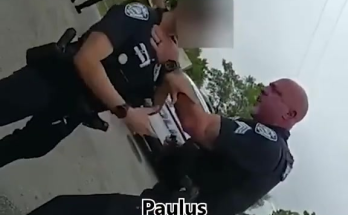
Bodycam footage from responding officers shows them approaching calmly.
One officer addresses her respectfully.
“Ma’am, we need to speak with you.”
She turns, visibly frustrated.
“I just want to talk to him,” she insists.
Officers inform her that the homeowner has requested that she leave immediately.
She shakes her head.
“He’s ignoring me. I’m not leaving until he comes out.”
The Legal Line: Trespassing
At this moment, the situation shifted from emotional confrontation to legal boundary.
The responding officer clearly explains the law.
“If the homeowner has told you to leave and you refuse, that becomes trespassing.”
Trespassing laws vary slightly by jurisdiction, but generally, remaining on private property after being asked to leave is a criminal offense.
The officer gives her another chance.
“You need to step off the property now.”
Instead of complying, she continues arguing.
That refusal changed everything.
Escalation and Detainment
After multiple warnings, one officer states calmly:
“Ma’am, you’re now being detained for trespassing.”
The tone remains professional.
The officers do not shout.
They do not rush.
They gently take her by the arm.
She resists briefly — not violently, but enough to require physical guidance.
“I didn’t do anything wrong!” she protests.
Within seconds, she is placed in handcuffs.
The encounter ends without physical injury or major incident.
But the emotional intensity lingers in the footage.
Neighbors Speak Out
Several neighbors later spoke to local reporters.
Many admitted they had noticed the woman visiting the house several times in recent weeks.
“She would show up late at night sometimes,” one neighbor said. “We didn’t know what was going on, but it felt tense.”
Police later confirmed that there had been two prior complaints involving similar behavior.
No arrests were made in those earlier incidents.
This time, the refusal to leave left officers with little choice.
The Emotional Element
Breakups are rarely simple.
Psychologists note that the end of a relationship can trigger intense emotional responses — including denial, anger, desperation, and anxiety.
Dr. Elaine Parker, a licensed relationship therapist, explains:
“When someone feels suddenly cut off, especially if closure hasn’t occurred, they may feel compelled to force a conversation. But emotional urgency does not override legal boundaries.”
In many cases, individuals do not recognize when their emotional actions cross into unlawful territory.
This incident appears to be one such example.
Viral Reaction: Sympathy vs. Accountability
Once the footage hit social media, reactions were swift and divided.
Some viewers expressed sympathy.
“She just wanted closure,” one comment read.
“Heartbreak makes people do irrational things.”
Others took a firmer stance.
“Breakups are hard, but you can’t show up uninvited.”
“Boundaries exist for a reason.”
Many praised the officers for handling the situation calmly and professionally.
“She’s lucky they were patient,” one viewer noted.
The viral nature of the video amplified every angle of the debate.
The Role of Doorbell Cameras
Technology played a central role in this story.
Doorbell cameras have become common security tools in suburban neighborhoods.
They provide documentation.
They create evidence.
They remove ambiguity.
In this case, the footage clearly captured the woman’s refusal to leave — a key factor in determining trespassing.
Without video, the situation could have devolved into conflicting accounts.
Instead, there was clear documentation.
When Love Turns into Legal Trouble
Law enforcement officials frequently encounter situations where emotional disputes escalate into criminal behavior.
Sergeant Cole Matthews, one of the responding officers, later commented:
“It’s one of those situations where emotions run high, and poor decisions make things worse. We always encourage people to resolve conflicts through communication or legal channels — not confrontation.”
While heartbreak can cloud judgment, repeatedly ignoring requests to stay away can escalate quickly.
The Restraining Order
Following the arrest, the homeowner filed for a restraining order.
Restraining orders legally prohibit contact or proximity.
Violating such an order can result in more serious consequences, including arrest and additional charges.
Courts often grant temporary restraining orders when there is evidence of repeated unwanted contact.
In this case, prior complaints strengthened the request.
Understanding Trespassing Laws
Trespassing laws are straightforward but frequently misunderstood.
In most jurisdictions, a person commits trespassing when they:
- Enter property without permission
- Remain after being asked to leave
- Return after prior notice not to
Intent is not always the deciding factor.
Even if the intent is “just to talk,” remaining on private property against the owner’s wishes qualifies.
That distinction is critical.
The Psychology of Refusal
Why do some individuals refuse to leave even when confronted by police?
Experts suggest a combination of emotional dysregulation and denial.
When someone feels rejected, they may experience a surge of adrenaline and desperation.
That emotional state can override rational decision-making.
However, law enforcement must respond to behavior — not emotional explanations.
The Broader Conversation About Boundaries
This case highlights a larger societal issue: respecting boundaries.
In modern relationships, digital communication often blurs lines.
Text messages. Social media. Location tracking.
When a relationship ends, the transition from constant contact to zero contact can feel abrupt.
But legally and emotionally, respecting distance is essential.
Showing up uninvited crosses that line.
Community Reflection
Residents of the neighborhood have since described the event as unsettling but instructive.
“It was dramatic, yes,” one resident said. “But it reminds people that you can’t force someone to engage with you.”
The event has become a local talking point — a reminder that emotional situations can escalate quickly.
Police Response Under Scrutiny
In viral incidents, police conduct is often scrutinized heavily.
In this case, many viewers praised the officers’ measured approach.
They issued clear warnings.
They explained the law.
They avoided unnecessary force.
Bodycam footage supports the narrative of professionalism.
Such calm responses can prevent situations from escalating further.
Legal Consequences Ahead
The woman may face misdemeanor trespassing charges.
Depending on the jurisdiction, penalties could include:
- Fines
- Community service
- Probation
- Court-mandated counseling
If the restraining order is violated in the future, consequences could become more severe.
Lessons About Closure
One of the most common themes in online discussion has been “closure.”
Many relationships end without a final conversation that feels satisfying.
But forcing that conversation rarely produces healing.
Relationship counselors emphasize:
Closure often comes from acceptance, not confrontation.
Attempting to compel someone into dialogue can worsen the situation — legally and emotionally.
Social Media’s Role in Public Judgment
Once footage goes viral, narratives harden quickly.
Clips are shared without full context.
Viewers project their own experiences onto the scene.
Some see desperation.
Others see harassment.
But viral exposure rarely reflects the full complexity of a relationship.
That nuance often disappears online.
A Cautionary Reminder
Police departments routinely warn that showing up uninvited to an ex’s home can have serious consequences.
Even if intentions seem harmless, refusal to leave can result in arrest.
What feels like an emotional plea can legally become trespassing.
This case underscores that reality.
Walking Away Isn’t Weakness
As Sergeant Matthews noted, emotions can run high during breakups.
But walking away — even when it feels impossible — is often the healthiest option.
Boundaries exist to protect both parties.
Respecting them protects dignity, safety, and legal standing.
When Emotion Meets Law
The viral footage of a woman refusing to leave her ex-boyfriend’s home has sparked debate across the country.
Some see heartbreak.
Others see accountability.
But the law remains clear.
Private property rights are enforceable.
Repeated warnings matter.
And refusing to leave can lead to arrest.
Ultimately, this story serves as a reminder:
Emotions may be powerful, but boundaries are stronger.
Sometimes walking away isn’t defeat.
It’s wisdom.