The sound of Martha’s hysterical screams tearing through the humid afternoon air was the exact moment my entire world stopped spinning.
It wasn’t a yell of surprise or a casual call over the fence. It was a guttural, primal shriek that froze the blood in my veins.
“He’s killing him! Oh my God, somebody help, the dog is killing the boy!”
I was standing at the kitchen sink, the warm suds of dishwater clinging to my wrists. I had just closed my eyes for three seconds. Just three seconds of stolen peace in a life that hadn’t felt peaceful in over a year.
The ceramic coffee mug slipped from my soapy fingers. It hit the hardwood floor, shattering into a dozen jagged pieces, sending dark, cold coffee splattering across my bare ankles.
But I didn’t feel it. I didn’t feel anything except the sudden, violent hammering of my own heart against my ribs.
My son. My five-year-old boy, Leo.
And Brutus.
Brutus is a hundred and ten pounds of pure, unadulterated muscle. He’s a German Shepherd mix I pulled from the darkest, coldest corner of a county kill shelter exactly eleven months ago. He has a scar running down the left side of his snout, a torn ear, and eyes that hold too much human sorrow for an animal.
When people see Brutus, they cross the street. Mothers pull their strollers closer. Delivery drivers toss packages from the safety of the sidewalk.
But they don’t know him. They don’t know that when my husband, Greg, packed his bags one rainy Tuesday and decided being a father to a sensitive four-year-old was simply “too much pressure,” Brutus was the only thing that kept this house from collapsing into complete despair.
Greg’s departure left a gaping, bleeding hole in our lives. Leo, who used to chatter endlessly about dinosaurs and outer space, went entirely mute. For four weeks, my sweet boy didn’t utter a single syllable. He just stared out the front window, waiting for a silver Honda Accord that was never coming back.
I was drowning. I was working double shifts as an ER nurse just to keep the mortgage paid in this idyllic, picture-perfect Pennsylvania suburb where single mothers were treated like cautionary tales. I was failing. I felt the judgment of the neighborhood every time I hauled the trash to the curb in my oversized sweatpants, running on three hours of sleep.
Then came Brutus.
I adopted him on a whim, driven by some desperate, lonely instinct. The shelter volunteers warned me. They said he was a former guard dog, chained to a radiator in a meth house for the first three years of his life. They said he was traumatized. They said he might not be “good with kids.”
But the day I brought that massive, battered beast into our quiet home, something miraculous happened.
Leo was sitting on the living room rug, staring blankly at the wall. Brutus walked in, his giant paws clicking cautiously against the floorboards. He took one look at my broken, silent little boy.
The dog didn’t jump. He didn’t bark. He just walked over, lowered his massive, scarred frame to the floor, and gently rested his heavy chin squarely on Leo’s tiny lap.
He let out a long, heavy sigh.
And for the first time in a month, Leo reached out his little hand. He buried his fingers in the thick, coarse fur behind Brutus’s ears. And Leo whispered, “You’re sad, too.”
From that second on, they were tethered together by some invisible, unbreakable thread. Where Leo went, Brutus followed. If Leo was building blocks, Brutus was laying in a circle around him, acting as a furry, impenetrable wall. If Leo had a nightmare, Brutus was already at the side of his bed, licking the tears from his cheeks before I even reached the doorway.
Brutus wasn’t just a pet. He was Leo’s protector. He was the father figure Greg had refused to be. He was the man of the house.
But the neighborhood didn’t see that.
They saw a weapon.
And no one saw a weapon more clearly than Martha Higgins.
Martha lived right next door. She was a sixty-something widow whose entire existence seemed to revolve around her prize-winning petunias, the Homeowner’s Association bylaws, and peering through her Venetian blinds with a pair of reading glasses perched precariously on her nose.
Martha had never hidden her disdain for us. When Greg left, she brought over a casserole, but her eyes darted around my messy living room, taking inventory of my failures. When I brought Brutus home, the casserole diplomacy ended.
She called the HOA three times in the first month. She claimed Brutus barked too loud (he rarely barked). She claimed he looked at her aggressively through the chain-link fence (he was usually just watching the squirrels). She once cornered me by the mailboxes, her lips pursed so tight they practically disappeared.
“That beast is a liability, Sarah,” she had hissed, wrapping her cardigan tighter around herself. “A dog with that kind of history? It’s a ticking time bomb. You mark my words. One day, his instincts are going to kick in, and that poor fatherless boy of yours is going to pay the price.”
I had bitten my tongue, smiled politely, and walked away. I couldn’t afford a war with my neighbor. I was too tired.
But I never forgot the cold certainty in her eyes. She was waiting for me to fail. She was waiting for Brutus to prove her right.
And now, listening to her agonizing screams from the backyard, I knew she thought her prophecy had just come true.
The night before had been a nightmare. A freak summer storm had rolled through our county with the ferocity of a hurricane. The wind had howled like a wounded animal, rattling the windowpanes and violently violently shaking the ancient oak trees that lined our property.
Lightning had flashed so brightly it turned the midnight sky a sickly, electric purple. Thunder cracked so hard the floorboards vibrated.
Leo had spent the entire night huddled in my bed, his small hands clutching the collar of my sleep shirt. Brutus was right there with us, his massive body pressed firmly against Leo’s back, a warm, breathing anchor against the storm.
We had lost power around 2:00 AM. A massive crack had echoed through the neighborhood, followed by the terrifying sound of heavy timber snapping and crushing metal.
When the sun finally rose, casting a pale, gray light over the devastation, I saw that the old elm tree in Martha’s yard had dropped a massive, twisting branch squarely onto our shared fence line, crushing the chain-link into twisted metal spaghetti.
The yard was a mess of debris, scattered leaves, and broken patio furniture. I hadn’t even had time to properly assess the damage. I was just trying to get through the morning. I had called the hospital to say I would be late for my shift. I had given Leo a bowl of dry cereal in the dim, powerless kitchen.
I was exhausted. A deep, bone-weary exhaustion that made my movements sluggish.
Around 10:00 AM, the rain finally stopped, leaving behind a thick, suffocating humidity. The air smelled strange—like wet earth, crushed pine needles, and something metallic and sharp that I couldn’t quite place. It smelled like ozone.
Leo had been begging to go outside. He had his bright yellow rubber boots on, eager to stomp in the puddles.
“Just stay on the patio, baby,” I had warned him, kissing the top of his messy blonde head. “Mommy needs to clean up the kitchen. Don’t go near the broken fence. It’s dangerous.”
“I know, Mommy,” he had promised, his big blue eyes wide and sincere. “I’ll take Brutus.”
Brutus had been acting strange all morning. Usually, he was the first one at the back door, eager to patrol his territory. But today, he was agitated. He kept pacing between the kitchen and the back door, whining softly in the back of his throat. The hair along his spine—his hackles—were raised in a stiff, bristly ridge.
I assumed the storm had simply spooked him. Dogs are sensitive to barometric pressure changes, after all.
I opened the sliding glass door. Brutus didn’t bolt out like he normally did. He stepped out cautiously, his nose to the ground, sniffing the humid air intensely. He let out a low, rumbling growl aimed at the far corner of the yard—the corner where the oak tree had fallen.
“Go on, buddy,” I had murmured, rubbing his flank. “Protect the perimeter.”
I watched them for a moment. Leo giggling as he splashed in a shallow puddle on the concrete patio, Brutus standing rigid beside him, his ears pinned back, his eyes locked on the overgrown grass near the property line.
Satisfied they were fine, I turned back inside. I walked to the kitchen sink. I picked up a dirty coffee mug. I closed my eyes.
Three seconds.
Then came Martha’s scream.
“He’s killing him! The dog is killing him!”
The terror in her voice was absolute. It wasn’t an exaggeration. It was the sound of a woman witnessing a murder.
I didn’t think. I moved with the sheer, blinding adrenaline of a mother. I left the shattered mug on the floor, ignoring the hot pain as a shard of ceramic sliced into the sole of my bare foot. I sprinted toward the sliding glass door, throwing it open with such force it bounced off the track.
“Leo!” I screamed, my voice tearing my throat.
The scene in the backyard defied my brain’s ability to process it.
The world seemed to slip into agonizingly slow motion. The air was thick and heavy, pressing against my chest, making it impossible to breathe.
In the far corner of the yard, near the crushed, mangled remains of the chain-link fence, Leo was on his back in the wet grass.
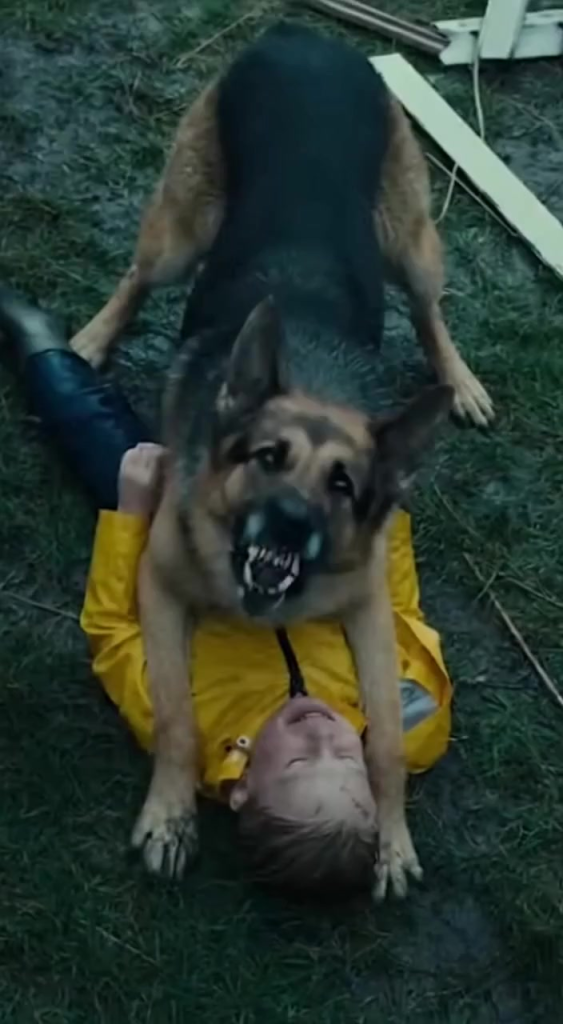
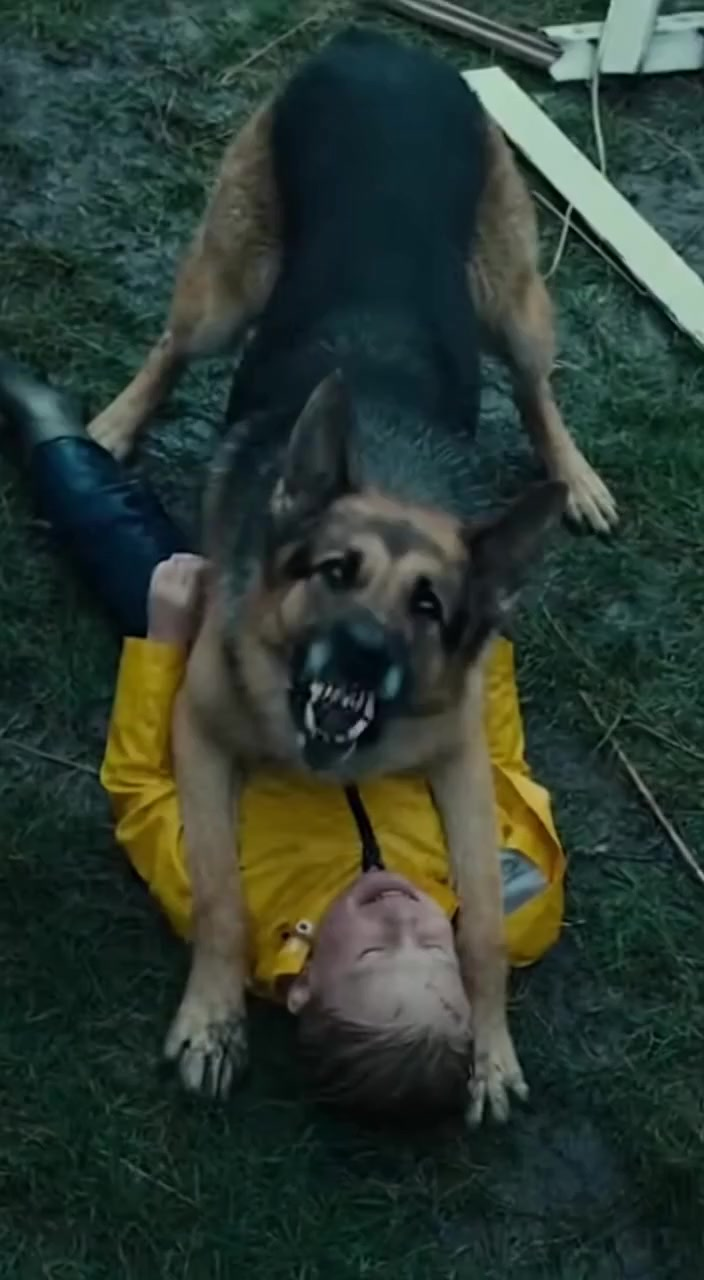
And Brutus was on top of him.
The dog’s massive, muscular body was completely pinning my tiny son to the ground. Brutus’s front paws were planted firmly on Leo’s shoulders, pressing him deep into the mud. Brutus’s jaw was open, his teeth bared, saliva flying from his jowls as he let out a series of deafening, aggressive barks that shook the ground.
Leo was thrashing. My sweet, gentle boy was crying, his little fists weakly hitting Brutus’s chest, trying to push the 100-pound animal off him.
“Get off!” Leo sobbed, his face smeared with mud and tears. “Brutus, let me go!”
But Brutus wasn’t looking at Leo. He was staring intensely at the ground just beyond Leo’s head, snapping his jaws violently at the empty air, acting like a feral beast possessed by a demon.
From the other side of the broken fence, Martha was leaning over the debris, a cordless home phone pressed frantically to her ear. Her face was chalk-white, her eyes bulging with horror.
“Yes, 911! Send the police immediately! The dog has the boy pinned! He’s going to tear his throat out! Hurry!” she shrieked into the receiver, pointing a trembling, manicured finger at my dog.
She locked eyes with me as I stumbled onto the patio, bleeding from my foot.
“I told you, Sarah!” she screamed over the noise. “I told you that monster would turn on him! Do something! He’s killing your son!”
My mind fractured. Every insecurity, every fear, every warning from the shelter volunteers rushed into my brain like a flood of poison.
Former guard dog. Traumatized. Ticking time bomb.
Was it true? Had the storm triggered some deep, suppressed trauma inside Brutus? Had my desperation for a companion blinded me to the danger I had put my own child in?
“Brutus! NO!” I roared, sprinting barefoot across the muddy lawn. I slipped, falling hard onto my knees, staining my scrubs with wet earth, but I scrambled back up, ignoring the burning pain in my foot.
As I got closer, the noise became deafening. Brutus wasn’t just barking; he was roaring. A deep, chest-rattling sound I had never heard him make before.
I grabbed Brutus by his heavy leather collar and yanked with all the strength my panicked body could muster.
“Get away from him!” I screamed, tears blinding me.
But Brutus is a hundred and ten pounds of solid muscle. I am a hundred and thirty pounds of exhausted nurse. He didn’t budge. He planted his back legs, dropping his center of gravity, effectively becoming a boulder on top of my son.
Instead of backing down, Brutus turned his massive head toward me. He didn’t bite me, but he bared his teeth—the scar on his snout stretching tight—and let out a warning growl that sent a shard of pure ice straight into my heart.
He was warning me. He was warning his owner to back off.
“Mommy!” Leo shrieked, reaching his little mud-covered hand out from under the dog’s massive chest. “Mommy, help!”
“I’m coming, baby, I’m coming!” I cried, grabbing a thick, broken tree branch from the grass. I didn’t want to hurt my dog. God, I loved this dog. He had saved my son’s soul. But right now, my son’s life was on the line. I raised the branch, tears streaming down my face, preparing to strike the animal that had slept at the foot of my bed for eleven months.
Before I could bring the wood down, the wail of police sirens shattered the morning air.
Martha must have conveyed the absolute urgency of the situation because the police didn’t just drive up; they arrived like a military strike. I heard the screech of tires skidding onto the wet pavement in front of my house, followed immediately by the slamming of heavy car doors.
“Over here! In the back!” Martha was screaming, waving her arms frantically over the broken fence. “Hurry! He’s got the boy!”
Heavy boots thundered down my side alley. The wooden gate to my backyard was kicked open with such violent force that it snapped off its hinges.
Three police officers burst into the yard. They were in full tactical gear, their faces tight with adrenaline and fear.
The moment they saw the scene—a screaming child pinned to the mud by a massive, snarling German Shepherd, a bleeding mother standing over them with a weapon, and a hysterical neighbor—their training took over.
There was no hesitation. No questions asked.
“Police! Step away from the animal, ma’am! Step away now!” the lead officer, a tall man with graying temples, bellowed.
I turned to them, completely unspooled. “He won’t let him go! I can’t move him!”
“Ma’am, drop the stick and back away immediately!” the officer ordered. As he spoke, I heard a sound that will haunt my nightmares until the day I die.
The simultaneous shhhk-clack of three service weapons being drawn from their holsters.
Three black, metal barrels leveled directly at Brutus’s head.
“We have a clear shot,” the second officer said, his voice trembling slightly. “If it bites down on the kid’s neck, take it out.”
“No!” I screamed, dropping the branch and throwing myself halfway between the guns and my dog. “No, please don’t shoot him! Please!”
“Ma’am, move out of the line of fire!” the lead officer roared, his eyes wide with panic. “The dog is in attack mode. We have to neutralize it before it kills your son!”
“Do it!” Martha shrieked from the fence line. “Shoot that monster before it’s too late!”
Time stopped.
I looked at the officers, their fingers tightening on the triggers. I looked at Martha, her face contorted in righteous terror. I looked at Leo, sobbing under the weight of the beast.
And then, I looked at Brutus.
For a fraction of a second, amidst the screaming, the sirens, and the threat of imminent death, Brutus stopped barking.
He turned his head and looked directly into my eyes.
His ears were still pinned flat. His body was still rigid. But his eyes… his eyes weren’t feral. They weren’t the eyes of a killer lost to a bloodlust.
They were the eyes of a creature begging me to understand.
He whined. A high-pitched, desperate sound that didn’t match his fearsome posture.
And in that brief moment of silence, I finally heard it.
A sound that didn’t belong to the storm, or the sirens, or the screaming.
It was a sharp, aggressive, rhythmic hissing.
Bzzzt. Crackle. Bzzzt. It sounded like a massive, angry rattlesnake hiding in the tall grass. It was accompanied by the harsh, metallic smell of ozone that had confused me earlier.
The sound was coming from the ground. Right next to Leo’s left ear.
Brutus hadn’t pinned Leo to attack him.
He had pinned him to stop him from moving.
I slowly turned my eyes toward the overgrown weeds where Brutus had been snapping his jaws.
There, hidden beneath the thick, wet summer grass, violently thrashing like a live serpent, was a thick, black cable.
It was a high-voltage power line.
The ancient oak tree hadn’t just crushed the fence when it fell in the night. It had ripped the main municipal power line straight off the telephone pole. The wire had fallen into my yard, becoming entangled in the wet grass and mud.
Because the power had been out all morning, it had been dead. Harmless.
But right at this exact moment, the city utility workers must have re-routed the grid. The power had just surged back on.
The thick black cable was violently arching against the wet earth, shooting sparks of blue and orange electricity into the air. The wet ground around it was smoking, the grass literally turning black and burning from the intense, lethal heat.
And the exposed, sparking end of that live, high-voltage wire was exactly twelve inches away from my five-year-old son’s face.
If Leo had rolled to his left. If he had reached out his hand to push himself up. If he had taken a single step forward in his wet rubber boots.
He would have been instantly electrocuted.
Brutus wasn’t trying to kill my son.
With his heavy paws and his massive chest, knowing the police were raising their guns to shoot him, my abused, scarred, rescue dog was sacrificing his own life to physically pin my child to the ground, preventing him from touching the fatal wire.
“Stop!” I screamed at the top of my lungs, turning back to face the three loaded guns.
But as I raised my hands, the lead officer’s finger tightened on the trigger.
Chapter 2
The human brain is a terrifyingly efficient machine when it believes it is about to witness the end of its world. Time doesn’t just slow down; it fractures. It breaks apart into a million microscopic, agonizingly distinct shards of reality.
I didn’t just see the lead officer’s finger tighten on the trigger of his matte-black service weapon. I saw the faint tremble in his knuckles. I saw the white ring of pressure where his skin pressed against the metal. I saw the bead of sweat tracking a jagged path down his temple, cutting through the dust on his skin. I saw the dark, empty void of the gun barrel pointed directly at the massive, scarred head of the only creature that had managed to glue my family’s shattered pieces back together.
“Stop! It’s a wire! The power line!” my voice tore out of my throat, a ragged, bloody sound that didn’t even register as human. It was the primal roar of a mother watching her entire universe teeter on the edge of a cliff.
I threw my body forward, slipping again in the slick, churned-up mud of my ruined backyard. My knees slammed into the earth, but I didn’t feel the impact. I lunged, throwing my torso blindly into the space between the three drawn weapons and my dog. I didn’t care if I took the bullet. If they shot Brutus, his hundred-and-ten-pound body would go entirely limp. He would instantly collapse, a dead weight, pushing my tiny, fragile five-year-old son directly into the live, thrashing high-voltage cable that was violently sparking just inches from his ear.
If Brutus died, Leo died. It was a terrifying, absolute equation.
“Ma’am, get down!” the younger officer to the left shrieked, his voice cracking an octave with sheer, unadulterated panic. He was barely out of his twenties, his face pale underneath the brim of his cap.
But before the fatal poundage of pressure could be applied to the lead officer’s trigger, the universe intervened with a violence of its own.
CRACK-BZZZ-BOOM!
The sound was deafening. It wasn’t a gunshot. It was the explosive, concussive roar of raw, unharnessed electricity discharging into the saturated earth.
The heavy black utility cable, partially buried in the tall, wet grass next to Leo’s head, suddenly whipped violently into the air like a striking cobra. A blinding, localized explosion of electric-blue and blinding white light erupted from the exposed, frayed metal at its tip. The arc of electricity leapt from the wire to a nearby metal shard of the crushed chain-link fence, superheating the moisture in the air and vaporizing the grass instantly.
A heavy, suffocating cloud of gray smoke billowed upward, carrying the sharp, chemical stench of ozone and burning soil. The heat radiating off the sudden burst was so intense I felt it against my tear-streaked face from ten feet away.
The officers recoiled violently. Their extensive tactical training had prepared them for armed suspects, domestic disputes, and violent animals. It had not prepared them for a live, thousands-of-volts municipal power line thrashing around a flooded backyard like a mythological beast.
“Hold fire! Hold fire! Jesus Christ, hold your fire!” the lead officer bellowed. The authority in his voice was instantly replaced by a stark, naked horror. His name tag, gleaming briefly in the sudden flash of sparks, read HARRIS.
Sergeant Harris lowered his weapon, his eyes wide, tracking the thrashing black cable that had just settled back into the mud, still hissing and spitting tiny orange embers. The reality of the situation crashed over him, completely dismantling the narrative Martha had screamed into the 911 dispatcher’s ear.
He looked at the wire. He looked at my terrified, sobbing son. And then, he looked at the massive German Shepherd pinning the boy to the ground.
Brutus hadn’t flinched at the explosive sound. The sudden, violent burst of electricity had singed the fur on the right side of his massive chest. I could smell the distinct, nauseating odor of burnt hair mingling with the ozone. But the dog hadn’t moved a single, solitary millimeter. His heavy, muscular front paws remained planted firmly on Leo’s small shoulders. His back legs were locked into the mud. He was acting as a physical barricade, a living wall of bone and muscle, ensuring that no matter how much Leo thrashed, cried, or begged, the child could not roll over.
Brutus was taking the burn. He was holding the line.
“Oh my god,” the younger officer whispered, his gun dropping to his side, his hands shaking so violently he nearly dropped it into the muck. “The dog… the dog is keeping him away from the live wire.”
“Nobody move!” Sergeant Harris commanded, his voice suddenly dropping into a low, terrifyingly calm register. He threw his arm out, stopping the young officer and the third cop from taking another step forward. “Do not take another step! The ground is saturated. The power is surging. If you step in the wrong puddle, the step-potential will stop your heart before you even realize you’re dead.”
Step-potential. My mind, trained in emergency medicine triage, instantly supplied the definition. When a high-voltage line hits the ground, the electricity ripples outward through the earth in invisible, concentric rings of decreasing voltage, like a stone dropped in a pond. If you step across two zones with different voltages, the electricity uses your body as a bridge, traveling up one leg, through your heart, and down the other.
We were all standing in a minefield.
“Leo!” I sobbed, my voice breaking as I stayed frozen on my hands and knees in the mud. The shard of ceramic from the broken coffee mug was still embedded in the heel of my right foot, sending hot, agonizing pulses of pain up my calf, but I welcomed it. The pain meant I was alive. It meant my heart was still beating.
“Mommy! It hurts! Brutus is heavy!” Leo wailed, his little face entirely smeared with dark brown mud and snot. His bright yellow rain boots were just inches from a puddle that was currently bubbling softly from the electrical current running through the earth.
“I know, baby, I know!” I cried, desperate to crawl to him, to wrap my arms around his small body, but Harris barked at me.
“Ma’am, stay exactly where you are! Do not move! Do you understand me? If you break ground contact, you could complete a circuit. Stay absolutely still!”
I froze. I was practically a statue, my hands buried in the cold, wet mud. I looked at Brutus.
“Brutus,” I whispered, the tears flowing freely down my cheeks, mixing with the dirt. “Good boy. Good boy, Brutus. Hold him. Please, God, hold him.”
Brutus turned his head slightly, his golden-brown eyes meeting mine. The aggressive, feral snarl he had aimed at the police officers was gone. His ears flicked back. He let out a low, pathetic whine that rattled deep in his chest. He was exhausted. He was terrified. He was enduring the burning heat of the electrical arcs, the deafening noise, and the sheer weight of the situation.
But he didn’t move. This battered, abused animal, who had spent the first three years of his life chained to a radiator in a drug den, beaten and starved by humans, was now willingly sacrificing his own safety to protect a human child. He understood the danger in a way none of the adults had. He had smelled the ozone. He had heard the hissing in the grass before the surge happened. He knew exactly what that black wire was capable of.
“Dispatch, this is Unit 4,” Harris spoke rapidly into the radio clipped to his shoulder, his eyes never leaving the sparking cable. “Code Red priority. I need Penn Power down here yesterday. We have a downed municipal high-voltage line, currently live and arcing in a residential backyard. One child pinned in proximity, one large canine acting as a barrier. Repeat, the animal is protecting the child, but they are in the immediate strike zone. I need the grid shut off NOW. Get fire and rescue down here, stage them out front. Move!”
The radio crackled back with a burst of static. “Copy, Unit 4. Penn Power is responding to multiple grid failures from the storm. Contacting emergency dispatch for immediate localized shutoff. Fire and EMS are en route. ETA four minutes.”
Four minutes.
It might as well have been four decades.
To my left, across the twisted, crushed remains of the chain-link fence, I heard a sound that made my blood run cold. It was Martha.
She had dropped her cordless phone. It lay in the wet grass of her meticulously manicured lawn, emitting a faint, rhythmic beeping sound. Martha was gripping the top rail of the surviving fence, her knuckles completely white. Her jaw was unhinged, her eyes wide with a horrific, crushing realization.
She had almost gotten my son killed.
If she hadn’t screamed. If she hadn’t riled up the police. If they had listened to her frantic 911 call and come in shooting without assessing the scene, Brutus would be dead, and Leo would have rolled directly onto three thousand volts of municipal electricity.
“Oh my… Oh merciful heavens…” Martha gasped, her knees visibly buckling. She sagged against the fence, bringing a trembling, manicured hand up to cover her mouth. “The wire… I didn’t… I didn’t see the wire…”
I didn’t have the energy to hate her in that moment. I didn’t have the luxury of anger. All of my focus, every microscopic ounce of my soul, was tethered to the five-year-old boy crying in the mud and the massive, trembling beast protecting him.
“Mommy, please! Make him get off!” Leo sobbed, his voice growing hoarse. He was shivering now. The adrenaline was wearing off, leaving behind the cold reality of the wet earth and the terrifying noise of the sparking cable.
“Leo, look at me,” I commanded, forcing my voice to drop into the calm, authoritative tone I used in the ER when a patient was crashing. It was the voice that didn’t allow for panic. “Leo Thomas, look right at Mommy.”
Through his tears, his big blue eyes locked onto mine.
“You have to be a statue,” I told him, projecting my voice over the hiss of the electricity. “You are playing statues with Brutus. You cannot move a single muscle. Do you hear me? If you move, the bad lightning will get you. Brutus is keeping the bad lightning away. You have to let him help you.”
“I’m scared,” he whimpered, his bottom lip quivering violently.
“I know you are, my brave boy. I’m scared too. But the police are here. They are going to turn the lightning off. You just have to wait. Can you be brave for Brutus? Look at him. He’s being so brave for you.”
Leo awkwardly shifted his eyes upward, looking at the massive, heavy chin resting just inches from his own face. Brutus looked down at him, his tongue lolling out, panting heavily from the stress. The dog let out a small, reassuring boof sound, and gently nudged Leo’s cheek with his wet nose.
Miraculously, Leo stopped thrashing. He went limp in the mud, trusting the dog implicitly. “Okay, Mommy. I’ll be a statue.”
The wail of sirens pierced the heavy, humid air, growing rapidly louder until they seemed to surround the house entirely. The heavy, rhythmic thumping of diesel engines vibrated through the ground. The fire department had arrived.
“Harris! Sit rep!” a booming voice shouted from the side alley.
I carefully turned my head without moving my hands or knees. A massive man in full heavy-duty turnout gear came jogging through the shattered wooden gate, followed closely by a paramedic holding a trauma bag. The paramedic—a tall, weathered-looking man whose jacket read SULLIVAN—took one look at the scene and immediately threw his arm out to stop the firefighters behind him.
“Whoa, whoa, hold up! Live wire!” Sullivan shouted.
“It’s the main feed,” Harris called back, sweat dripping off his chin. “It’s arcing intermittently. We got a kid and a dog about twelve inches from the hot zone. Mother is in the hazard radius too. Ground is fully saturated.”
“Where the hell is the utility truck?” Sullivan demanded, dropping his trauma bag on a dry patch of concrete near the patio.
“They’re trying to remote-kill the localized grid, but the storm wrecked the relays!” Harris explained, his frustration bleeding through his professionalism. “They have to send a lineman to manually cut the junction at the street pole. We just have to wait.”
“We can’t wait!” I screamed, the panic finally clawing its way back up my throat. “Brutus is exhausted! He can’t hold him forever! If the dog shifts his weight, my son will touch that wire!”
Sullivan, the paramedic, looked at me. His eyes were deeply kind, the kind of eyes that had seen the absolute worst of human tragedy and still managed to maintain their empathy.
“Ma’am, what’s your name?” he asked, his voice a steady, rhythmic baritone that somehow cut through the chaotic noise of the yard.
“Sarah. My name is Sarah.”
“Okay, Sarah. I’m Sully. I’ve been a paramedic for twenty-two years. I need you to listen to me very carefully. You are doing a fantastic job. You stopped a tragedy from happening. But right now, physics is the boss. If we rush in there, the electricity will use us as a ladder to the ground. We will all die. Do you understand?”
I nodded, fresh tears spilling over my lips, tasting of salt and mud.
“Good,” Sully said. He turned his attention to the dog. He studied Brutus for a long, quiet moment. He looked at the scarred snout, the heavy musculature, the unwavering focus. “That is a hell of an animal you’ve got there, Sarah. He knows exactly what he’s doing. He’s grounded himself on the safest patch of earth he could find. He’s not going to move.”
“He’s a rescue,” I whispered, a strange, fierce wave of pride cutting through my terror. “He was a bait dog… a guard dog. Everyone told me he was dangerous.”
“People are idiots,” Sully stated simply, never taking his eyes off the boy and the dog. “That animal has more tactical sense than half the rookies in my firehouse. He’s got your boy. Trust him.”
For the next ten minutes, the backyard was a terrifying purgatory. The wire continued to hiss and spit, occasionally snapping with a loud crack that sent sparks raining down on the wet grass. Every time it arced, I held my breath, waiting for the fatal jolt, waiting for the smell of burning flesh. But Brutus held firm. He was a monument of canine devotion, an immovable object standing between my son and sudden death.
I spent those ten minutes locked in my own mind. I thought about Greg. I thought about the day he packed his duffel bag, the casual, cowardly way he had stood in the hallway and said, “I just can’t do this, Sarah. The kid… he’s too needy. The mortgage, the pressure… it’s suffocating. I need to find myself.”
He had walked out, leaving me to hold the sky up by myself. He had left Leo, who loved him with the fierce, unconditional adoration only a four-year-old can possess, to navigate the devastating trauma of abandonment.
Greg had claimed he couldn’t handle the pressure of protecting us.
Yet here was a dog—an animal discarded by society, labeled a monster, locked in a cage—who was currently risking electrocution, holding absolute, unwavering focus under the threat of drawn police guns, simply because he loved the little boy underneath him. Brutus was twice the father, twice the protector, that Greg had ever been.
“Utility is on site!” a voice shouted from the front of the house. “They’re at the pole!”
The collective breath held by every first responder in the yard seemed to hitch. We waited. The silence stretching between the hissing of the wire was agonizing.
Then, quite suddenly, the violent, rhythmic buzzing stopped.
The heavy black wire went completely still. The sparks ceased. The smell of ozone began to dissipate on the humid breeze.
“Grid is dead!” a distant voice echoed from the street. “Power is cut at the junction! You are clear!”
“Sully, confirm?” Harris yelled.
Sully pulled a small, pen-like device from his pocket—a non-contact voltage tester. He cautiously stepped off the concrete patio, placing his boots carefully in the mud. He walked toward the wire, extending the device.
Silence. No beeping. No red light.
“It’s dead,” Sully confirmed, letting out a massive, shuddering exhale. “Scene is safe. Move in!”
The moment Sully declared the scene safe, it was as if an invisible spell had been broken.
Brutus, the magnificent, terrifying beast who had held his ground against electricity and firearms, suddenly let out a massive, weary sigh. His rigid muscles unlocked. He slowly, carefully lifted his heavy front paws off Leo’s shoulders. He took one step backward, completely clearing the boy, and then his back legs simply gave out.
The hundred-and-ten-pound dog collapsed onto his side in the mud, panting rapidly, his chest heaving, absolutely spent.
“Leo!” I screamed, scrambling to my feet. I ignored the agonizing shooting pain from the glass in my heel. I sprinted across the ruined lawn, dropping to my knees beside my son.
I hauled him up by his armpits, dragging his muddy, wet little body against my chest. I crushed him to me, burying my face in his messy, dirty hair. He smelled like rain, mud, and the terrifying, metallic tang of electricity.
“Mommy!” Leo wailed, wrapping his arms around my neck, burying his face in my shoulder. “I was a statue, Mommy! I was a good statue!”
“You were perfect,” I sobbed hysterically, rocking him back and forth in the mud, kissing his cheeks, his forehead, his muddy nose. “You were so brave. You’re okay, my baby. I’ve got you. Mommy’s got you.”
Sully was beside us instantly. His large, gentle hands quickly ran over Leo’s arms, his chest, his legs, checking for any signs of electrical burns. He checked Leo’s pupils, felt his pulse.
“He’s good, Sarah,” Sully said softly, his voice thick with emotion. “He’s completely unharmed. Just scared, cold, and a little bruised from the dog’s weight. But he’s perfect.”
“Thank God,” I choked out, pulling Leo tighter against my heart.
I turned my attention to Brutus. The giant dog was still lying on his side, his eyes half-closed, his breathing rapid and shallow. The fur on his right shoulder was visibly singed, a jagged, blackened patch where the heat of the arcing electricity had kissed him.
I crawled the two feet over to him, keeping Leo wrapped securely in my left arm. I reached out with a trembling hand and laid it on Brutus’s massive, heavy head.
“Brutus,” I whispered, my voice breaking completely.
The dog opened his eyes. He let out a soft, high-pitched whine and forced his heavy head up just enough to drag his rough, raspy tongue across the tears streaming down my muddy cheek.
“You saved him,” I cried, burying my face in his thick neck fur, not caring about the dirt or the smell of burnt hair. “You saved my baby. You’re the best boy in the whole world.”
Brutus let out a long, contented sigh and rested his chin heavily on my knee.
Around us, the chaos of the emergency response was settling into a controlled hum. Firefighters were securing the downed wire, wrapping it in bright yellow caution tape. Officer Jenkins, the young cop who had nearly pulled the trigger, was sitting on an overturned patio chair, his head buried in his hands, visibly shaking as the adrenaline crash hit his system.
Sergeant Harris walked slowly over to where we were huddled in the mud. He unclipped his radio, hooked it to his belt, and took off his police cap. He looked down at me, at Leo, and finally, at the massive dog lying exhausted across my lap.
The veteran police officer, a man who had likely seen decades of violence and tragedy, slowly dropped to one knee in the mud, ruining his uniform pants.
He didn’t look at me. He looked directly at Brutus.
Harris reached out a slow, deliberate hand. He let Brutus sniff his knuckles. Brutus didn’t growl. He simply huffed and closed his eyes. Harris gently stroked the thick fur behind the dog’s torn ear.
“I am so sorry,” Sergeant Harris whispered, his voice thick with a profound, heavy shame. He looked up at me, his eyes shining with unshed tears. “Ma’am… Sarah. I almost… I almost killed the hero of this story. Because I didn’t look. Because I assumed the worst.”
“You were doing your job,” I said softly, wiping the mud from Leo’s face. “You thought he was attacking.”
“I should have assessed,” Harris said, shaking his head bitterly. “If you hadn’t put yourself in front of my barrel… God forgive me, I would have shot him.” He looked back at Brutus, his hand lingering on the dog’s neck. “I’ll be writing up a commendation for this animal in my official report. I’ve never seen anything like it. Never.”
“He’s family,” I said simply.
“I can see that,” Harris replied, slowly standing back up.
“Sarah.”
The voice was thin, reedy, and trembling.
I turned my head. Martha was standing at the edge of my patio. She had somehow navigated through the broken gate, bypassing the firefighters. She looked completely wrecked. Her pristine beige cardigan was snagged and dirty, her hair was disheveled, and her face was streaked with ruined mascara.
She looked at the scorched earth. She looked at the heavy black wire now being handled by men in thick rubber gloves. And then, she looked at Brutus, who was currently letting Sully the paramedic gently examine his singed shoulder.
Martha took a slow, hesitant step forward, stopping ten feet away. Her hands were clutched together so tightly her knuckles were translucent.
“Sarah, I…” Martha started, her voice cracking violently. She swallowed hard, tears welling up in her eyes. “I thought he was mauling him. I truly believed… I looked out the window and I saw the monster I expected to see. I didn’t see the truth. I just saw my own fear.”
I stared at her. I thought about the months of dirty looks, the HOA complaints, the whispered rumors she had spread about me being a negligent, trashy single mother keeping a dangerous beast around her child. I thought about how close her prejudice had come to causing a bloodbath in my backyard.
“Martha,” I said, my voice eerily calm despite the exhaustion sinking into my bones. “You called the police because you thought my son was dying. I understand that.”
Martha let out a small, relieved sob, stepping forward. “Oh, Sarah, thank you—”
“But,” I interrupted, my voice hardening into steel, stopping her dead in her tracks. “If you ever, ever refer to my dog as a monster again. If you ever look at him with anything less than absolute respect for the rest of his life. I will let him dig up every single one of your prize-winning petunias, and I will sit on my porch and drink coffee while he does it. Are we absolutely clear?”
Martha stared at me, her mouth opening and closing silently like a fish. She looked at the fierce, unyielding protection in my eyes, and then she looked at Brutus, who had lifted his head and was watching her with a calm, intelligent gaze.
Slowly, Martha nodded. “Yes,” she whispered humbly. “Yes, Sarah. We are clear.”
Sully finished taping a small gauze pad over Brutus’s singed fur. He stood up, wiping the mud from his knees. “Alright, Mom. Let’s get you and the boy inside. You’ve got a nasty cut on your foot that needs cleaning, and your hero dog needs a massive bowl of water and a steak.”
I nodded, feeling the adrenaline finally evaporate, leaving behind a crushing, monumental fatigue. I stood up, wincing as the pain in my foot flared, but I refused Sully’s offer of a stretcher.
I picked Leo up, settling his muddy weight onto my hip.
“Come on, Brutus,” I said softly. “Let’s go inside.”
The massive German Shepherd hauled himself to his feet. He shook his heavy coat, sending a shower of mud and water flying into the air, completely splattering Sergeant Harris’s pristine boots. Harris didn’t even flinch; he just smiled a tight, respectful smile.
Brutus limped slightly as he walked toward the sliding glass door, his massive frame radiating exhaustion. But as he reached the threshold, he stopped. He turned around, his golden eyes scanning the ruined yard, the police officers, the utility workers, and finally, resting on Leo, safe in my arms.
Only then did the great dog step inside the house, ready to sleep.
But as I stepped through the doorway, carrying the weight of my son and the terrifying reality of what we had just survived, I realized something fundamental had shifted. The storm had broken our fence, but it had shattered the walls I had built around myself.
I wasn’t just the abandoned wife anymore. I wasn’t just the struggling, exhausted nurse trying to keep her head above water.
I was a mother who had stood down drawn guns. And I was backed by a guardian who had stared down lightning.
We were a family. And we were entirely unbreakable.
Or so I thought, until the phone ringing in the kitchen abruptly shattered the newfound peace, carrying a voice I hadn’t heard in over a year. A voice that was about to turn our hard-won survival back into a nightmare.
Chapter 3
The shrill, piercing ring of the phone on the kitchen counter sliced through the heavy, exhausted silence of the house like a scalpel.
It was my cell phone. It had been plugged into the wall charger next to the sink, miraculously surviving the chaos of the morning and the shattered ceramic coffee mug that still lay scattered across the hardwood floor in a pool of cold, brown liquid.
I was standing in the center of the kitchen, completely numb, shivering in my muddy, ruined scrubs. Leo’s small, incredibly heavy body was pressed flush against my chest, his arms locked around my neck in a vice grip that I had no intention of loosening. His breath was warm against my collarbone, a steady, rhythmic puff of air that served as the only proof I needed that the universe hadn’t completely ended.
Beside me, Brutus stood motionless. The great dog was a terrible sight—his thick coat matted with thick brown mud, dead leaves, and wet grass. The right side of his chest bore the jagged, blackened, foul-smelling scorch mark where the lethal heat of the municipal power line had tried to claim him. But his golden eyes were alert, tracking my every movement, waiting for my cue.
The phone rang again. A harsh, demanding digital vibration against the marble countertop.
Sully, the paramedic, who had followed us inside with his heavy red trauma bag slung over his shoulder, paused near the doorway. He looked at the buzzing phone, then back at me. His weathered, kind face was unreadable, but his eyes held a quiet understanding. He knew the look of a woman who was holding onto her sanity by a single, frayed thread.
“You want me to get that, Sarah?” Sully asked, his voice low and incredibly gentle. “Could be the police dispatch following up, or the hospital wondering where their nurse is.”
I swallowed the sandpaper dryness in my throat. My heart, which had just begun to slow to a normal, human rhythm, suddenly spiked again. A cold, creeping dread pooled in the pit of my stomach.
I didn’t know why, but my instincts—the same primal, deeply buried mother-bear instincts that had propelled me barefoot into a live electrical field—were screaming at me not to answer it.
“No,” I whispered, my voice hoarse and completely wrecked from screaming over the roar of the electrical arc. “No, I’ve got it. Let me just…”
I shifted Leo’s weight, supporting him with my left arm, and limped heavily toward the counter. Every time I put weight on my right foot, a hot, searing spike of agony shot up my calf from the shard of ceramic deeply embedded in my heel. But the physical pain was secondary. It was almost a relief. It grounded me. It proved I wasn’t a ghost hovering over the wreckage of my own backyard.
I reached out with a trembling, mud-caked hand and picked up the phone.
The caller ID flashed brightly across the cracked screen.
Greg.
The air in my lungs turned to solid ice.
I stared at those four letters, watching them illuminate the kitchen, feeling a sudden, violent wave of nausea wash over me.
Greg. My husband. My ex-husband, in every sense except the final, stamped legal paperwork that I hadn’t had the time, money, or emotional bandwidth to file yet. The man who had looked at me eleven months ago, right in this very kitchen, while Leo was playing with his plastic dinosaurs in the next room, and calmly stated that the “vibe” of our family was destroying his mental health.
He hadn’t called in four months. Not for Leo’s fifth birthday. Not for Christmas. Not when the pediatric dentist bills piled up. He had vanished into his new, burden-free existence in a downtown apartment, a ghost who only materialized in the form of a meager, legally mandated child support deposit on the first of the month.
And now, right at this exact, impossible moment, he was calling.
I looked at Sully. I looked at Brutus. I looked at the muddy, tear-streaked face of my son resting against my shoulder.
My thumb hovered over the red ‘Decline’ button. I wanted to silence him. I wanted to throw the phone into the sink and pretend he didn’t exist.
But a dark, sick curiosity overrode my exhaustion. How did he know? Why now?
I slid my thumb across the green icon and slowly brought the phone to my ear.
“Hello?” I rasped, my voice sounding hollow and utterly foreign, even to my own ears.
“Sarah? Jesus Christ, Sarah, are you there? Is Leo okay?!”
Greg’s voice exploded through the tiny speaker. It was high-pitched, frantic, and dripping with a thick, syrupy layer of panic that instantly made my skin crawl. It didn’t sound like a father terrified for his child. It sounded like a man performing terror for an audience.
I closed my eyes, leaning my hip heavily against the cold marble counter to take the weight off my bleeding foot.
“Leo is fine,” I said, my tone completely flat, devoid of any warmth or reassurance. “He’s right here in my arms.”
“Oh, thank God. Thank God,” Greg breathed heavily into the receiver. “I just… I just saw it, Sarah. I saw the video. My phone has been blowing up for the last ten minutes. I’m leaving the office right now. I’m coming to get him.”
The words hit me like a physical blow. The exhaustion vanished, replaced by a sudden, white-hot surge of adrenaline.
“What video?” I demanded, my voice hardening instantly. “What are you talking about, Greg? And you are absolutely not coming to get him.”
“The video on Facebook, Sarah! Your crazy neighbor, Martha? She live-streamed the whole damn thing to the neighborhood watch group, and someone ripped it and put it on Twitter. It’s everywhere. I watched a hundred-pound mutt pin my son to the mud while the cops had their guns drawn! What the hell is wrong with you, Sarah?! I knew that beast was dangerous! I warned you!”
My brain misfired. I pulled the phone slightly away from my ear, staring at it in sheer disbelief.
Martha. Of course.
While I was screaming for my son’s life, while Brutus was taking the agonizing heat of a live electrical current, while the police were preparing to execute my dog in front of my child… Martha hadn’t just been screaming on the phone with 911. She had been broadcasting our trauma to the world. She had been filming her own self-righteous, horrifyingly inaccurate commentary for an audience of suburban voyeurs.
And Greg, sitting safely in his climate-controlled, child-free downtown office, had watched it.
But he hadn’t seen the ending. He hadn’t seen the truth.
“You didn’t see the whole thing, Greg,” I said, my voice dropping to a terrifyingly calm whisper. The kind of whisper that precedes a hurricane. “You saw a fragment. You saw Martha’s hysterical, twisted version of reality.”
“I saw enough, Sarah!” Greg yelled, his voice echoing in the quiet kitchen. “I saw you let a feral animal attack my kid! I called my lawyer on the way to the car. This is textbook negligence. I told you that dog was a liability! I’m coming over there right now, and I’m taking Leo with me. You are clearly not capable of providing a safe environment for him!”
The absolute, unmitigated audacity of his words hung in the air, toxic and suffocating.
My kid. Negligence. Not capable.
He was using this. He was weaponizing the most terrifying ten minutes of my entire existence to play the hero. The man who had abandoned his traumatized four-year-old because he couldn’t handle the “stress” of fatherhood was now trying to swoop in and steal my son based on a viral misunderstanding.
I felt a low, rumbling growl vibrate against my leg.
I looked down. Brutus had stepped forward. He wasn’t looking at the phone, but he was staring intently up at my face. He could smell the sudden, sharp spike of cortisol and adrenaline flooding my bloodstream. He could hear the rigid tension in my voice. Even exhausted, burned, and traumatized, the dog was instantly back on duty. He stepped closer, pressing his heavy, muddy shoulder firmly against my thigh, a silent, immovable anchor.
“Greg,” I said, my voice as cold and hard as a diamond. “Listen to me very carefully. You do not get to call him ‘your kid.’ You surrendered that right the day you packed your bags because you wanted to go find yourself. You do not get to critique my environment. And you absolutely, unequivocally, do not get to come to my house.”
“Sarah, be reasonable—”
“Shut up,” I snapped, the sheer ferocity in my tone causing even Sully to raise an eyebrow from across the room. “You saw a video of a dog pinning Leo to the ground. What you didn’t see, because Martha was too busy trying to get us all killed, was the live, three-thousand-volt municipal power line thrashing in the grass exactly twelve inches from Leo’s head. That ‘feral animal’ you’re talking about? He didn’t attack Leo. He threw his own body over him. He took the electrical burns to his own flesh to keep our son from rolling onto a wire that would have instantly stopped his heart.”
There was a profound, stunned silence on the other end of the line. I could hear the faint sound of traffic in the background. Greg was in his car.
“What… what are you talking about?” Greg stammered, his righteous anger suddenly deflating into confusion. “A power line?”
“Yes, Greg. A power line. While you were drinking your artisanal coffee downtown, my dog was staring down the barrel of three police glocks and taking literal lightning strikes to keep your son alive. Brutus is more of a father, more of a protector, and more of a man than you will ever be in your entire pathetic life.”
“Sarah, please, you’re upset—”
“If you come to this house,” I continued, ignoring his weak interruption, “if you step one foot onto my property to try and take my traumatized child away from the only creature that makes him feel safe, I promise you, I will make sure the rest of that video gets released. The police reports. The paramedic reports. I will make sure a judge sees exactly who stayed and who ran. Do not test me today, Greg. I am not the exhausted, weeping woman you left behind eleven months ago.”
I didn’t wait for his response. I didn’t want to hear another syllable of his excuses or his fake, manufactured concern.
I hit the red button, ending the call, and tossed the phone onto the counter next to the sink.
The silence that followed was heavy, thick with the unsaid echoes of my rage. I stood there, trembling violently, the adrenaline crash finally hitting me with the force of a freight train. My knees buckled slightly.
“Whoa, easy there, Mom,” Sully’s voice broke the tension.
The paramedic was beside me in two long strides. He gently but firmly placed a large, calloused hand on my shoulder, steadying me.
“Let’s put the boy down,” Sully instructed gently. “He’s safe. You’re safe. But if you put any more weight on that foot, you’re going to drive that ceramic straight into your bone, and I’ll have to carry you both to the rig.”
I nodded, the tears suddenly welling up again, hot and stinging against my muddy cheeks. I slowly lowered Leo to the floor.
Leo didn’t protest. He immediately sank to his knees and wrapped his small arms tightly around Brutus’s thick, muddy neck. Brutus let out a long, heavy groan and rested his massive chin on top of Leo’s head, closing his eyes. They were a single, intertwined mass of mud, burnt fur, and unconditional love.
“Okay, Sarah, hop up here,” Sully said, gesturing to a sturdy wooden barstool at the kitchen island.
I awkwardly hopped over and sat down, wincing as the injured foot dangled in the air. Sully pulled up a chair across from me, unzipped his massive red trauma bag, and pulled out a pair of sterile blue nitrile gloves, snapping them onto his wrists with practiced efficiency.
“Let’s see the damage,” he murmured, gently taking my right ankle in his hands and lifting my foot.
I hissed through my teeth as he manipulated the heel. The bottom of my foot was smeared with dried blood, coffee, and dirt. Dead center in the heel, a jagged, triangle-shaped piece of white ceramic was buried deep in the flesh.
“You hit this hard,” Sully noted, his eyes crinkling at the corners. “Ran right through the kitchen without looking, huh?”
“I heard Martha scream,” I whispered, staring down at my hands. They were caked in mud and shaking so badly I could barely interlock my fingers. “I thought… I thought my dog was killing my son.”
“Of course you did,” Sully said smoothly, pulling a bottle of saline, sterile gauze, and a pair of heavy medical forceps from his bag. “Given the context, given the screaming neighbor, your brain did exactly what it was supposed to do. It went to war.”
He looked up at me, holding the forceps. “This is going to sting. I’m going to pull it straight out, then flush it. You ready?”
“Do it,” I said, gripping the edge of the kitchen island.
Sully clamped the metal teeth of the forceps onto the edge of the ceramic shard. He didn’t hesitate. With one smooth, forceful tug, he yanked the shard free.
A sharp, breathless cry escaped my lips. A fresh stream of bright red blood immediately welled up from the puncture wound, spilling over the side of my heel.
“Got it,” Sully said, tossing the bloody shard onto a piece of gauze. He immediately grabbed the bottle of saline and squeezed it forcefully, flushing the wound with a cold, stinging stream of water. “Deep puncture, but it missed the tendon. You’re going to need stitches, though. And a tetanus shot, considering you just ran through a muddy minefield.”
“I’m a nurse,” I said, wincing as he packed the wound with tight, sterile gauze and began wrapping it firmly with a roll of white medical tape. “I can stitch it myself at the hospital later. I just… I can’t leave them right now. I can’t leave Leo.”
Sully paused his wrapping and looked over at the boy and the dog. Leo had fallen completely asleep on the kitchen floor, his thumb tucked into his mouth, his head resting squarely on Brutus’s front paws. The dog was awake, his eyes tracking Sully’s movements, but he remained perfectly still, refusing to disturb the sleeping child.
“I don’t blame you,” Sully said softly. “That right there? That’s a bond you don’t mess with.”
He finished taping my foot, securing it tightly. “Keep off it as much as you can today. If it starts throbbing intensely, or if you see red streaks moving up your ankle, you go straight to the ER. Understood, nurse?”
“Understood,” I nodded, managing a weak, watery smile. “Thank you, Sully. Truly.”
“Don’t thank me,” the big paramedic said, packing up his bag. He stood up, towering over me in the small kitchen. “You’re the one who stood down three loaded glocks. You’re the one who told off the ex-husband.”
“You heard that?” I flushed, suddenly embarrassed.
“Hard not to,” Sully chuckled, slinging the bag over his shoulder. “Sounded to me like a woman who finally figured out she doesn’t need a knight in shining armor, because she’s already got a dragon.” He pointed a thick finger at Brutus.
Sully walked to the front door. He paused with his hand on the knob, looking back at the kitchen.
“Hey, Sarah?”
“Yeah?”
“That video your ex mentioned? The one the neighbor streamed?” Sully’s expression turned serious. “He’s right. It’s already everywhere. Jenkins, the rookie cop? He told Harris the dispatch center is getting flooded with calls from people who saw it online. They’re demanding the city put the ‘vicious dog’ down. The narrative out there right now is ugly.”
My stomach dropped. The dread I had felt earlier returned with a vengeance.
“But,” Sully continued, his voice firm, “Sergeant Harris already pulled the dashcam footage from his cruiser, and he’s having Jenkins pull his bodycam. They have the audio of the electrical surge. They have the footage of the dog protecting the kid. The police department is releasing an official statement to the local news within the hour, clearing the dog entirely and explaining the live wire. Harris is making sure the truth gets out there faster than the neighbor’s lie.”
Tears blurred my vision again. Sergeant Harris, the man who had almost pulled the trigger, was now leading the charge to save my dog’s reputation.
“Thank you,” I choked out, unable to say anything else.
“Take care of your pack, Sarah,” Sully said gently, and then he stepped out the front door, closing it quietly behind him.
The house was finally silent.
I sat on the barstool for a long time, listening to the hum of the refrigerator and the soft, rhythmic breathing of my son and my dog. The sheer magnitude of what had happened over the last hour pressed down on me, heavy and suffocating.
I looked at the kitchen clock. It was only 11:30 AM.
It felt like I had lived three lifetimes since I dropped that coffee mug.
I slowly eased myself off the stool, testing the weight on my bandaged foot. It hurt—a deep, throbbing ache—but it was manageable. I hobbled over to the pantry and pulled out a massive, family-sized package of ground beef I had bought for spaghetti night.
I walked over to Brutus. I knelt down awkwardly on my good knee, trying not to disturb Leo.
I tore the plastic off the meat. “Here, buddy,” I whispered, holding the raw, red mound of beef out in my hands. “You earned this. You earned everything.”
Brutus didn’t wolf it down. He sniffed it delicately, looked at me with those deep, ancient eyes, and then slowly, carefully took the meat from my hands, making sure not to graze my skin with his teeth. He ate quietly, letting out soft sounds of contentment.
For the next two hours, I existed in a state of robotic survival mode.
I managed to gently wake Leo up, coaxing him into the downstairs bathroom. I ran a warm bath, peeling the muddy, soaked clothes off his small body. He was quiet, subdued, the trauma of the morning settling into his bones.
“Did the bad lightning go away, Mommy?” he asked softly as I used a washcloth to gently scrub the thick, brown mud from his hair.
“It’s all gone, baby,” I promised him, kissing his wet forehead. “The police and the firemen made it safe. It can never hurt you now.”
“Brutus is a good statue,” Leo murmured, his eyes drooping heavily.
“He’s the best statue in the world.”
After I got Leo dressed in clean, dry pajamas and tucked him into my bed upstairs—with Brutus limping slowly behind us to take up his customary guard position at the foot of the mattress—I finally took a shower myself.
I stood under the scalding hot water, watching the mud, the blood, and the smell of ozone wash down the drain. I leaned my head against the wet tile and wept. I wept for the sheer terror of it. I wept for the cruelty of Martha’s assumptions. I wept for the cowardly manipulation of my ex-husband.
But mostly, I wept in pure, overwhelming gratitude that my son was alive.
When I finally emerged, dressed in clean sweatpants and an oversized t-shirt, I hobbled downstairs to tackle the kitchen. I needed to clean up the broken glass. I needed to do something normal, something mundane, to convince my brain that the crisis was over.
But as I reached the kitchen counter, my phone screen lit up again.
And then it lit up again. And again.
It wasn’t just ringing. It was vibrating continuously, a manic, unbroken seizure of notifications.
I picked it up, my heart sinking.
I had forty-seven missed calls. Mostly unknown numbers. A few from the hospital where I worked. Three from my mother in Ohio.
But it was the lock screen notifications that made the blood drain from my face.
Twitter (X): You have been tagged in a post by @LocalNewsChannel8… Facebook: 300+ people have shared a video you are tagged in… Instagram: @RescueDogsRock mentioned you in a reel…
The viral explosion Sully had warned me about hadn’t just happened; it had gone nuclear.
I unlocked the phone and opened a link sent by a coworker.
It was a local news station’s website. The headline took up the entire screen in bold, screaming black letters:
“HERO HOUND: RESCUE DOG SHIELDS 5-YEAR-OLD FROM LETHAL HIGH-VOLTAGE WIRE IN TERRIFYING SUBURBAN STANDOFF.”
Below the headline was a video. It wasn’t Martha’s frantic, screaming live stream.
It was Officer Jenkins’ bodycam footage.
The police department had released it, just as Harris promised.
I hit play, my hands trembling.
The perspective was chaotic, bouncing violently as the officer sprinted down my alley and kicked open the broken wooden gate. The audio was deafening—Martha screaming in the background, my own panicked voice yelling, the deep, terrifying roars coming from Brutus.
The camera leveled out, showing the agonizing standoff. The three drawn guns. Me, barefoot in the mud, throwing myself in front of the barrels.
And then, the sound. The horrifying CRACK-BZZZ-BOOM of the electrical surge.
The bodycam captured the blinding flash of blue light. It captured the thick cable whipping through the air. And, most importantly, it captured the absolute, unflinching stillness of Brutus, taking the burn, refusing to let Leo move an inch toward death.
The video ended with Sully the paramedic declaring the wire dead, and Brutus collapsing exhausted in the mud.
I scrolled down to the comments. There were thousands of them. Tens of thousands.
“I’m sobbing at my desk. That mother is a warrior, and that dog is a literal angel.” “Everyone who judges pit bulls, rottweilers, and shepherds needs to watch this. We don’t deserve dogs.” “Who is the horrible neighbor screaming to shoot the dog?! She almost got them all killed!” “Get this dog a steak and the key to the city immediately.”
The narrative had completely flipped. In the span of three hours, I had gone from being the negligent mother of a killer beast to a viral sensation of maternal sacrifice and canine heroism.
It was overwhelming. It was terrifying. I didn’t want to be a viral sensation. I just wanted to be left alone to heal.
I put the phone face down on the counter, desperate to shut it all out.
But the universe, it seemed, wasn’t done with me today.
At exactly 4:15 PM, as the late afternoon shadows began to stretch long and dark across the ruined, tape-covered backyard, a heavy, aggressive pounding echoed from the front door.
It wasn’t a polite knock. It was the demanding, entitled pounding of someone who believed they owned the space they were trying to enter.
Brutus, who had been resting his burned shoulder on the living room rug, instantly snapped awake. He didn’t bark. He stood up, his hackles raising slightly, and let out a low, menacing rumble deep in his chest. He limped toward the hallway, placing himself squarely between the stairs leading up to Leo’s room and the front door.
I felt the cold knot of dread return, harder and heavier than before.
I limped to the front door, looking through the peephole.
Standing on my front porch, wearing a perfectly pressed navy blue suit, his hair meticulously styled, smelling faintly of expensive cedar cologne that managed to seep through the wood of the door, was Greg.
He hadn’t listened. He had driven the forty-five minutes from the city.
He was standing there, his arms crossed over his chest, glaring at the door. Behind him, parked illegally in front of my mailbox, was his pristine silver Honda Accord.
“Sarah! Open the door!” Greg shouted, hitting the wood again with the flat of his palm. “I know you’re in there! I saw the news. I saw the bodycam footage. Open the damn door before I call the police and have them escort me in!”
I took a deep, shuddering breath. I looked down at Brutus. The dog was staring at the door, his golden eyes unblinking, his massive chest expanding and contracting with a slow, deliberate rhythm. He was ready.
I unlocked the deadbolt and pulled the door open, stepping squarely into the frame, completely blocking the entrance.
“I told you not to come here, Greg,” I said, my voice eerily calm.
Greg looked me up and down. He took in my messy hair, the exhaustion carved into my face, the heavy white bandages wrapped around my foot, and the muddy sweatpants. His lip curled in a mixture of pity and disgust.
“Look at you,” he scoffed, shaking his head. “Look at this place. There’s caution tape in the yard. Your foot is bleeding through the bandages. The whole neighborhood is a circus. This is exactly what I’m talking about, Sarah. You’re completely out of control.”
“The city utility line broke during a storm, Greg,” I stated, staring dead into his eyes. “An act of God. Not an act of Sarah. What exactly is your purpose here?”
“My purpose?” Greg laughed, a sharp, humorless sound. He took a step forward, trying to intimidate me. “My purpose is my son. I saw that video. That… that electrical explosion. He could have died today, Sarah. Under your watch. Because you let a dangerous situation escalate.”
“He lived today, Greg. Under my watch. Because my dog did what you couldn’t do. He stayed.”
The words hit him like a slap to the face. A flash of genuine anger sparked in his eyes, breaking the polished veneer.
“Don’t you dare compare me to a mutt,” Greg hissed, stepping closer to the threshold. “I have a lawyer, Sarah. A very good one. I’ve already sent him the video and the news links. He’s drafting an emergency custody order as we speak. You live in a hazardous environment. You keep an aggressive, hundred-pound animal around a traumatized child. A judge is going to take one look at this circus and hand Leo over to me.”
“You don’t want him, Greg,” I said quietly, the tragic truth of it hanging between us. “You didn’t want him eleven months ago when he was crying for his daddy every night. You just don’t want to look like the bad guy now that we’re on the local news.”
“I am his father!” Greg shouted, losing his temper entirely. He lunged forward, grabbing the edge of the door, trying to push past me into the house. “I am going upstairs to get my son, and you are not going to stop me!”
He shoved his shoulder against the door, throwing me off balance. I stumbled backward, a sharp cry of pain escaping as I accidentally put weight on my stitched foot.
Greg stepped triumphantly over the threshold into the hallway.
But he didn’t get a chance to take a second step.
A shadow detached itself from the living room wall.
Brutus stepped directly into the hallway, completely blocking Greg’s path to the stairs. The dog didn’t growl. He didn’t bark.
He simply stood up to his full, terrifying height, his massive shoulders broad and imposing. He lowered his scarred head, locking his golden eyes directly onto Greg’s face. He bared his teeth—just slightly, just enough to show the long, lethal white canines that had been capable of crushing bone.
And then, Brutus let out a sound I had never heard before. It wasn’t the aggressive, chaotic roar he had directed at the sparking wire. It was a deep, guttural, low-frequency vibration that seemed to emanate from the very center of the earth. It rattled the picture frames on the wall. It was the sound of an apex predator drawing a line in the sand.
You do not pass.
Greg froze. All the color instantly drained from his face. His arrogant posture collapsed. He looked at the massive beast standing between him and the stairs, and the stark, undeniable reality of his own cowardice finally caught up with him.
He was terrified.
“Call him off, Sarah,” Greg whispered, his voice trembling, his eyes wide with genuine fear. He slowly raised his hands, backing up a step. “Call him off right now.”
I stood up straight, ignoring the throbbing pain in my foot. I looked at the man who had broken my heart, and then I looked at the dog who had saved my soul.
“I don’t have to,” I said softly, staring Greg down. “He knows exactly who the real threat is. Get out of my house, Greg. Or I’ll let him throw you out.”
Chapter 4
The silence in the hallway was so absolute, so heavy, that I could hear the erratic, shallow wheezing of Greg’s breath catching in his throat.
He was paralyzed. The arrogant, entitled man who had barged through my front door, threatening legal action and waving his expensive lawyer’s invisible mandates like a weapon, had simply ceased to exist. In his place stood a hollow, terrified shell, entirely stripped of his bravado by the sheer, unadulterated presence of a hundred-and-ten-pound rescue dog who had already decided that Greg was a threat to his pack.
Brutus didn’t move. He didn’t have to. The low, seismic rumble vibrating in his chest was a universal language. It was a promise, written in the ancient, primal code of predators and protectors: Take one more step toward the stairs, and I will tear you apart.
I watched the exact moment Greg’s spirit broke. His eyes, wide and bloodshot with panic, darted from Brutus’s bared, lethal white canines to the jagged, burned patch of flesh on the dog’s shoulder. He saw the physical evidence of what this animal was willing to endure for my son. He realized, with a crushing, humiliating finality, that he could not win this fight. Not physically. Not morally. Not ever.
“Sarah…” Greg stammered, his voice dropping into a pathetic, high-pitched whine. He took another slow, deliberate step backward, his polished leather shoes scraping awkwardly against the hardwood floor. He kept his hands raised in a gesture of absolute surrender. “You’re crazy. You’re completely insane to keep that… that thing in the house. He’s a killer.”
“He’s a father,” I replied, my voice slicing through the air with a calm, surgical precision. The adrenaline had faded, leaving behind a cold, hard clarity that I had never possessed in the entirety of our six-year marriage. “He stayed when the storm hit. He stayed when the lightning struck. He took the burns, Greg. While you were packing a duffel bag because you couldn’t handle a toddler crying at night, this dog was looking down the barrel of three police guns and refusing to abandon his post. Don’t you dare stand in my hallway and pretend you care about Leo’s safety. You only care about your own reflection.”
Greg’s jaw tightened. A flash of weak, impotent rage crossed his face, but he didn’t step forward. He was too much of a coward to cross the invisible line Brutus had drawn on the floorboards.
“My lawyer will contact you,” Greg spat, trying desperately to salvage a shred of his dignity as he reached blindly behind him for the doorknob. “You’ll see. A judge will watch that video and see a volatile environment. I’m taking my son out of this madhouse.”
“Call your lawyer, Greg,” I challenged him, stepping forward slightly, causing Brutus to shift his weight in tandem with me. “Tell him to draft the papers. But while you’re at it, tell him to check Twitter. Tell him to look at the local news. Tell him to read the official police statement from the precinct. Because right now, the entire country is watching a video of this dog saving Leo’s life. And if you try to drag me into a courtroom, I won’t just fight you. I will legally subpoena you to explain, on the public record, why you haven’t paid half your child support, why you haven’t called your traumatized son in four months, and why you abandoned us to ‘find yourself’ while I worked double shifts at the hospital to keep a roof over his head. I will let the whole world see exactly what kind of man is trying to take a child away from the hero who saved him.”
Greg stopped fumbling with the doorknob. His face went entirely pale, the color draining away until he looked sickly and translucent in the afternoon light.
He knew I was right. He lived for his reputation. He lived for the pristine, burden-free image he had cultivated in his new downtown life. The thought of a public, highly publicized custody battle where he was cast as the deadbeat dad attacking the viral hero dog was his absolute worst nightmare. He had come here hoping to bully a tired, broken single mother into submission.
He hadn’t expected to find a mother who had just walked through fire and come out forged in steel.
“You’re a bitter, spiteful woman, Sarah,” he whispered, his voice trembling with a mixture of fear and profound defeat.
“I used to be,” I corrected him softly. “Now, I’m just a mother. Get out of my house. And don’t ever come back.”
Greg yanked the front door open, nearly tripping over the threshold in his haste to escape the oppressive, terrifying presence of the dog. He practically sprinted down the front steps, his polished shoes slipping slightly on the wet concrete. He threw himself into the driver’s seat of his silver Honda Accord, slammed the door, and peeled away from the curb so fast his tires squealed against the asphalt, leaving a dark, ugly streak of rubber behind.
I stood in the open doorway, watching his taillights disappear around the corner, blending into the suburban landscape until he was gone. Truly, finally gone.
A heavy, profound silence rushed back into the house, filling the space he had vacated. The suffocating weight that had been pressing down on my chest for eleven agonizing months—the guilt, the insecurity, the desperate hope that he might come back and fix our family—evaporated into the humid summer air.
I slowly closed the door and turned the deadbolt until it clicked with a satisfying, final thud.
I looked down. Brutus was sitting on the floorboards, his posture relaxed, his ears returning to their normal, slightly droopy position. The menacing, earth-shaking growl had ceased entirely. He looked up at me, his golden eyes soft and questioning, and let out a small, tired huff of air.
I collapsed onto my knees right there in the hallway, ignoring the sharp, throbbing spike of pain from the fresh stitches in my heel. I wrapped my arms around his massive, thick neck, burying my face in his coarse fur. He smelled intensely of mud, burnt hair, and wet dog, but in that moment, it was the greatest scent in the entire world.
“It’s over, buddy,” I sobbed into his fur, the tears coming fast and unbidden, washing away the last remnants of the day’s terror. “He’s gone. It’s just us now. It’s just our pack.”
Brutus leaned his heavy weight against me, raising a large, muddy paw to clumsily pat my shoulder. He licked the salt from my cheek, a rough, comforting gesture that anchored me back to reality.
We stayed like that on the floor for a long time, a tangled mess of exhausted survival, until the sun dipped completely below the horizon, casting the house into a deep, peaceful twilight.
The next morning broke with a blinding, unapologetic brightness, as if the violent, world-ending storm of the previous day had never happened. The sky was a brilliant, bruised blue, and the air was crisp and cool, stripped of the suffocating humidity.
I woke up stiff, aching in places I didn’t even know I possessed muscles. My right foot throbbed with a dull, rhythmic intensity, a constant reminder of the ceramic shard, but the pain was manageable.
I was lying on the living room rug. I had dragged my duvet and pillows downstairs the night before because Leo had refused to sleep in his bed. He had wanted to be close to the front door, close to Brutus. The three of us had slept in a tangled pile on the floor.
I sat up, wincing as my back cracked. Leo was still fast asleep, his face smushed against a pillow, his breathing deep and even.
Brutus, however, was already awake. He was lying near the sliding glass door, staring out into the ruined backyard. When I called his name softly, he tried to stand up, but a sharp, pathetic whine escaped his throat. His front right leg buckled slightly, and he immediately sat back down, holding his burned shoulder awkwardly away from his body.
The adrenaline that had sustained him through the standoff and the confrontation with Greg had completely worn off. The true extent of his injuries was finally catching up with him.
Panic flared in my chest. “Okay, buddy. Okay. Stay down. We’re going to the doctor.”
It took twenty minutes to coax Leo awake, get him dressed, and convince Brutus to limp slowly, painfully out to my beaten-up Subaru. Lifting a hundred-and-ten-pound dog into the back of an SUV with a stitched heel was an exercise in pure agony, but the adrenaline of maternal duty pushed me through it.
The waiting room at the local veterinary clinic was usually chaotic, filled with barking terriers and hissing cats in carriers. But when I limped through the double glass doors with Leo holding my left hand and Brutus limping heavily on his leash beside my right leg, the entire room fell dead silent.
People recognized us.
The viral video hadn’t just stayed on the internet; it had permeated the very fabric of our small Pennsylvania town. A woman sitting near the window with a golden retriever covered her mouth, her eyes welling up with tears as she looked at the jagged, blackened burn mark on Brutus’s shoulder. The receptionist behind the desk stopped typing, her jaw dropping slightly.
“Sarah,” Dr. Evans, a tall, gray-haired veterinarian who had treated Brutus when I first adopted him from the kill shelter, emerged from the back hallway. He didn’t ask me to fill out any forms. He didn’t ask me to wait. He took one look at the dog and immediately pushed the swinging door open. “Bring him straight back to Room Two. Right now.”
The exam room smelled intensely of rubbing alcohol and sterile steel. It was a smell I knew intimately from the ER, and it usually brought me comfort. Today, it terrified me.
“Let’s get him on the table,” Dr. Evans said, his voice unusually soft as he and a veterinary technician helped me lift Brutus’s heavy, lethargic body onto the stainless steel surface.
“He wouldn’t put weight on his leg this morning,” I explained, my voice shaking. “He took a direct hit from the electrical arc, Dr. Evans. The paramedic yesterday said it missed his heart, but…”
“I saw the news, Sarah,” Dr. Evans interrupted gently, pulling on a pair of sterile gloves. “My wife showed me the police footage last night. We couldn’t believe it.”
He reached out and gently ran his gloved fingers around the perimeter of the blackened, matted fur on Brutus’s right shoulder. Brutus flinched, letting out a low, pained groan, and turned his head to bury his snout in Leo’s small chest. Leo stood on his tiptoes, wrapping his arms around the dog’s head, whispering quiet, soothing nonsense into his torn ear.
“Okay, big guy,” Dr. Evans murmured. “I need to shave this away to see the tissue underneath. It’s going to pinch, but I’ll be quick.”
The sound of the electric clippers filled the small room. As the blackened, burned fur fell away, the true horror of the injury was revealed. The skin underneath was raw, blistered, and deeply cracked, angry red and weeping clear fluid. The electrical current had superheated the moisture in the air right next to his body, causing a localized second-and-third-degree thermal burn.
I pressed my hand to my mouth, feeling the bile rise in my throat. I deal with trauma every day at the hospital, but seeing the physical manifestation of the agony my dog had silently endured for my son completely broke me.
“Dear God,” Dr. Evans whispered, his professional composure slipping for a fraction of a second. He leaned closer, inspecting the burn pattern. He looked up at me, his eyes shining with unshed tears. “Sarah, do you understand what happened here?”
“The wire arced…” I started, my voice trembling.
“It didn’t just arc,” Dr. Evans corrected, shaking his head slowly in awe. “Look at the direction of the blast pattern. Electricity seeks the path of least resistance to the ground. When that high-voltage line whipped up and discharged, the air superheated. Brutus shifted his body weight at the exact millisecond of the surge. He threw his right shoulder upward, intentionally placing his own mass between the highest concentration of heat and the boy beneath him.”
Dr. Evans pointed to a smaller, secondary scorch mark lower on the dog’s flank that I hadn’t even noticed.
“He acted as a biological grounding rod,” the vet explained, his voice thick with emotion. “If he hadn’t shifted his shoulder to take the brunt of the thermal wave, the radiant heat alone would have caused third-degree burns across your son’s face and neck, blinding him instantly. This dog didn’t just hold him down. He actively shielded him from the blast.”
I looked at Brutus. He was panting softly, his head still resting against Leo’s chest, enduring the pain of the examination with the stoic, heartbreaking patience of an animal who had learned long ago that human hands were meant to be endured. Only now, he knew my hands were safe.
“Will he be okay?” I choked out, wiping the tears from my eyes with the back of my hand.
“He’s a tank,” Dr. Evans smiled weakly, grabbing a jar of thick, white silver sulfadiazine cream. “The burn missed the major muscle groups. He’s got severe tissue damage on the dermis, but the underlying structure is sound. We’ll debride the dead tissue, apply a heavy burn salve, wrap it, and put him on a strong regimen of antibiotics and pain management. He’s going to have a massive, ugly scar right here for the rest of his life. But he is going to live. He is going to be perfectly fine.”
I sagged against the wall, sliding down slightly until my good leg caught my weight. I closed my eyes, letting the immense, crushing weight of the last twenty-four hours finally lift off my shoulders.
“Thank you,” I breathed. “Thank you so much.”
When we finally walked out of the exam room an hour later—Brutus looking slightly ridiculous but far more comfortable with his entire right shoulder wrapped tightly in bright blue medical bandages, slightly sedated from the pain medication—I walked up to the reception desk to pay the bill.
“I don’t know what the total is,” I said to the receptionist, pulling out my battered credit card, praying it wouldn’t decline. “But whatever it is, I’ll pay it.”
The receptionist looked up at me, a soft, incredibly warm smile spreading across her face. She pushed my hand back toward my purse.
“There’s no bill, Sarah,” she said gently.
“What do you mean? The burn cream, the antibiotics, the exam…”
“The phones have been ringing off the hook since we opened,” she explained, gesturing to the flashing lights on her console. “When people saw you walk in, someone posted it on the local community Facebook page. We’ve had over forty different people call in the last hour asking to put money on Brutus’s account. Your bill is entirely paid for. And he has a credit of about three thousand dollars for any future visits. He’s got lifetime care from this town.”
I stood there, completely stunned, staring at the woman. The isolation, the judgment, the feeling of being the neighborhood pariah that had plagued me for eleven months was instantly shattered. The community wasn’t judging me anymore. They were rallying behind me.
The drive home was quiet. Leo sat in the back seat, gently stroking Brutus’s good ear, singing a quiet, nonsensical song about brave dogs and lightning.
When I pulled onto our street, I had to stop the car completely.
My house was unrecognizable.
The twisted, mangled remains of the chain-link fence that had separated my yard from Martha’s had been completely ripped out of the ground. In its place, a massive, bright yellow commercial work truck was parked on the grass. Five men wearing matching t-shirts that read ‘O’Connor Custom Fencing’ were actively digging post holes and hauling massive, beautiful panels of six-foot-tall, solid cedar privacy fencing from a flatbed trailer.
I slowly pulled the car into the driveway and put it in park, staring in utter bewilderment.
As I opened my door and limped out, a burly man with a thick red beard and a clipboard walked over to me, wiping the sweat from his forehead.
“You Sarah?” he asked, his voice booming but friendly.
“I am,” I replied cautiously. “Who ordered a fence? I didn’t authorize this. I can’t afford a cedar privacy fence.”
“Nobody ordered it, ma’am,” the man laughed, tapping his clipboard with a pen. “I’m Mike O’Connor. I own the company. I saw the video of your boy and your dog last night. I also saw that flimsy, broken chain-link hazard that nearly got them killed. No hero dog should have to patrol a yard with a broken fence. Me and the boys decided to donate a Saturday to fix it for you. Top-of-the-line cedar. Six feet high. It’ll keep your boy safe, and it’ll give your dog the fortress he deserves.”
I didn’t have words. The sheer, overwhelming generosity of strangers—of people who had nothing to gain from helping a tired single mother—broke the last remaining dam of my emotional reserves. I covered my face with my hands and wept openly in the driveway.
“Hey, no crying,” Mike smiled, patting my shoulder awkwardly. “We just need you to stay out of the yard until about four o’clock so we can set the concrete.”
“Thank you,” I managed to whisper, looking at the beautiful, sturdy wood being erected around my property. “You have no idea what this means to me.”
“Thank the dog,” Mike winked, walking back to his crew.
I helped Brutus out of the car, guiding him carefully up the front steps, and unlocked the door. We settled into the living room, the sounds of hammers and drills providing a strange, comforting soundtrack to the afternoon.
Around 2:00 PM, a knock at the front door startled me.
I wasn’t expecting anyone else. I cautiously walked to the door, checking the peephole.
It was Martha.
She was standing on the porch, not in her usual pristine cardigan and pearls, but in a faded pair of jeans and a slightly wrinkled t-shirt. She looked ten years older than she had the day before. Her eyes were red-rimmed and swollen, and she was clutching a large, heavy-looking styrofoam cooler to her chest.
I unlocked the door and opened it slowly, keeping my body blocking the entrance, remembering the cold, hard boundary I had set with her yesterday.
“Martha,” I said evenly. “What are you doing here?”
Martha didn’t look at me with the usual disdain. She looked at my bandaged foot, she looked at the exhaustion carved into my face, and then she looked past me, catching a glimpse of Brutus resting on the rug with his bright blue shoulder wrap.
Her lip trembled violently.
“Sarah,” Martha started, her voice cracking instantly. She cleared her throat, trying to compose herself, but failed. “I know… I know you told me never to speak about him again. I know you hate me. And you have every right to.”
She awkwardly shifted the heavy cooler, holding it out to me.
“I went to the artisan butcher shop downtown this morning,” she rushed out, her words tumbling over each other. “I bought twenty pounds of grass-fed, premium ribeye steaks. The butcher vacuum-sealed them so you can freeze them. I… I wanted to bring them for Brutus.”
I looked at the cooler, then back at her face. The gesture was so bizarre, so completely out of character for the neighborhood busybody, that it momentarily stunned me.
“Martha, you didn’t have to do that,” I said, my tone softening slightly despite myself.
“I did,” she whispered, tears finally spilling over her lashes and tracking down her wrinkled cheeks. “I had to do something. Sarah, I haven’t slept a single minute. I’ve replayed that video a hundred times. I watched the police footage. I watched him take that burn for your little boy.”
She took a shaky breath, looking down at her sensible shoes.
“You called me a coward yesterday. You said I only saw my own fear. You were right.”
Martha looked up at me, and for the first time in the year I had lived next to her, I didn’t see a bitter, judgmental woman. I saw a profoundly broken human being.
“My husband, Thomas,” Martha said softly, her voice carrying the heavy, dusty weight of an old, deep grief. “He wasn’t an accountant or a businessman. He was a lineman for Penn Power. Thirty-two years ago, during a massive ice storm, a primary junction line snapped. He was in the bucket truck. The protocol failed. The line surged.”
The air left my lungs. The pieces of the puzzle violently snapped together in my mind, forming a picture that made my heart ache.
“He was electrocuted instantly,” Martha sobbed, covering her mouth with her trembling hand. “They brought his watch back to me. That’s all that survived the fire. Yesterday… when I heard that crack… when I smelled the ozone in the air… I wasn’t in my backyard anymore, Sarah. I was back in 1992. I was back in the worst moment of my entire life. I looked over the fence, and I saw the wire, and my brain simply broke. I saw the dog pinning Leo, and my trauma convinced me the dog was the danger, not the wire. Because if I acknowledged the wire, I had to acknowledge how Thomas died.”
I stood frozen in the doorway, staring at the woman I had despised for eleven months.
She hadn’t called the police out of malice. She had called them out of a blinding, terrifying PTSD flashback. She had looked into my yard and seen her dead husband’s ghost, and she had panicked, projecting her terror onto the easiest target: the scarred, scary-looking rescue dog.
“I almost got your family killed because I haven’t dealt with my own ghosts,” Martha cried softly, the styrofoam cooler shaking in her hands. “I am so deeply, profoundly sorry, Sarah. I know apologies don’t fix what I did. But I needed you to know the truth. I don’t hate you. I don’t hate your dog. I was just… terrified.”
The anger that had been simmering in my chest toward her completely vanished, replaced by a deep, hollow empathy. We were both just women trying to survive the wreckage of the men we had lost—her to death, me to abandonment.
I reached out, ignoring the cooler entirely, and wrapped my arms tightly around Martha’s frail, shaking shoulders.
Martha gasped in surprise, going stiff for a second, before she completely collapsed against me, burying her face in my shoulder and sobbing with the ugly, cathartic release of a sorrow that had been trapped for three decades.
“I forgive you, Martha,” I whispered into her hair. “We survived it. All of us. It’s okay. It’s over.”
We stood on the porch for a long time, two neighbors finally bridging the gap that a broken fence had created.
When Martha finally pulled away, wiping her face with a tissue, she smiled a watery, genuine smile. “I see Mike O’Connor is building you a real fence out there,” she noted.
“Yeah,” I chuckled, wiping my own tears. “He said Brutus needed a fortress.”
“He does,” Martha agreed wholeheartedly. She looked down at the cooler. “Will you take the steaks? Please? I spent a ridiculous amount of my pension on them.”
“I will,” I laughed, taking the heavy cooler from her. “Thank you, Martha. Truly.”
“I’ll let you rest,” she said, turning to walk down the steps. She paused at the bottom, looking back. “If you ever need someone to sit with the boy while you work a shift, Sarah… my door is open. I mean it.”
“I’ll hold you to that,” I promised.
The rest of the weekend passed in a blur of quiet healing. The cedar fence was completed by Sunday evening, turning the backyard into a beautiful, private sanctuary that smelled of fresh wood. The power company fully repaired the utility pole, burying the lethal line deep underground where it could never threaten us again.
On Monday morning, my phone rang.
It wasn’t a reporter. It was a local 202 area code.
“Hello, Sarah? This is David Sterling. I’m an attorney with the Family Law Clinic downtown.”
My heart did a familiar, panicked stutter step. “If Greg sent you—”
“No, no, quite the opposite,” the lawyer interrupted smoothly, his tone remarkably kind. “I saw the news segment, Sarah. I also happen to be familiar with your ex-husband’s firm. I reached out to him yesterday after doing some digging into public records regarding his severe lack of child support payments.”
“You did?” I asked, bewildered.
“I did. I offered to represent you, pro bono, should he decide to pursue his ridiculous threats of a custody battle based on the incident in your yard. I informed him that I have a team of paralegals ready to subpoena his financial records, his communications, and lay out his complete history of abandonment before a family court judge, while simultaneously inviting the local news to cover the trial of the viral hero dog.”
A slow, triumphant smile spread across my face. “And what did he say?”
“He panicked,” Mr. Sterling chuckled darkly. “He instructed his own counsel to draft a formal surrender of his parental rights and sign over full legal and physical custody to you, effectively immediately, in exchange for a sealed agreement regarding his back-owed child support. He doesn’t want the fight, Sarah. He wants to disappear. The paperwork is being couriered to your house right now. You won. He’s legally out of your hair forever.”
I closed my eyes, letting the immense, final weight lift off my soul. The legal severing was complete. The ghost was exorcised.
“Thank you, Mr. Sterling,” I breathed, the relief so profound it made me dizzy. “I can’t tell you what this means to me.”
“Enjoy your family, Sarah,” the lawyer said warmly. “And give that dog a pat on the head for me.”
That evening, the house was quieter than it had been in a year. Not the tense, suffocating silence of waiting for the other shoe to drop, but a deep, resonant peace. The air was clear. The perimeter was secure.
I walked upstairs to tuck Leo in.
His room was dark, illuminated only by the soft glow of a star-shaped nightlight plugged into the wall. I sat on the edge of his small bed, pulling the dinosaur-print comforter up to his chin.
Brutus, despite his heavy blue bandage and his noticeable limp, had insisted on following us upstairs. He walked slowly over to the side of the bed, let out a massive, rumbling sigh, and collapsed onto the rug, resting his chin on his front paws, his golden eyes watching the doorway.
I brushed the blonde hair out of Leo’s eyes, kissing his forehead.
“You doing okay today, my brave boy?” I whispered in the dark.
Leo looked at me, his bright blue eyes entirely clear. The distant, traumatized glaze that had haunted him for the past eleven months was gone.
“Mommy?” Leo asked, his voice small but incredibly steady.
“Yeah, baby?”
Leo reached his hand down over the side of the bed, letting his small fingers trail through the coarse, unburned fur on Brutus’s head. The dog leaned into the touch, closing his eyes contentedly.
“Daddy ran away because he was scared, didn’t he?” Leo asked, articulating the profound, heartbreaking truth that I hadn’t had the courage to explain to him.
My breath caught in my throat. I didn’t want to poison his memory of his father, but I couldn’t lie to him anymore. The events of the last few days had burned away the luxury of comforting illusions.
“Yes, baby,” I whispered softly, fighting the tears in my eyes. “He was scared of the hard things. He wasn’t strong enough to stay.”
Leo was quiet for a long moment, processing the information. He looked down at the massive, scarred, burned beast sleeping on his rug.
“But Brutus stayed,” Leo said simply, his voice carrying the absolute, unshakeable logic of a child who has finally understood the geometry of the world. “Brutus is the bravest. He isn’t scared of the lightning. And he isn’t scared of the hard things. He’s my real dad now.”
A single, hot tear escaped my eye and tracked down my cheek. I didn’t correct him. I didn’t tell him that dogs couldn’t be fathers. Because in every way that actually mattered, in every metric of loyalty, protection, and unconditional love, he was entirely correct.
“He is, baby,” I smiled, squeezing his little hand. “He’s the bravest of us all.”
“I’m not going to be quiet anymore, Mommy,” Leo whispered, closing his eyes, a soft, peaceful smile on his face. “I don’t need to wait for the car to come back. I have you. And I have Brutus.”
“You have us forever,” I promised him, my voice breaking with the sheer, overwhelming love I felt for the two broken things that had put me back together.
I sat there until Leo’s breathing deepened into the rhythmic cadence of sleep.
I quietly slipped out of the room, leaving the door cracked open so the hall light could spill in. I walked down the stairs, out the back door, and stood on the concrete patio.
The air was cool, carrying the scent of the fresh cedar wood from the new fence. The yard was dark, safe, and completely sealed off from the judgment and danger of the outside world.
I looked up at the stars, bright and unblinking in the clear Pennsylvania sky.
I thought about the kill shelter. I thought about the cold, concrete run where Brutus had sat, labeled a monster, labeled a liability, scheduled to be euthanized because the world had looked at his scars and decided he was entirely worthless.
They say when you adopt a dog, you save their life. But anyone who has ever truly loved a broken animal knows that’s a beautifully arrogant human lie.
We don’t rescue them. We just open the door. They are the ones who walk into our shattered, messy, terrifying lives and teach us how to stand our ground. They teach us that scars aren’t a warning; they are proof that you survived the fire. They teach us that true strength isn’t about never feeling fear, but about planting your feet in the mud and refusing to let the lightning strike the things you love.
I leaned against the doorframe, a profound, unshakeable gratitude settling deep into my bones as I listened to the steady, heavy breathing of the massive beast guarding my son’s door upstairs.
The storm had tried to break us, but it only proved what we already were: an unbreakable pack.
Author’s Note: Life will inevitably throw high-voltage storms your way, often when you are already exhausted, bleeding, and convinced you have nothing left to give. In those moments, pay very close attention to who runs away to protect themselves, and who willingly plants their feet in the mud beside you to take the burn. The family you are born into is an accident of biology; the family you choose—whether they walk on two legs or four—is built on the absolute, uncompromising foundation of who stays when the lightning strikes. Never judge a soul by the scars they carry; those scars are simply the road map of the fires they have already survived. And sometimes, the very thing the world tells you to fear is the exact thing that was born to save you.