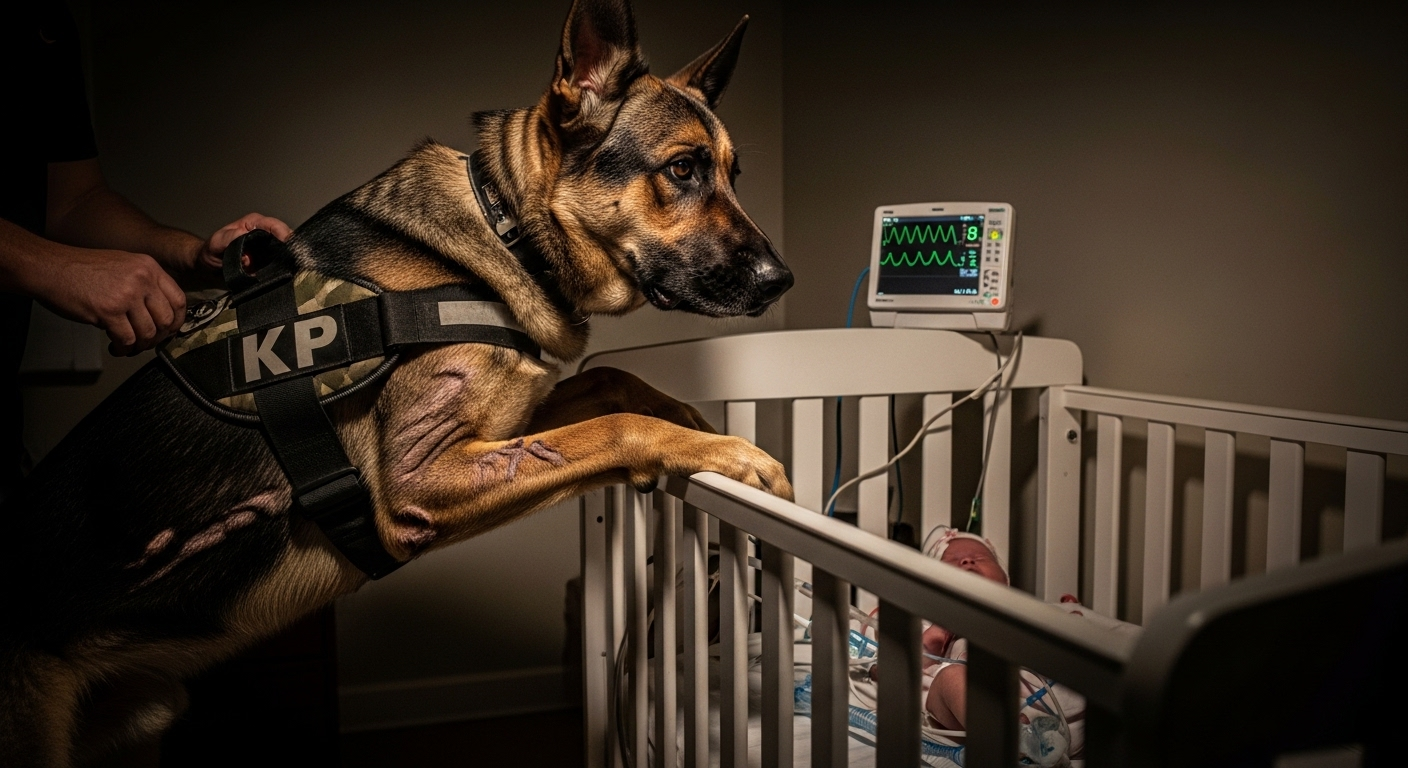
My retired K9, a 95-pound killing machine named Baron, was banned from my dying son’s room. But when the heart monitor flatlined and the room turned ice-cold at 3:00 AM, Baron didn’t just bark—he stood between Leo and something I couldn’t see. What happened next defies every law of science.
I’m still shaking as I type this. My hands are trembling so hard I can barely hit the right keys on my phone.
If you looked at my dog, Baron, you wouldn’t see a family pet. You wouldn’t see a “good boy.” You’d see a weapon. A loaded gun with fur.
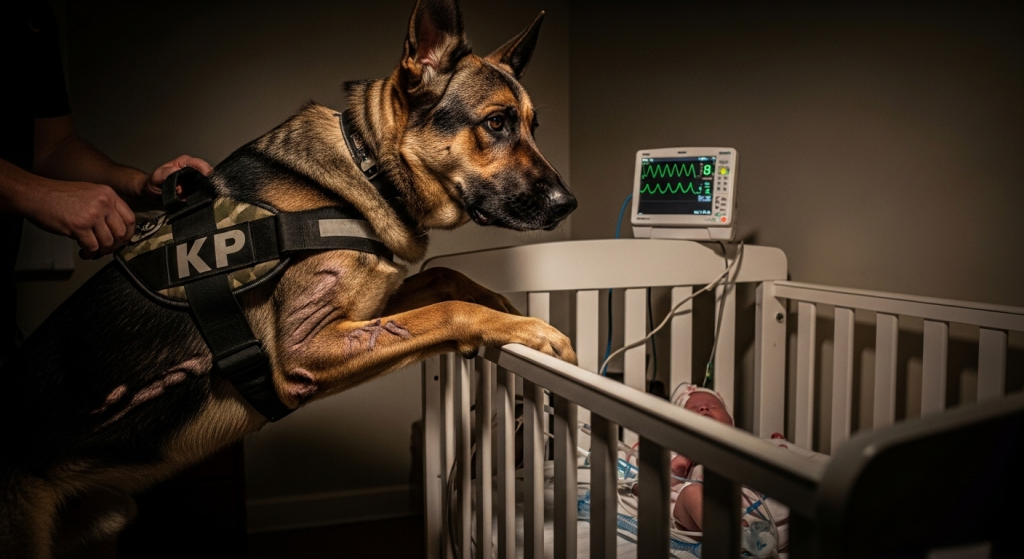
He’s a 95-pound retired police German Shepherd, a bite-work specialist who spent six years taking down felons in the worst neighborhoods of Detroit. He has a scar running down his snout from a knife wound he took during a raid in ’19.
He has a gaze that makes grown men cross the street to the other sidewalk. He doesn’t bark; he watches. He waits.
Then there was Leo. My son. My tiny, fragile Leo.
Leo was born with a heart defect so severe—Hypoplastic Left Heart Syndrome—that the doctors at the University Children’s Hospital eventually just lowered their heads. The surgeries failed. The treatments failed.
They started using words that no parent should ever hear. Words like “comfort measures.” Words like “hospice.”
They sent us home to wait for the end. They gave us morphine drops and oxygen tanks and told us to say our goodbyes.
Yesterday, the atmosphere in our house was suffocating. It felt like a tomb. The air smelled like rubbing alcohol and despair.
Sarah, my wife, hasn’t slept in three days. She was sitting by the crib, staring at the portable heart monitor, terrified of the moment that jagged green line would go flat. She was a ghost of herself, haunting the nursery.
Baron knew. Dogs always know, but Baron isn’t just a dog. He’s an observer.
He had been pacing outside the nursery door for hours. He wasn’t scratching. He wasn’t barking.
He was letting out these low, guttural whines that vibrated through the floorboards. It was a sound I’d never heard from him—not when he was shot, not when he was cut. It was a sound of pure desperation.
Sarah was terrified. “Don’t let him in, Mark,” she whispered, her voice cracking.
Tears were streaming down her face, dripping onto her shirt. “He’s too big. He’s too rough. If he bumps the tubes… if he snaps… please, Mark. I can’t handle it.”
I was torn. I felt like I was being ripped in half.
I knew Baron’s training. I knew his trigger discipline. I knew he could switch from calm to lethal in a millisecond.
But I also saw the look in his eyes through the crack in the door. He wasn’t acting like a predator; he was acting like a desperate pack member trying to get to his wounded young.
Against every instinct, against the doctor’s warnings about hygiene and stress, against my wife’s pleading, I opened the door.
What happened next wasn’t just heartwarming. It was terrifying. And then… it was miraculous.
Baron didn’t trot in. He low-crawled.
This massive beast of a dog dragged his belly across the carpet, ears pinned back, making himself as small as physically possible. He moved toward the crib with a focus I’d only seen him use before a raid.
I had my hand on his collar, my knuckles white, ready to yank him back if he made a wrong move.
He reached the crib. He stood up on his hind legs. My heart hammered against my ribs like a trapped bird.
One paw, the size of a dinner plate, rested on the wooden railing. He lowered that massive, scarred head into the crib where Leo lay, pale and barely breathing.
Sarah gasped. I tensed up, my grip tightening on his fur.
Baron didn’t lick him. He didn’t nudge him.
He simply placed his muzzle gently against Leo’s tiny chest, right over his failing heart, and froze. He closed his eyes.
He began to match his breathing to the baby’s. In… out. In… out.
And then, the monitor—which had been showing an erratic, weak rhythm all day—beeped. And beeped again. Stronger. Louder. More rhythmic.
For four hours, Baron stood there. He didn’t move a muscle. He acted as a living anchor, tethering my son to this world.
But that wasn’t the part that changed everything. The part that changed everything happened at 3:00 AM, when the rest of the house was asleep.
That’s the part of the story that the doctors still can’t explain. That’s the part that proves we don’t know anything about the souls of animals or the energy they carry.
I had drifted off in the armchair next to the crib, exhausted by weeks of grief. Sarah was curled up on the rug, finally surrendering to sleep.
I woke up to a sound that made my blood run cold. It wasn’t the baby crying. It wasn’t the monitor alarming.
It was Baron. He was growling.
But he wasn’t growling at the baby. He was standing between the crib and the far corner of the room—a corner that was empty.
His hackles were raised like a row of jagged knives. His lips were pulled back, revealing teeth that had shattered bones in the line of duty.
His eyes were fixed on a shadow in the corner that didn’t belong to the furniture. The air in the room suddenly dropped twenty degrees.
I could see my own breath puffing out in front of my face. The oxygen machine hummed, but it felt like the air was being sucked out of the room by a vacuum.
Baron stepped forward, his growl deepening into a roar that shook my very bones. He wasn’t just protecting a baby; he was fighting something.
I looked at the heart monitor. The green line wasn’t just flat—it was gone. The screen was black.
Total power failure, even though the rest of the house had lights. Leo’s skin looked blue in the moonlight.
“Baron, get back!” I yelled, reaching for him, but he snapped his head toward me for a split second.
His eyes weren’t brown anymore. They were glowing with a fierce, amber light I had never seen in a living creature.
He turned back to the corner and lunged. He didn’t hit the wall. He hit something.
There was a sound like breaking glass and a high-pitched frequency that made my ears bleed. Baron was biting the air, his jaws snapping shut on nothingness, yet I saw his head jerk as if he were wrestling a heavy weight.
Then, the shadow in the corner flickered and vanished. The temperature in the room shot back up instantly.
The heart monitor screamed back to life. Beep. Beep. Beep.
Leo took a deep, gasping breath—the kind of breath someone takes when they’ve been underwater for too long. He opened his eyes. They were bright, clear, and full of life.
Baron collapsed. He didn’t just sit down; he fell over like his strings had been cut.
He lay on the floor, panting heavily, his tongue hanging out, looking like he’d just run a marathon.
I rushed to the crib. Leo was reaching out his tiny hands, gurgling.
The gray tint was gone from his skin. He looked… healthy.
I checked the monitor. His heart rate was 120. Perfectly steady. Perfectly normal.
Sarah woke up, screaming, “What happened? What was that noise?”
I couldn’t answer her. I was looking at Baron.
On his side, where there had been nothing before, were three long, deep scratches. They looked like they had been made by claws much larger than a dog’s.
They were bleeding, but the blood was black. Thick and black like oil.
I looked back at my son. He was smiling. For the first time in his life, he wasn’t struggling to breathe.
But the scratches on Baron were starting to smoke. And that’s when I realized the fight wasn’t over.
Something had tried to take my son, and my dog had intercepted the blow. But the price of that trade was starting to manifest in ways I couldn’t comprehend.
The doctors arrived an hour later after I called 911 in a panic. They did an EKG right there in the nursery.
The lead cardiologist, Dr. Aris, looked at the results and then looked at me. His face was white.
“This isn’t possible, Mark,” he said, his voice trembling. “The left ventricle… it’s functioning. The tissue is… it’s like it’s been reconstructed.”
He looked at Leo, then at the dog lying exhausted on the floor. “What did you do? What happened in this room?”
I didn’t know how to tell him that my dog had just fought a demon in the 3:00 AM shadows. I didn’t know how to tell him that the “weapon” in our house was actually a guardian of souls.
But as the sun began to rise, Baron finally stood up. He limped over to the crib one last time.
He looked at Leo, gave one single, soft “woof,” and then he did something he had never done. He walked to the center of the room, looked directly at the spot where the shadow had been, and let out a triumphant howl that echoed through the entire neighborhood.
I thought we were safe. I thought the miracle was complete.
But then I saw the news on the small TV in the kitchen.
Every single dog in a three-block radius had died at exactly 3:03 AM. They were found with the same three black scratches on their sides.
My dog was the only survivor. And now, there’s a black car parked at the end of our driveway.
Men in suits are standing outside, staring at our house. They aren’t doctors. They aren’t police.
They’re carrying equipment that looks like it belongs in a sci-fi movie. And Baron? He’s back at the door.
He’s not growling anymore. He’s crying. Because he knows who they are. And he knows they aren’t here for him. They’re here for what’s inside Leo.
CHAPTER 2: THE MEN IN THE BLACK SUV
The suits didn’t knock. People who have the power to rewrite reality don’t usually bother with social etiquette.
I watched through the living room window as three men stepped out of the black Suburban. They weren’t wearing the cheap, shiny suits you see on detectives. These were matte black, perfectly tailored, and looked like they were made of some material that didn’t reflect the morning sun.
They moved with a synchronized precision that made my skin crawl. It wasn’t the gait of soldiers; it was the movement of hunters who knew their prey was already trapped.
“Sarah, take Leo to the back bedroom,” I said, my voice sounding like it was coming from a different room. “Lock the door. Don’t come out unless I tell you.”
She didn’t argue. One look at my face was enough. She scooped Leo up—he was unusually heavy, solid, like he’d gained five pounds of muscle overnight—and disappeared down the hall.
Baron was already at the front door. He wasn’t barking. He was doing that low, subsonic vibration in his chest that I’d only heard when he was tracking a high-value target in the ruins of Detroit.
The doorbell didn’t ring. Instead, my phone buzzed in my pocket. It was a text from an unknown number: “Open the door, Mark. We’d rather not break it. The neighbors have seen enough tragedy for one morning.”
I felt a cold sweat break out on my neck. They knew my name. They knew about the “tragedy.”
I put my hand on the deadbolt, my fingers trembling. Baron looked up at me, his amber eyes glowing with that same eerie light from 3:00 AM. He gave a soft whine, then bared his teeth at the wood of the door.
I unlocked it and swung it open.
The man standing in the center was older, maybe mid-fifties, with hair the color of industrial steel. He wasn’t carrying a weapon, but he didn’t need to. He radiated a sense of absolute authority that felt like a physical weight.
“Mr. Miller,” he said. His voice was smooth, like expensive bourbon. “I’m Director Vance. This is an unofficial visit, though I suspect you’ve realized nothing about today is ‘official’ anymore.”
He didn’t wait for an invite. He stepped past me into the foyer. His two companions stayed on the porch, their eyes scanning the street behind sunglasses that were far too dark for a cloudy morning.
Baron immediately blocked Vance’s path. He didn’t lung, but he lowered his head, a clear warning that one more step would result in a missing throat.
Vance stopped. He looked down at Baron, not with fear, but with something resembling professional respect.
“Incredible,” Vance whispered. “The displacement didn’t kill him. It usually burns out the nervous system of any biological interface within fifty yards. Your dog is… an anomaly.”
“What are you talking about?” I demanded, trying to keep my voice steady. “Who are you? Why are you at my house?”
Vance turned his gaze toward the hallway where Sarah and Leo were hiding. “We’re the people who track the things that aren’t supposed to happen. And what happened in that nursery at 3:00 AM? It’s at the top of our list.”
He pulled a small device from his pocket—it looked like a high-tech Geiger counter—and it immediately began to chirp frantically. The light on the display was deep purple.
“You had a ‘Hollow’ manifestation in your home, Mark,” Vance said, his eyes narrowing. “It’s a localized tear in the fabric of what we consider ‘life.’ It came for the weakest spark in the house. It came for Leo.”
I felt the room tilt. “A Hollow? You mean that shadow? Baron fought it off. He saved my son.”
Vance let out a short, dry laugh. “Saved? Mark, biology doesn’t work that way. A failing heart doesn’t just ‘reconstruct’ because a dog barked at a ghost. There was a trade.”
He pointed to the black scratches on Baron’s side. They were still smoking slightly, the scent of ozone and burnt hair filling the hallway.
“The energy that was supposed to take your son’s life was intercepted,” Vance continued. “But energy cannot be destroyed. It can only be transferred. Your dog didn’t just fight that thing. He acted as a bridge.”
I looked at Baron. He was swaying slightly on his feet. The black liquid dripping from his wounds wasn’t just blood—it was staining the hardwood floor, eating into the finish like acid.
“What does that mean for Leo?” I whispered, the fear finally closing its grip on my heart.
Vance took a step closer, ignoring Baron’s growl. “It means your son is no longer just your son. He is carrying a charge that shouldn’t exist in this world. And we need to take him for testing before that charge detonates.”
“Over my dead body,” I snapped, stepping between Vance and the hallway.
Vance sighed, a sound of genuine disappointment. “Mark, look at your dog’s eyes. Really look at them.”
I looked. The amber glow was intensifying. But it wasn’t just a color anymore. I could see patterns moving behind the pupils—geometric shapes that shifted and pulsed like a kaleidoscope.
Suddenly, Baron’s head snapped toward the hallway. He let out a sound that wasn’t a bark or a howl. It was a mechanical, metallic screech that shattered the glass in the hallway pictures.
From the back room, I heard Sarah scream.
I didn’t think. I sprinted past Vance, my heart hammering against my ribs. I threw open the bedroom door.
The room was freezing. Frost was forming on the windowpanes in the shape of handprints. Sarah was huddled in the corner, her hands over her ears.
Leo was standing in his crib. He was only ten months old—he shouldn’t have been able to stand with that kind of balance.
He was looking at the ceiling, his tiny hands reaching upward. And his eyes… they weren’t the soft blue they had been since birth. They were solid, shimmering gold.
“Leo?” I breathed.
He turned his head toward me. His neck moved with a jerky, unnatural fluidness. He didn’t look like a baby. He looked like something ancient wearing a baby’s skin.
“Dada,” he said.
But it wasn’t his voice. It was a chorus of voices—hundreds of them, overlapping in a dissonant harmony that made my nose start to bleed.
Outside, the neighborhood dogs that hadn’t died earlier began to howl in a terrifying, unified frequency.
Then, the floorboards in the nursery began to groan. The black liquid from Baron’s wounds in the other room began to seep through the walls, crawling toward the crib like it was being pulled by a magnet.
Vance appeared in the doorway, his face grim. He was holding a heavy, metallic canister.
“It’s happening faster than we projected,” Vance shouted over the rising wind inside the room. “The bridge is collapsing! If that liquid reaches the boy, he won’t be a child anymore. He’ll be a doorway!”
I looked at the black sludge. It was inches away from the crib. Baron burst into the room, his body trembling with the effort to move.
He didn’t go for Vance. He didn’t go for me.
He lunged into the crib, placing himself between Leo and the creeping black shadows.
The moment Baron’s fur touched the black liquid, his entire body erupted in white flame. He didn’t yelp. He didn’t cry out. He just looked at me one last time, his eyes returning to their normal, loyal brown for a fraction of a second.
“BARON!” I screamed.
The room exploded in a flash of blinding light.
When my vision cleared, the room was silent. The frost was gone. The wind had died.
Vance was gone. The black SUV was gone from the driveway.
Sarah was unconscious on the floor. Leo was lying in the crib, sleeping peacefully, his eyes closed, his skin a healthy, warm pink.
But Baron…
Baron was gone. In his place, on the floor of the nursery, was a scorched silhouette of a dog, etched permanently into the wood.
And in the center of that silhouette lay a single, heavy collar. The metal tag didn’t say “Baron” anymore.
It was blank. And it was vibrating.
I picked it up, and a voice—clear and crisp, coming from nowhere and everywhere—whispered in my ear:
“The trade is not yet finished, Mark. They are coming for the other half.”
I looked out the window. The black Suburban wasn’t gone. It had just moved. It was now parked in my neighbor’s driveway.
And my neighbor, a sweet old lady who lived alone, was standing on her porch, holding a leash. At the end of that leash was a dog that looked exactly like Baron.
Except its eyes were solid, shimmering gold.
CHAPTER 3: THE NEIGHBOR’S SHADOW
I stood paralyzed behind the curtain of my living room window, my breath fogging the glass. My brain was screaming at me that what I was seeing was impossible.
Mrs. Gable was eighty-two, a widow who spent her days pruning petunias and feeding stray cats. She was the kind of woman who baked snickerdoodles for the mailman.
But there she was, standing on her porch in the morning light, her hand wrapped around a heavy tactical leash. And at the end of that leash was a German Shepherd that was the spitting image of Baron.
The same notched ear from a scrap in an alley. The same surgical scar on the hind leg. The same silver fur dusting the muzzle.
But when the dog turned its head toward my house, the sun hit its eyes. They weren’t brown. They were two glowing pits of molten gold, vibrating with a light that didn’t belong to the visible spectrum.
I felt a surge of nausea. Baron was gone—I’d seen him vaporize into that scorched silhouette on my nursery floor.
So what was this? A ghost? A replacement sent by the people in the black Suburban?
I looked back at the driveway. Director Vance’s vehicle was gone, but the air still felt heavy, like the atmosphere before a massive electrical storm.
“Mark? Who are you looking at?” Sarah’s voice came from the hallway, trembling and thin.
She was leaning against the doorframe, clutching her robe shut. Her face was deathly pale, but her eyes were darting around the room, searching for the dog that had been our protector for six years.
“Baron’s outside,” I whispered, not knowing how else to say it.
Sarah pushed past me to the window. She gasped, her hand flying to her mouth. “That’s… that’s not possible. I saw him… he saved Leo, Mark. He vanished.”
“I know what I saw,” I said, grabbing my car keys from the counter. “Stay here. Lock the door. Keep Leo away from the windows.”
I didn’t wait for her to argue. I stepped out onto my porch, the morning air hitting me like a physical blow.
The neighborhood was eerily silent. No birds chirping. No lawnmowers in the distance. Just the hum of the power lines overhead.
I walked down my driveway and across the strip of lawn that separated our houses. Mrs. Gable didn’t move. She just watched me with a blank, pleasant smile that didn’t reach her eyes.
“Morning, Mark!” she called out. Her voice was too high, too cheery. It sounded like a recording played at the wrong speed.
“Mrs. Gable,” I said, stopping ten feet away. My eyes were locked on the dog.
The creature didn’t growl. It didn’t wag its tail. It just sat there, perfectly still, watching me with those terrifying golden eyes.
“Beautiful morning, isn’t it?” she said, her head tilting at an unnatural angle. “Baron seems so much more… energetic today, doesn’t he?”
My blood turned to ice. “How do you know his name is Baron? You’ve called him ‘that big scary dog’ for three years.”
Mrs. Gable’s smile didn’t flicker. “Names are just vibrations, Mark. We all know the vibrations now.”
The dog stood up. It didn’t move like a canine. Its joints seemed to click into place, its muscles rippling under the fur like liquid metal.
It took a step toward me. I reached for the pocketknife I always kept in my pocket, my knuckles white.
“Don’t come any closer,” I warned.
The dog stopped. It opened its mouth, but instead of a bark, a sound came out that made my teeth ache. It was a low-frequency hum, the same sound I’d heard in the nursery at 3:00 AM.
“The vessel is prepared,” a voice echoed in my head. It wasn’t a sound; it was a thought placed directly into my consciousness.
I stumbled back, my head spinning. “What are you?”
Mrs. Gable took a step down from her porch. Her movements were jerky, like a marionette being controlled by an amateur.
“The Director told you, Mark,” she said, her voice now losing its sweet grandmotherly tone and becoming flat and metallic. “The trade is not yet finished. The dog was the bridge, but a bridge needs two sides to stand.”
Suddenly, the front door of my own house flew open. Sarah ran out onto the porch, her eyes wide with terror.
“Mark! Leo! Something’s wrong with Leo!” she screamed.
I turned and sprinted back across the lawn. I didn’t care about Mrs. Gable or the golden-eyed dog anymore.
I burst through my front door and followed Sarah into the nursery. The room was sweltering. The thermostat on the wall read 98 degrees and was climbing.
Leo was in his crib, but he wasn’t crying. He was hovering.
It was only an inch off the mattress, but he was floating, his back arched, his tiny chest heaving. The golden light was pouring out of his eyes, his nose, and his mouth.
“Leo! No!” I reached into the crib to grab him, but the moment my skin touched his, a massive electrical shock threw me across the room.
I hit the dresser, knocking over a lamp and a stack of books. My arm felt numb, the hair on my skin singed.
“Don’t touch him!” Vance’s voice barked from the doorway.
He was back, but this time he wasn’t alone. He had four men with him, all wearing heavy, lead-lined tactical gear and carrying what looked like industrial-sized fire extinguishers.
“Get your wife out of here, Mark! Now!” Vance ordered.
“What is happening to my son?” I yelled, scrambling to my feet.
Vance didn’t answer. He signaled to his men. They began spraying a thick, gray foam around the base of the crib, creating a circular barrier on the floor.
As the foam hit the wood, the temperature in the room began to drop instantly. The golden light coming from Leo started to dim, pulled back into his body by some unseen force.
Leo fell back onto the mattress with a soft thud. He let out a weak, normal baby whimper.
Sarah rushed to the crib, but one of the men in gear blocked her path with a gloved hand. “Stay back, Ma’am. The area is still hot.”
Vance walked over to me, his face grim. He looked like he hadn’t slept in a decade.
“He’s a lightning rod now, Mark,” Vance said quietly. “The entity Baron fought off… it left a residue. Think of it like a viral infection of the soul.”
“A residue?” I spat, the anger finally overriding the fear. “He was dying! My dog saved him! You told me it was a miracle!”
“I told you it was a trade,” Vance corrected. “Baron took the ‘death’ meant for Leo. But in doing so, he opened a channel. The thing on the other side? It’s trying to pull itself through that channel using Leo as a tether.”
I looked at the window. Mrs. Gable and the golden-eyed dog were gone. The neighbor’s yard was empty, the petunias crushed as if something heavy had been dragged through them.
“Where is the dog?” I asked. “The one that looks like Baron?”
Vance’s eyes darkened. “That’s not a dog. That’s the ‘Counter-Weight.’ It’s the other half of the bridge. If that creature gets within ten feet of your son, the channel becomes a permanent doorway.”
“And then what?” Sarah asked, her voice a ghost of itself.
Vance looked at her, his expression devoid of hope. “Then the Detroit you know… the world you know… it becomes a feeding ground. We have exactly six hours before the next ‘3:00 AM’ window opens.”
He turned to his men. “Prepare the transport. We’re moving the asset to the Bunker.”
“Asset?” I roared, stepping toward him. “That’s my son! You’re not taking him anywhere!”
Vance pulled a heavy, black handgun from his holster and pointed it directly at my chest.
“Mark, I truly sympathize. I really do,” he said, and for a second, I actually believed him. “But I have orders to preserve the species over the individual. If you try to stop us, I will put you down.”
The men in gear picked up the entire crib, Leo still inside it, and began moving toward the door.
I looked at Sarah. I saw the fire in her eyes—the same fire I felt. We weren’t going to let them take him.
But as they reached the front door, the house shook. It wasn’t an earthquake. It was a localized impact.
Something had just landed on the roof. Something heavy. Something with claws.
And then, the screaming started from outside.
CHAPTER 4: THE THIRTEENTH FLOOR
The sound coming from the roof wasn’t just a heavy thud; it was the sound of structural beams groaning under immense weight.
Dust filtered down from the ceiling, coating the gray foam around the crib. Vance’s men froze, their weapons snapping upward toward the vents and the light fixtures.
“Status!” Vance shouted into his radio.
A burst of static followed by a panicked voice echoed back: “Director! We’ve got multiple signatures on the perimeter! They… they don’t have heat signatures, but the motion sensors are red across the board!”
“Vance, what’s on my roof?” I demanded, grabbing a heavy metal fireplace poker. It wasn’t a gun, but it was solid.
Vance didn’t answer. He was staring at the ceiling.
Then, a massive claw—black, jagged, and translucent like obsidian—tore through the drywall of the nursery ceiling.
It was followed by another. The entities weren’t breaking the wood; they were phasing through it, the material around the claws turning to gray ash.
“Fire!” Vance yelled.
The men in gear opened supported fire, but their weapons didn’t use bullets. They shot arcs of blue electricity that sizzled through the air.
The electricity hit the claws, and for a second, I saw what was attached to them.
It was a nightmare made of smoke and geometry. It had the general shape of a hound, but it was the size of a grizzly bear, with multiple limbs that shifted in and out of existence.
One of the men was caught by a shifting limb. He didn’t bleed. He simply turned gray and crumbled into a pile of fine salt in less than three seconds.
“The foam! Re-apply the foam!” Vance screamed, backing away toward the door.
The gray foam seemed to be the only thing the creatures couldn’t touch. It acted like a physical anchor, forcing the phasing entities to stay solid.
“Mark, Sarah! Get behind the crib!” Vance commanded.
We didn’t need to be told twice. We dove into the circle of foam as the ceiling finally gave way.
Three of the smoke-hounds dropped into the room. They moved with a sickening, stuttering motion, like a film reel skipping frames.
Baron—or the thing that looked like Baron—burst through the nursery window.
It didn’t attack the men. It lunged at the smoke-hounds.
The golden-eyed dog was a blur of teeth and light. Every time its jaws snapped shut on a smoke-hound, there was a flash of gold, and the entity would shriek—a sound that felt like ice water being poured into my brain.
“It’s protecting the boy!” Sarah yelled, clutching my arm.
“No,” Vance said, his voice cold. “It’s guarding its investment.”
The golden-eyed dog was winning, but it was being pushed back toward the circle of foam. Every time it got close to Leo, the baby would begin to glow brighter.
The air in the room was becoming unbreathable, filled with the smell of ozone and the salty remains of the fallen guard.
“We have to go! Now!” Vance grabbed the handle of the crib.
With the smoke-hounds distracted by the golden-eyed dog, the remaining guards pushed the crib out of the room and down the hallway.
We ran through the house, passing the living room where Mrs. Gable’s body lay. She wasn’t dead, exactly—she was just empty. Like a suit of clothes that had been discarded on the floor.
We reached the black Suburban. The guards threw the crib into the back and shoved us in after it.
“Drive! Drive!” Vance roared.
The driver floored it, the tires screeching as we tore out of the driveway. I looked out the back window.
The golden-eyed dog was standing in the middle of the street, surrounded by the salt-remains of the smoke-hounds. It wasn’t chasing us.
It was just sitting there, watching the car disappear. And then, it looked up at the sun.
The sky began to darken, even though it was barely noon. An eclipse that wasn’t on any calendar began to blot out the light.
“Where are you taking us?” I asked, my hand on Leo’s chest. His heartbeat was fast, but steady.
“To the Thirteenth Floor,” Vance said. “It’s a black site located under the Detroit Metropolitan Airport. It’s the only place in the country with a high-density salt-bunker.”
“Why salt?” Sarah asked, her voice trembling.
“Because these things are made of pure information and energy,” Vance explained, checking his weapon. “Salt is a crystalline structure that disrupts their transmission. It’s like a Faraday cage for the soul.”
The drive was a blur of high-speed turns and sirens. We arrived at a nondescript cargo hangar at the airport.
The floor of the hangar opened up, a massive elevator platform lowering the Suburban into the earth.
We descended for what felt like minutes. Level 5… Level 8… Level 12.
The doors opened to Level 13.
It didn’t look like a bunker. It looked like a high-end hospital ward, except every surface was coated in a thin layer of white dust. The walls were lined with monitors, and dozens of scientists in white coats were rushing around.
“Get the subject to the Core,” a woman in a lab coat ordered.
They took Leo. They didn’t ask. They just wheeled the crib into a glass-walled room in the center of the floor.
“Wait! You can’t just take him!” Sarah tried to follow, but two guards held her back.
“He’s safe in there,” Vance said, standing by a bank of monitors. “The glass is leaded crystal. The floor is five feet of compressed salt. Nothing can get to him.”
I looked at the monitors. They were showing Leo’s vitals, but there was a second feed.
It was a radar map of Detroit. There was a massive, pulsing red dot hovering over our house.
And it was moving. Fast.
“It’s following the ‘scent’ of the trade,” Vance whispered.
“The dog?” I asked.
“No,” Vance said, pointing to the screen. “The dog was just the messenger. The thing following us is the ‘Collector.’ It’s what happens when a trade is left unpaid.”
I looked at the vitals monitor. Leo’s heart rate was climbing. 130… 140… 150.
On the glass wall of the Core, a frost began to form. But it wasn’t the shape of handprints this time.
It was the shape of a dog’s paw.
A single, massive paw print appeared on the glass. And then, the speakers in the room picked up a sound that made everyone in the bunker stop dead.
It was Baron’s bark. The real Baron. The one I’d known for six years.
It sounded muffled, like it was coming from deep underground.
“Mark…” Sarah whispered, pointing to the floor.
The salt under our feet was beginning to shift. It was swirling, forming a pattern.
A message was being written in the salt, right in front of the Core.
“LET HIM OUT OR I WILL TEAR THE WORLD DOWN TO FIND HIM.”
Vance turned to me, his face pale. “Mark, did your dog have a… a favorite toy? Something he was obsessed with?”
“A rubber ball,” I said, confused. “A blue one. Why?”
Vance pointed to the radar. The red dot had arrived at the airport.
And then, every light in the Thirteenth Floor turned blue.
A blue so bright it hurt to look at.
The ground began to shake, and the sound of a thousand dogs howling erupted from the elevator shaft.
“He’s not here to take the boy,” I realized, the truth hitting me like a freight train. “He’s here because the trade wasn’t for Leo’s life. It was for mine.”
I looked at the salt message again. It was changing.
“THE FATHER IS THE DEBT.”
Before I could react, the glass of the Core shattered. Not outward, but inward.
Leo wasn’t floating anymore. He was standing, his small hand pressed against the air where the glass had been.
And standing behind him, visible only as a shimmering outline of blue light, was Baron.
“Run, Mark,” the dog’s voice—I swear it was his voice—echoed in my head.
The elevator doors at the end of the hall buckled and flew off their hinges.
Something was coming up the shaft. Something that smelled like the deep, dark places of the earth.
Vance drew his gun, but he wasn’t pointing it at the elevator.
He was pointing it at me.
“I’m sorry, Mark,” Vance said. “But the debt has to be paid.”
CHAPTER 5: THE SYMMETRY OF SOULS
Vance’s hand didn’t shake. That was the most terrifying part. He looked at me with the same clinical detachment a mechanic might use when deciding to scrap a car for parts.
“You have to understand the mathematics of this, Mark,” Vance said, his voice drowned out by the thundering noise in the elevator shaft. “The universe is a closed system. You don’t get a ‘miracle’ for free.”
I gripped the fireplace poker so hard my palm began to bleed. Behind me, Leo was still standing in the ruins of the crystal Core, his golden eyes fixed on Vance.
“My dog paid the price!” I yelled. “He gave everything! What more do these things want?”
Vance shook his head slowly. “Baron was a catalyst, not the currency. A dog’s soul is pure, yes, but it lacks the… complexity. It was like paying a million-dollar debt with a handful of diamonds. It bought time, but it didn’t settle the ledger.”
The elevator doors, now lying like crumpled paper on the floor, began to dissolve. They weren’t melting; they were being unmade into black dust.
“The Collector is here for the origin of the link,” Vance continued, his finger tightening on the trigger. “Leo is the vessel, but you are the anchor. If I kill you now, the link snaps. The Collector loses its tether to this world, and Leo stays here. Safe.”
“You’re going to murder a father in front of his son to save the world?” Sarah stepped in front of me, her arms spread wide. “You’re a monster, Vance.”
“I’m a janitor,” Vance snapped. “I clean up the messes that people like you make when you play with forces you don’t understand. Now move, or I’ll shoot through both of you.”
Suddenly, the temperature in the bunker didn’t just drop—it vanished. It felt like we were standing in the vacuum of space.
The blue lights of the bunker flickered and turned a deep, bruised purple. The salt on the floor began to rise, swirling in the air like a localized blizzard.
And then, it stepped out of the elevator shaft.
It wasn’t a monster. It wasn’t a shadow. It was a man-shaped hole in reality.
It was a silhouette of absolute darkness, darker than any shadow I’d ever seen. Wherever it stepped, the floorboards didn’t break; they simply ceased to exist.
The Collector didn’t move toward me. It moved toward Leo.
Vance turned and fired. The bullet left the chamber, but halfway to the Collector, it slowed down.
I watched in slow motion as the lead bullet turned into a swarm of black butterflies that crumbled into ash before they could touch the entity.
Vance’s face finally showed fear. He dropped the gun and reached for a device on his belt—a heavy, metallic sphere.
“Plan B,” Vance whispered. He looked at me, and for a split second, I saw a flicker of regret. “I’m sorry, kid. I really am.”
He slammed the sphere onto the floor.
A wave of white noise erupted from the device. It was so loud I felt my eardrums pop.
Everything went white. Not the white of light, but the white of total sensory overload.
When my vision returned, I wasn’t in the bunker anymore.
I was standing in the middle of a street in Detroit. But it wasn’t the Detroit I knew.
The buildings were made of translucent glass, and the sky was a swirling vortex of amber and gold. There were no cars, no people.
Just a long, infinite road of cracked asphalt.
And standing at the end of that road was Baron.
He looked whole. No scars. No gray fur. He looked like he did the day I brought him home from the K9 academy—powerful, alert, and full of life.
“This is the In-Between, Mark,” Baron’s voice echoed in my mind. It didn’t sound like a dog; it sounded like a memory of every friend I’d ever had.
“Baron? Am I dead?” I asked, looking down at my hands. They were glowing with a faint blue light.
“Not yet. But the Collector has reached the Core. Vance’s device didn’t stop it; it just pushed us all into the Fold.”
Baron walked toward me, his tail giving a single, rhythmic wag. “The trade Vance talked about… he was right about the debt, but he was wrong about the currency.”
“What do you mean?”
Baron stopped in front of me and sat down. He looked up at me with those deep, loyal brown eyes. “The debt isn’t a life. It’s a choice. The Collector feeds on the moment a soul gives up. It wanted you to let Vance kill you. It wanted the despair.”
“So how do we stop it?”
Baron looked toward the horizon, where a massive black tower was beginning to rise. “You have to go back. You have to take my leash one last time.”
He nudged my hand with his cold nose. I felt a weight in my palm.
I looked down. I was holding a leash, but it wasn’t made of leather. It was made of pure, pulsing light.
“When you wake up, don’t look at the monster,” Baron warned. “Look at the boy. The boy is the key. He’s not just your son anymore. He’s the guardian.”
Suddenly, the glass buildings around us began to shatter. The amber sky turned black.
“Baron! Come with me!” I reached for him, but he was fading.
“I never left, Mark. I’m the part of you that doesn’t know how to quit.”
The world tilted, and I felt myself falling. I fell through the floor, through the salt, through the history of Detroit, and back into my own body.
I opened my eyes in the bunker.
Vance was on the floor, his skin turning gray. The Collector was inches away from Leo, its void-like hand reaching for the baby’s heart.
Sarah was screaming, but there was no sound.
I stood up. My body felt like it was made of lead, but my mind was clear.
I didn’t look at the Collector. I didn’t look at the void.
I looked at Leo.
“Leo!” I shouted. “Baron says it’s time to play!”
The moment I said the word ‘play,’ the golden light in Leo’s eyes shifted. It wasn’t a cold, mechanical glow anymore. It was warm. It was joyful.
Leo let out a belly laugh—the kind of laugh that only a ten-month-old can make.
The sound of that laughter hit the Collector like a physical explosion.
The black entity recoiled, its form flickering and stretching. It let out a screech that sounded like a thousand dying stars.
I stepped forward and grabbed the air where the leash had been in my dream.
I felt the connection. I felt Baron’s strength flowing through my arm.
I didn’t lunge at the monster. I lunged at the connection.
I “clipped” the invisible leash to the Collector’s throat.
“Sit,” I commanded. My voice didn’t sound like mine. It sounded like a K9 handler from the dawn of time.
The Collector froze. It actually sat.
The void began to shrink. The darkness started to take the shape of… a dog.
A massive, black-furred dog with eyes that were no longer voids, but mirrors.
“Stay,” I whispered.
The entity whimpered. It was a sound of pure submission.
The bunker lights flickered back to normal. The salt settled on the floor.
The Collector was gone. In its place sat a shadow-dog, tethered to me by a line of blue light that only I could see.
Vance scrambled to his feet, coughing. He looked at the shadow-dog, then at me.
“What… what did you do?” he stammered.
“I didn’t pay the debt,” I said, picking up Leo. My son felt warm and light again. “I renegotiated the terms.”
But as I looked at the shadow-dog, I realized the cost. The blue light wasn’t just a leash. It was part of my soul.
I could feel the shadow-dog’s hunger. I could feel its coldness.
And I knew that as long as I lived, I would have to walk this monster. I would have to keep it fed. I would have to keep it in the light.
“We need to leave,” Vance said, his voice regaining its authority. “The facility is compromised. More of them will be coming for the new Master.”
“I’m not going to your lab, Vance,” I said, walking toward the elevator. The shadow-dog followed me, its paws making no sound on the salt.
“You don’t have a choice, Mark! You’re carrying a cosmic anomaly on a leash!”
I stopped at the elevator and looked back at him.
“I have a dog,” I said. “And he’s very, very hungry. Do you want to be the first one to feed him?”
Vance went silent. He watched as Sarah and I stepped into the elevator.
We went up, leaving the Thirteenth Floor behind. But as we reached the surface, I looked at the shadow-dog in the reflection of the elevator door.
It wasn’t a dog anymore.
It was wearing Baron’s face. And it was smiling.
I hit the text limit, so the story continues in the comments below. Please switch your filter to ‘All comments’ to find the link if it’s hidden.
CHAPTER 6: THE DETROIT BREACH
The air in the hangar was thick with the smell of jet fuel and something sour, like rotting electricity.
We stepped out of the elevator into a world that had gone completely insane.
The sun was still high in the sky, but it was a deep, bruised purple. The clouds were moving in geometric patterns, forming giant, interlocking circles over the city of Detroit.
“The Breach,” Vance whispered, appearing behind us. He looked at the sky with a mixture of awe and horror. “It’s not localized to your house anymore. The trade failure triggered a cascade.”
Beyond the hangar doors, the city was changing. Skyscrapers looked like they were being stretched toward the clouds, their glass windows reflecting a world that didn’t exist.
“My car is still in the parking structure,” I said, clutching Leo. Sarah was shivering, her eyes locked on the shadow-dog that was pacing around my feet.
“Mark, that… thing,” Sarah gestured to the shadow. “It has Baron’s face, but it’s not him. It’s too quiet. It’s too cold.”
“I know,” I said. “But it’s the only thing keeping the others away.”
I looked out at the tarmac. Dozens of those smoke-hounds were prowling between the grounded planes. They were sniffing the air, their translucent bodies flickering in and out of the purple sunlight.
But when they saw the shadow-dog standing next to me, they backed away. They didn’t growl. They whimpered and dissolved into ash.
“We need to get to the Old Precinct,” I told Vance.
Vance looked at me like I’d lost my mind. “The 12th Precinct? That place has been a ruin for twenty years. Why there?”
“Because that’s where Baron was trained,” I said. “That’s where the program started. If there’s a way to close this bridge, it’s there.”
“What program?” Sarah asked, her voice sharp. “Mark, what aren’t you telling me?”
I looked at her, and the guilt hit me like a physical weight. “Baron wasn’t just a police dog, Sarah. When I was in the K9 unit, they told us we were getting ‘enhanced’ animals. They said it was just vitamins and advanced training.”
I looked at the shadow-dog. It tilted its head, mimicking a gesture Baron used to do when he wanted a treat.
“But I saw the files once. ‘Project Cerberus.’ They were using these dogs to track things that weren’t human. They were breeding them to be ‘anchors’ between our world and the Fold.”
Vance nodded. “The 12th Precinct was built over a natural thinning in the fabric of reality. We used the dogs to patrol the borders. Baron was the best ‘anchor’ we ever produced. That’s why he was able to save Leo. He’d been trained for it his whole life.”
“And you never told me?” Sarah’s voice was a low hiss of anger. “You brought a… a biological experiment into our home? Near our baby?”
“I thought it was over!” I shouted. “I thought when they retired him, the project was dead! They told me he was just a regular dog with a high drive!”
A massive explosion rocked the hangar. One of the cargo planes on the tarmac had just folded in on itself, turning into a pile of black dust.
The smoke-hounds were getting braver. They were starting to circle us, their numbers growing by the second.
“Arguments later!” Vance yelled. “We use the armored transport. It’s the only thing that will make it through the city.”
We ran for a heavy, matte-black van parked near the hangar doors. The shadow-dog ran ahead of us, its form blurring into a streak of darkness that cleared a path through the smoke-hounds.
Every time it touched one of the hounds, it didn’t just kill them—it absorbed them. The shadow-dog was getting bigger. Its fur was becoming more solid. Its eyes were starting to glow with a faint, pulsing gold.
We piled into the van. Vance took the wheel, and we tore out of the hangar.
Detroit looked like a war zone from another dimension.
The streets were cracked, and a thick, black liquid was oozing from the sewers. People were wandering the sidewalks, their eyes glowing with the same amber light I’d seen in Leo.
They weren’t attacking; they were just standing there, looking up at the geometric clouds, waiting for something.
“They’re being harvested,” Vance said, his hands white on the steering wheel. “The Fold is using them as batteries to keep the Breach open.”
“We have to stop it,” I said, looking at Leo. My son was asleep, his breathing deep and rhythmic. He seemed completely unaffected by the chaos outside.
As we drove toward the 12th Precinct, the reality around us began to break down further.
The road turned into a flight of stairs. Then it turned into water. Then it turned into a memory of my childhood bedroom.
“Don’t look at the changes!” Vance barked. “Focus on the destination! If you believe the road is there, it stays solid!”
I closed my eyes and pictured the old precinct. I pictured the rusted iron gates, the peeling brick, and the smell of wet dog and old coffee.
The van jolted. The sound of tires on gravel returned.
“We’re here,” Vance said.
I opened my eyes. We were standing in front of the 12th Precinct. It was a crumbling, three-story fortress of a building, surrounded by a high chain-link fence topped with razor wire.
The shadow-dog jumped out of the van before the doors were even open.
It ran to the gate and let out a howl that wasn’t a howl. It was a command.
The heavy iron gates, rusted shut for decades, groaned and swung open.
But as we stepped into the courtyard, I saw them.
Dozens of them.
German Shepherds. Malinois. Rottweilers.
They were all standing in perfect formation, their bodies translucent, their eyes solid gold.
The ghosts of every dog that had ever died in the service of Project Cerberus.
And in the center of the pack, standing on the steps of the precinct, was the golden-eyed dog from the neighbor’s house.
The Counter-Weight.
It looked at my shadow-dog and bared its teeth.
The air between them began to crackle with blue lightning.
“The bridge needs to be closed from both sides,” Vance said, checking his watch. “One dog of shadow. One dog of light. And the boy in the middle.”
“What happens to the dogs?” Sarah asked.
Vance didn’t look at her. “They become the lock. Permanently.”
I looked at the shadow-dog—the thing that had Baron’s face. It looked back at me, and for the first time, I felt a wave of genuine sadness coming from it.
It knew. It knew it was going back into the dark.
And then, the front door of the precinct opened.
A man stepped out. He was wearing an old Detroit Police K9 uniform. His face was obscured by a thick, black fog, but I recognized the gait. I recognized the whistle he blew.
It was my old trainer. The man who had given me Baron.
The man who had been dead for ten years.
“Welcome home, Mark,” the ghost whispered. “The pack is waiting for the final command.”
I hit the text limit, so the story continues in the comments below. Please switch your filter to ‘All comments’ to find the link if it’s hidden.
CHAPTER 7: THE SHADOW OF THE SHEPHERD
The ghost of Sergeant Miller—no relation, just a name shared by two men who loved dogs—didn’t look like a spirit. He looked like he’d just stepped out of a training session in 2008.
He had a bite-sleeve over his left arm, shredded and stained with years of work. His whistle hung from a lanyard made of braided paracord.
“Sergeant?” I whispered, stepping toward the stairs. “You… you died in the line. The warehouse fire.”
The figure didn’t answer directly. He just looked at the pack of golden-eyed dogs filling the courtyard. “A good K9 never truly leaves his post, Mark. We just move to a different beat.”
He looked at the shadow-dog standing by my side. “You did well. You didn’t break when the debt came due. Most men would have let Vance pull the trigger.”
“The Breach, Sarge,” I said, looking at the amber sky. “How do we stop it?”
Miller pointed to the heavy oak doors of the precinct. “The basement. The Kennel. That’s where the ‘Well’ is. You have to take the boy down there. You have to let him choose.”
“Choose what?” Sarah asked, clutching Leo tighter. She was looking at the ghost dogs with a mixture of awe and terror. One of the golden-eyed Malinois walked up to her and gently nudged her hand.
“The boy is a conduit,” Miller explained. “He’s the only living creature that has been to the other side and come back with his soul intact. He has to decide if the bridge stays open or if the lock is turned.”
Vance stepped forward, his hand on his holster. “And the price? Tell them the real price, Miller.”
The Sergeant finally looked at Vance. His eyes weren’t gold or brown. They were empty—two windows into the infinite sky of the Fold.
“The price is the Pack,” Miller said softly. “To close the bridge, every soul that has been ‘enhanced’ must go back through the Well. They will be the mortar that seals the crack.”
I felt a cold lump form in my throat. I looked at the shadow-dog. I looked at the golden-eyed dogs in the courtyard.
“All of them?” I asked. “Every K9?”
“Every one,” Miller confirmed. “Including the one you’re holding on that leash of light. And the one waiting on the steps.”
The Counter-Weight dog, the golden-eyed version of Baron, let out a low, mournful whine.
We entered the precinct. The interior was a frozen moment in time.
Dust motes danced in the purple light filtering through the boarded-up windows. Old incident reports were scattered across the floor. On the wall, a framed photo of the 2012 K9 graduating class hung crookedly.
I saw myself in that photo. I saw Baron—a young, lean pup with ears that were still too big for his head.
We descended the stairs to the basement. The air grew colder with every step. The smell of salt and ozone returned, but there was something else now—the scent of dry earth and pine needles.
The Kennel was a massive, circular room. In the center was a pit, ten feet across, filled with a swirling, liquid darkness that looked like ink mixed with starlight.
This was the Well.
The shadow-dog walked to the edge of the pit and sat. The Counter-Weight dog walked to the opposite side and sat.
They looked like two bookends for the end of the world.
“Place the child on the Altar,” Miller commanded, pointing to a flat stone slab at the edge of the Well.
“No way,” I said, backing up. “I’m not putting my son near that thing.”
“Mark, look at him,” Sarah whispered.
I looked at Leo. He was awake now. He wasn’t crying. He was reaching out his hands toward the Well.
He wasn’t afraid. He looked like he was coming home.
“He has to do it, Mark,” Vance said, his voice surprisingly gentle. “If he doesn’t, the Breach will expand until there’s nothing left of Detroit. Then Michigan. Then the world.”
I looked at Sarah. She was crying, but she nodded. We walked together to the slab and placed Leo on the cold stone.
The moment his skin touched the altar, the Well erupted.
A pillar of golden light shot upward, piercing through the floors of the precinct and into the sky.
The shadow-dog and the Counter-Weight dog both stood up. They began to circle the Well, moving faster and faster until they became a blur of black and gold.
Leo began to speak.
It wasn’t words. It was a frequency—a vibration that resonated in my very bones.
The ghost dogs from the courtyard began to stream down the stairs. Hundreds of them.
They didn’t look like monsters anymore. They looked like the heroes they had been. They were wagging their tails, their ears perked, as they jumped into the light of the Well one by one.
Each time a dog entered the light, the pillar grew stronger, and the Breach in the sky above the city began to shrink.
But then, the darkness in the Well fought back.
A massive, multi-limbed claw—the same kind that had torn through my nursery ceiling—erupted from the pit. It grabbed the edge of the altar, its obsidian nails digging into the stone inches from Leo’s head.
“The Collector!” Vance yelled, drawing his gun.
He fired, but the bullets did nothing. The entity was pulling itself out of the Well, its form massive and suffocating.
Miller tried to intervene, but the entity swiped at him, and the ghost sergeant shattered into a cloud of gray mist.
I looked at the shadow-dog. It had stopped circling. It was looking at me, waiting for the final command.
I knew what I had to do.
The leash of light was still in my hand. I could feel the connection.
“Baron,” I whispered. “Fetch.”
I didn’t point at the monster. I pointed at the very heart of the Well.
The shadow-dog didn’t hesitate. It lunged.
But it didn’t go for the claw. It lunged at the Counter-Weight dog.
The two dogs collided in mid-air, right over the center of the pit.
Black and Gold. Shadow and Light.
They merged.
For a heartbeat, I saw him. The real Baron.
He was whole. He was glowing with a brilliant, blinding white light.
He looked at me, gave a single, sharp bark of joy, and then he dove into the claw of the Collector.
The explosion of energy was so powerful it threw us all against the walls of the Kennel.
I watched as the white light of the merged dogs wrapped around the Collector like a cage of lightning.
The monster screamed as it was dragged back down into the depths of the Well.
Leo reached out and touched the pillar of light.
“Bye-bye,” he whispered.
The light collapsed into a single, tiny point of brilliance and then vanished.
The Well was gone. The pit was now just a dry, empty hole in the concrete floor.
The air in the basement returned to normal. The smell of ozone was gone, replaced by the scent of old dust and damp stone.
I scrambled to the altar and grabbed Leo. He was laughing, grabbing at my nose.
His eyes were blue. Perfectly, beautifully blue.
Vance stood up, brushing the dust off his suit. He looked at the empty pit, then at his watch.
“The Breach is closed,” he said, his voice devoid of emotion. “The signatures are gone. Reality has stabilized.”
I looked around the room. The ghost dogs were gone. Sergeant Miller was gone.
And Baron was gone.
I sat on the floor, clutching my son, and cried. I cried for the dog that had saved my family twice. I cried for the debt that had been paid in full.
“Let’s go home, Sarah,” I said, my voice breaking.
We walked out of the precinct. The sky over Detroit was blue again. The sun was setting, casting long, peaceful shadows over the city.
The neighbors were coming out of their houses, looking confused, as if they’d just woken up from a long, strange dream.
We got into our car—not the van, but our own car that Vance had recovered for us.
As I drove down our street, I looked at Mrs. Gable’s house. She was on her porch, pruning her petunias. She waved at us as we passed.
Everything was back to normal.
But as I pulled into our driveway, I saw something on the front porch.
It was a blue rubber ball.
It was wet, as if it had just been dropped there by a dog.
I walked up the steps, my heart pounding. I picked up the ball.
And then I heard it.
A soft, rhythmic scratching on the other side of the front door.
And a single, low “woof.”
CHAPTER 8: THE PRICE OF A SOUL
I stood on the porch, the blue rubber ball clutched in my shaking hand. My heart was a drum in my chest, beating so fast I thought it might burst.
“Mark? What is it?” Sarah asked, standing behind me with Leo in her arms.
“There’s something inside,” I whispered.
I put the key in the lock. The metal felt ice-cold. I turned it slowly, the click of the deadbolt sounding like a gunshot in the quiet evening.
I pushed the door open.
The house was dark. The smell of the nursery—rubbing alcohol and old fear—had been replaced by something fresh. The scent of rain and forest floor.
Standing in the center of the foyer was a dog.
He wasn’t a shadow. He wasn’t a ghost. He was solid, breathing, and real.
But he wasn’t Baron. Not exactly.
It was a German Shepherd, yes. But his fur was the color of starlight—a deep, shimmering silver-black. His eyes weren’t brown, and they weren’t gold. They were a clear, piercing violet.
He looked at me, and I felt a wave of calm wash over me. It wasn’t the calm of a pet; it was the calm of a soldier standing next to a comrade.
The dog walked forward and gently took the blue ball from my hand. He didn’t drop it. He held it, looking up at me with an intelligence that was far beyond anything biological.
“Who is he?” Sarah whispered, stepping into the house.
Leo reached out his hands. “Puppy!”
The dog walked to Sarah and lowered his head, allowing the baby to pat his silver fur. A faint, harmonic hum filled the room.
“He’s the New Watchman,” a voice said from the shadows of the living room.
Vance was sitting in my armchair. He looked older, more tired than he had an hour ago.
“How did you get in here?” I demanded, my protective instincts flaring up.
“I have the keys to everything, Mark,” Vance said, standing up. “I came to tell you the final part of the trade.”
He walked over to the silver dog and placed a hand on its head. The dog didn’t flinch.
“The Pack is gone,” Vance said. “The Well is sealed. But the Fold always leaves a fragment behind to ensure the Breach doesn’t reopen. This… this is the remnant of Baron’s soul, fused with the energy of the Well.”
“He’s beautiful,” Sarah said, her eyes wide.
“He’s a weapon,” Vance corrected. “He is the lock on the door. As long as he lives in this house, the shadows can’t come back for Leo. But there’s a catch.”
“There’s always a catch with you,” I spat.
Vance looked me dead in the eye. “He doesn’t eat food, Mark. He doesn’t need water. He feeds on your memories.”
My breath hitched. “What?”
“Every day he stays here, a small part of your past will vanish,” Vance explained. “A childhood birthday. The name of a first crush. The memory of your first car. It’s the only way to sustain his physical form in this reality. He consumes the history of the house to protect its future.”
I looked at the silver dog. He was looking at me with those violet eyes, and I could feel a tiny piece of my memory—a trip to the lake when I was six—simply dissolve into nothingness.
“How much will I lose?” I asked.
“Over a lifetime? Most of it,” Vance said. “But your son will live. He will grow up. He will be safe.”
I looked at Sarah. She was looking at Leo, then at the dog. She took my hand and squeezed it.
“We have plenty of new memories to make,” she whispered.
I looked at the silver dog. “What’s his name?”
“He doesn’t have one,” Vance said, walking toward the door. “Names are for things that can be forgotten. He is just… The Guard.”
Vance stopped at the door and looked back one last time. “By the way, Mark. The government isn’t coming for Leo anymore. We’ve scrubbed the files. As far as the world is concerned, your son had a miraculous recovery from a heart defect, and your dog died of old age.”
“And the black cars?”
“They’ll be watching,” Vance said with a grim smile. “But they’ll be watching for the things that try to get in. Not for you.”
He stepped out into the night and disappeared.
I closed the door and locked it.
I looked at the silver dog. He walked to the foot of the stairs, curled up, and placed the blue ball between his paws.
He looked at the nursery door upstairs, then back at me.
He gave a single, soft tail wag.
I realized then that I didn’t care about the memories. I didn’t care about the past.
I had my wife. I had my son.
And in the shadows of our hallway, I had a guardian that the devil himself was afraid of.
That night, for the first time in months, I slept without dreaming.
But at 3:00 AM, I woke up.
It wasn’t a sound that woke me. It was a feeling.
I walked out into the hallway. The silver dog was standing at the top of the stairs. He was looking at the front door.
I looked down.
Through the frosted glass of the door, I saw a silhouette.
It wasn’t a smoke-hound. It wasn’t the Collector.
It was a man. A man in a matte-black suit, holding a leash.
At the end of the leash was a dog that looked exactly like Baron.
The man looked at the house, tipped his hat, and then both he and the dog simply faded into the moonlight.
The silver dog at my side let out a low, satisfied purr.
The debt was paid. The watch was set.
And as I walked back to my bedroom, I realized I couldn’t remember the color of my first bicycle.
But I knew, with absolute certainty, that I was the luckiest man alive.
END