I thought we were just stopping for a quick stretch, but my retired K9 partner just went into “combat alert” at a random car trunk. He hasn’t used this specific bark in four years, not since we left the Bureau. My heart is pounding because if Ranger is right, there’s something living—and terrified—inside that Nissan.

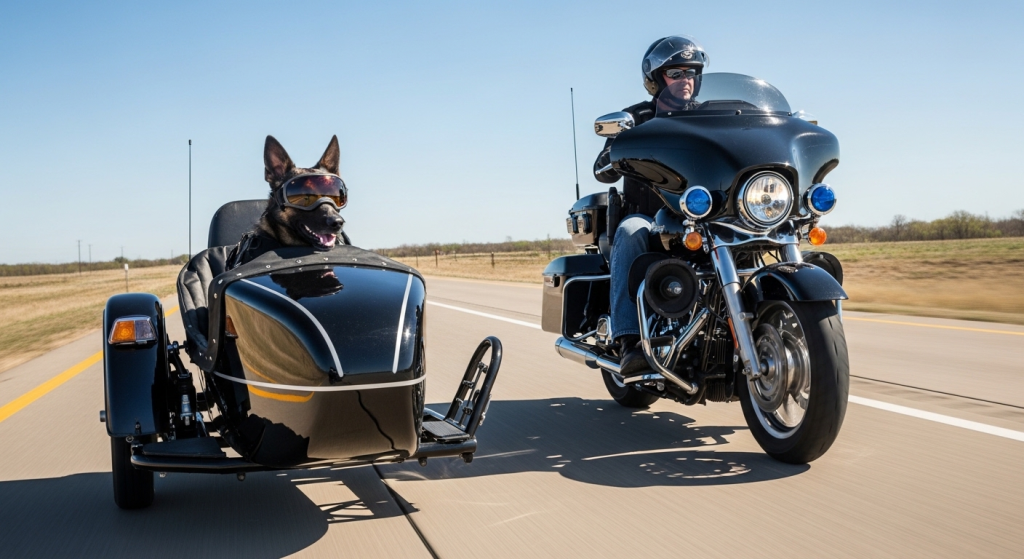
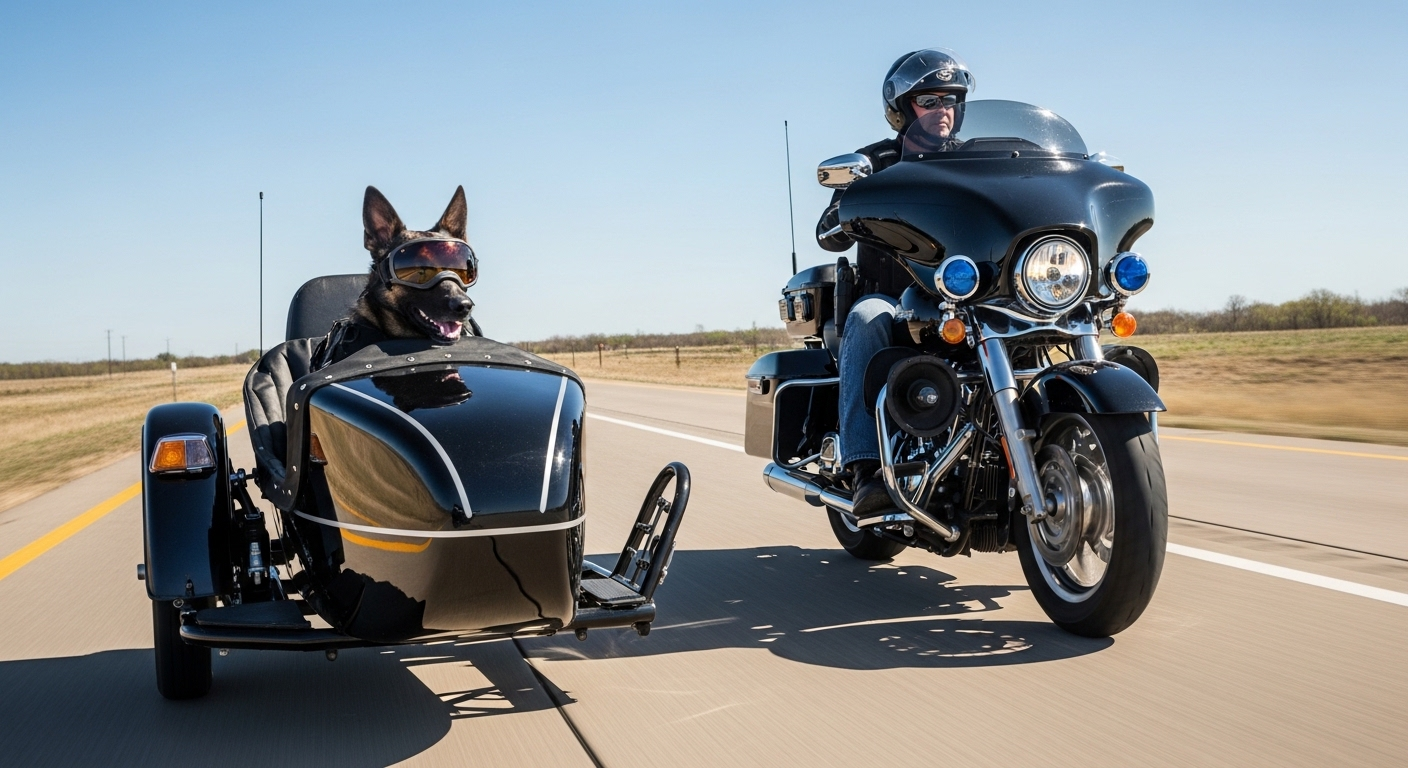
The pavement on I-40 doesn’t just hum; it screams when you’re leaning into a seventy-mile-an-hour headwind on a Road Glide. I could feel the vibration in my teeth, a steady, rhythmic grinding that reminded me I was still alive, even if my left knee felt like it was being put through a modern-day woodchipper. In the custom sidecar, Ranger was tucked in tight, his tactical goggles catching the afternoon sun like two copper coins. He was a good dog, the best partner I’d ever had in twenty years of chasing ghosts and gunpowder for the ATF. He deserved a better retirement than this dusty Oklahoma heat, but the road was the only thing that kept the both of us from falling apart in a suburban backyard.
We were about sixty miles east of Oklahoma City, in that stretch of highway where the horizon starts to feel like a threat. It’s too big, too empty, and the sky is so blue it looks fake. My knee gave a sharp, electric twinge, a reminder of the raid in ’22 that ended my career and nearly took my leg. I knew we had to pull over. Ranger needed to stretch his hips, and I needed to walk off the ghost of a thousand miles.
The Samaran Creek rest stop appeared like a concrete mirage. It wasn’t one of those fancy ones with a Starbucks and a gift shop; it was a relic of the seventies. Two squat buildings made of cinder blocks, a few cracked picnic tables, and a parking lot large enough to hold an army of truckers, though today it was nearly empty. I rolled the Harley to a stop near the edge of the grass, the engine ticking as it cooled.
“Alright, old man,” I grunted, swinging my leg over the seat. “Your turn.” I unclipped Ranger’s harness. He didn’t jump out like he used to; he slid out with a dignified caution, his back legs stiff from the ride. He was a Belgian Malinois, once a hundred pounds of pure muscle and redirected aggression, now a gray-muzzled senior citizen with two titanium pins in his hip. But his eyes—they were still the same. Sharp, amber, and always scanning for the anomaly.
I watched him trot toward the grass, his nose working the air. This was our routine. I’d give him five minutes, we’d share some water, and then we’d get back on the blacktop toward Tulsa. I was reaching into my saddlebag for his collapsible bowl, my mind miles away, thinking about the meeting at the clubhouse tonight. That’s when the world shifted.
Ranger stopped mid-stride. He didn’t sniff the grass. He didn’t look for a place to do his business. He froze, his body going rigid as a steel beam. I knew that posture. I’d seen it in warehouse raids in Detroit and border checks in El Paso. His ears were pinned forward, his tail was level, and his weight was shifted onto his front paws. He was looking at a white Nissan Altima parked about fifty yards away.
“Ranger?” I called out, my voice low. “Hey, come on. Focus.” He didn’t hear me. Or if he did, he didn’t care. He started to move toward the car, not a trot, but a tactical creep. Every muscle in his body was coiled. The Altima looked ordinary—rental stickers on the bumper, a bit of road salt from the northern states, windows tinted just enough to keep the heat out. It was empty. Or it should have been.
Then, Ranger let out a bark. It wasn’t the “I see a squirrel” bark. It wasn’t even his “someone is at the door” bark. It was the deep, guttural, relentless alert that he’d been trained for during seven years as an ATF human-detection K9. It was the bark that meant Living Human. Distressed. Found.
My blood didn’t just run cold; it turned to slush. I hadn’t heard that sound in four years. We were retired. We were just two old guys on a road trip. But Ranger wasn’t retired right now; he was back on the job. He reached the back of the Nissan and started pawing at the trunk seam, his barks echoing off the concrete buildings like gunshots.
I looked around the rest stop. It was eerily quiet. A minivan was parked near the restrooms, a family of four inside, oblivious. A lonely sedan sat by the vending machines. Nobody was near the white Nissan. I walked toward Ranger, my hand instinctively reaching for the small of my back where my Glock used to sit. I was unarmed, wearing nothing but denim, leather, and twenty years of trauma.
“Ranger, back,” I commanded. He ignored me. He was frantic now, his nose pressed into the gap between the trunk lid and the bumper. He was whining between barks, a high-pitched, desperate sound. I reached the car and saw it—a small, pink backpack sitting on the floor of the back seat. It had a little unicorn keychain hanging from the zipper. The car was locked. The engine was cold.
I put my hand on the trunk lid. The metal was hot from the sun, but I didn’t care. I leaned in close, pressing my ear against the surface. “Is anyone in there?” I whispered. My voice felt loud in the silence. For a second, there was nothing but the wind and Ranger’s heavy breathing. Then, I felt it. A soft, rhythmic thumping from the inside of the metal. Thump. Thump. Thump.
It wasn’t a random kick. It was a signal. My heart hammered against my ribs so hard I thought it might crack a bone. I looked through the rear window again. No driver. No keys. Just that pink backpack and a half-eaten bag of McDonald’s. “I’m here!” I shouted, slamming my palm against the trunk. “I’m right here! Can you hear me?”
The thumping got faster. It was desperate now. Ranger was digging at the asphalt under the car, his claws scratching a frantic rhythm. I looked back at the rest stop buildings. Someone owned this car. Someone had parked it here, walked away, and left a person—likely a child—locked in a trunk in the middle of a hundred-degree Oklahoma afternoon.
I pulled out my phone, my fingers shaking. I hit 911, but as the line started to ring, I saw the restroom door open. A man stepped out. He was wearing a plain gray t-shirt and jeans, looking like every other guy on the interstate. But when his eyes met mine, and then dropped to the dog barking at his trunk, his entire demeanor changed. He didn’t look confused. He looked like a man who had just seen the devil.
He didn’t run. Not yet. He stood there for a heartbeat, his hand reaching for his pocket. “Hey!” I yelled, the phone still ringing in my ear. “Is this your car?” He didn’t answer. He started walking toward me, not fast, but with a deliberate, cold focus that made the hair on my arms stand up. The 911 operator finally picked up. “911, what is your emergency?”
“I’m at the Samaran Creek rest stop on I-40,” I said, my eyes locked on the man. “I have a retired K9 alerting on a vehicle. There is a child in the trunk. I repeat, there is a person in the trunk. I need units here now.” The man was twenty feet away now. He reached into his waistband, and I knew I was out of time.
Chapter 2: The Standoff at Samaran Creek
The man in the gray t-shirt stopped ten feet away. He didn’t look like a monster. He looked like a CPA or a high school geography teacher. That’s the thing about the real predators—they don’t have horns. They have camouflage. But his eyes were dead. There was no soul behind them, just a cold, calculating void that I’d seen in the worst of the worst back in my ATF days.
“You’re making a mistake, buddy,” he said. His voice was oddly calm, almost melodic. “That’s my car. My dog is in the trunk. He’s aggressive, that’s why he’s in there. You and your mutt need to back off before someone gets hurt.”
I didn’t blink. I’ve stared down cartel enforcers with more heat than this guy was packing. “My dog isn’t a ‘mutt,’ and he isn’t barking at another dog. He’s a human-remains and live-find specialist. He’s telling me there’s a person in there. And I heard the knocking. So here’s how this goes.”
I shifted my weight, ignoring the scream of pain from my bad knee. I made sure I was standing directly between him and the driver’s side door. “You’re going to put your hands where I can see them. You’re going to sit on that curb. And we’re going to wait for the Highway Patrol to come and have a very long conversation about what’s in your trunk.”
The man’s hand stayed near his waistband. “You’re a long way from backup, biker. You really want to die for a dog’s mistake?”
“It’s not a mistake,” I said, my voice dropping an octave. “And I’m never alone.”
Behind me, the low, distant rumble of a dozen V-Twin engines began to roll across the plains. It started as a hum, then grew into a roar that shook the very ground we were standing on. The man’s head jerked toward the interstate off-ramp. My brothers from the Burnt River MC were pulling in, a wall of chrome and black leather led by Pike and Boon.
I hadn’t just called 911. I’d hit the emergency ping on our club’s GPS app the second I saw the pink backpack. The man’s face finally cracked. The calm evaporated, replaced by a frantic, cornered-rat look. He realized he wasn’t dealing with a lonely old man. He was dealing with a pack.
Pike slid his Softail to a halt just inches from the man, the exhaust coughing a final, defiant puff of smoke. He didn’t even take his helmet off before he was off the bike. “Wayne,” he barked, his eyes scanning the scene. “Status?”
“Ranger’s got a live hit on the trunk,” I said, never taking my eyes off the stranger. “Knocking confirmed. Subject is non-compliant and likely armed.”
The man took a step back, his hand trembling now. “This is kidnapping! You can’t do this!”
Boon, who stood six-four and looked like he was carved out of granite, stepped up beside me. “Funny word to use, ‘kidnapping.’ Why don’t you give us the keys, and we can all see how wrong my friend Wayne is?”
The man looked at the twelve bikers surrounding him. He looked at Ranger, who was still snarling at the trunk, his hackles raised like a row of jagged glass. He knew he was done. He reached into his pocket, pulled out a key fob, and threw it onto the pavement. “Open it then,” he spat. “See for yourselves.”
I picked up the fob. My hand was steady, but my heart was doing a hundred miles an hour. I walked to the back of the car. Ranger moved aside, but his eyes never left the seam of the trunk. I pressed the button.
The trunk popped with a sound that felt like a gunshot in the silence of the rest stop. I pulled the lid up, and the world stopped spinning.
There, curled in a ball amidst some dirty laundry and a tire iron, was a little girl. She couldn’t have been more than seven. Her wrists were bound with heavy-duty zip ties, and a thick strip of silver duct tape covered her mouth. Her eyes—huge, brown, and filled with a terror so deep it felt like it was swallowing the light—stared up at me.
She didn’t make a sound. She just trembled, a violent, full-body shiver that shook her small frame.
“Oh, God,” Boon whispered behind me.
I reached out, my hands—the ones covered in grease and old scars—shaking as I hovered over her. “It’s okay, sweetheart,” I said, my voice cracking. “I’ve got you. You’re safe now. I promise. You’re safe.”
Ranger stopped barking. He stepped forward and gently licked the girl’s hand. She flinched at first, then her fingers curled into his fur. It was the first sign of life I’d seen from her.
I looked back at the man in the gray t-shirt. He was trying to bolt toward the grass.
“Pike!” I roared.
But Pike didn’t need the order. He and Boon were on him before he’d made it five feet. They didn’t hit him—not yet—but they pinned him to the hot asphalt with a finality that made it clear he wasn’t going anywhere but a cage.
I turned back to the girl. I had to get her out. I had to get that tape off. But as I reached for her, I heard a sound from the front of the car. A phone was ringing. It was sitting in the center console. I looked at the screen as it lit up.
The caller ID simply said: THE BOSS.
And then, the car’s doors automatically locked with a heavy thud, trapping the girl’s legs inside the trunk as the lid started to hiss, closing on its own power.
“NO!” I lunged forward, but I was a split second too late.
Chapter 3: The Crunch of Metal and Bone
I jammed my prosthetic-braced arm into the gap of the closing trunk. The motor hissed, a high-pitched mechanical whine that sounded like a predator’s growl. The lid slammed down on my forearm, the pressure mounting until I felt the bone groan under the stress. I didn’t scream, but the world turned a blurry shade of red as the pain shot straight to my brain.
“Wayne!” Pike yelled, dropping the suspect to the ground to rush toward me. “Hold on, brother! I’ve got you!” Pike grabbed the edge of the lid, his massive biceps bulging as he fought the automated motor. Between the two of us, we managed to force the trunk back up just enough for me to slip my bruised arm out.
The girl inside let out a muffled whimper, her eyes darting between us and the closing lid. I didn’t care about the pain in my arm or the sweat stinging my eyes. I reached in, grabbed the edge of the trunk, and ripped the plastic emergency release cable I’d spotted earlier. The motor died with a pathetic spark, and the lid stayed open.
I leaned over the side, gasping for air. “It’s okay, Coraline. It’s okay,” I whispered, though my heart was still trying to kick its way out of my chest. “I’m not letting that thing close again. You’re coming out of there right now.”
I used my pocket knife to slice through the zip ties on her wrists. Her skin was pale and chafed, red welts rising where the plastic had bitten deep into her small arms. When the ties snapped, she didn’t reach for me; she reached for Ranger. My old partner leaned his head into the trunk, his tail thumping against the bumper in a slow, steady rhythm.
The little girl buried her face in Ranger’s fur, her small hands clenching his thick coat. For the first time, she started to cry—not a loud sob, but a quiet, broken sound that made my chest ache. I lifted her out of that dark hole, and she felt like she was made of nothing but air and fear. I wrapped my leather vest around her, the “Burnt River MC” patch covering her tiny shoulders.
Behind us, the man in the gray shirt was pinned to the asphalt by Dutch’s heavy boot. “Who is ‘The Boss’?” Dutch growled, his voice like grinding gravel. The phone in the center console was still vibrating, the screen glowing with a relentless persistence. The suspect stayed silent, his face pressed into the dirt, but his eyes were fixed on the horizon.
I looked up, following his gaze. The Samaran Creek rest stop was a dead end, surrounded by miles of flat Oklahoma scrubland. About a mile down the access road, a blacked-out SUV was idling on the shoulder. It wasn’t moving, just sitting there like a vulture waiting for the struggle to end. My gut, the one that had kept me alive in the ATF for two decades, told me the nightmare was just getting started.
“Pike, get the brothers in a perimeter,” I said, my voice cold and professional. “We’ve got company at the mile marker. Dutch, keep that piece of trash quiet. If he breathes too loud, handle it.”
Pike nodded, signaling the others to form a circle of steel around the girl and the car. We were twelve men with heavy bikes and a lot of history, but we were standing in the middle of nowhere. The Highway Patrol was still minutes away, and the SUV on the road was starting to move. It wasn’t heading away; it was turning toward the rest stop.
I sat on the bumper of the Nissan, holding Coraline close to my chest while Ranger stood guard at our feet. The SUV was picking up speed, the sun reflecting off its windshield so I couldn’t see the driver. It didn’t look like a rescue team. It looked like a cleanup crew.
“Wayne,” Boon called out, his hand moving to the side of his hip. “They aren’t stopping at the entrance. They’re coming in hot.”
I looked down at the little girl in my arms. She was safe for the moment, but the man on the ground had a Boss, and that Boss was currently barreling toward us in two tons of armored German engineering. I tightened my grip on her, feeling the weight of the situation. We were retired bikers and an old dog, and we were about to enter a war zone.
The SUV screamed into the parking lot, tires smoking as it drifted into a high-speed turn. It didn’t stop near the entrance or the restrooms. It headed straight for us, the engine roaring like a beast that hadn’t been fed in weeks.
Chapter 4: The Vulture Descends
The SUV screeched to a halt twenty feet from our line of bikes. The doors didn’t open immediately. For a long, tense minute, we just stared at the tinted glass, the only sound being the ticking of our cooling Harley engines and the heavy breathing of the man under Dutch’s boot. Ranger let out a low, vibrating growl that I felt in my own marrow.
“Stay behind me, Coraline,” I whispered, handing her off to Boon. “Take her to the restroom building. Lock the door and don’t come out unless you hear my voice.” Boon didn’t argue; he scooped her up and disappeared toward the cinder block structures.
Finally, the driver’s side door opened. A man stepped out, but he didn’t look like a thug. He was dressed in a sharp navy suit that probably cost more than my motorcycle. He wore aviator sunglasses and had a smile that didn’t reach his eyes. He looked like a lobbyist or a high-end lawyer, not a kidnapper.
“Gentlemen,” he said, spreading his hands wide. “I think there’s been a massive misunderstanding. My associate here was simply transporting a relative. You’ve caused quite a scene over a family matter.”
I stepped forward, my heavy boots thumping on the concrete. “I’ve seen a lot of family matters in twenty years of law enforcement. None of them involved zip ties, duct tape, and a seven-year-old in a trunk. And they definitely didn’t involve ‘Bosses’ in armored SUVs.”
The man in the suit chuckled, a dry, hollow sound. “Ah, a retired federal agent. I recognized the stance. You should know better than most, Mr. Barksdale, that some things are better left alone. The girl belongs to a very important family. We just want to take her home.”
“She’s going home,” I said, pointing a thumb toward the restroom where Boon had taken her. “But not with you. The Highway Patrol is five minutes out. If I were you, I’d start thinking about which prison you want to spend the next thirty years in.”
The man’s smile vanished. He reached into his suit jacket, and for a second, I thought he was pulling a weapon. Instead, he pulled out a thick envelope. He tossed it onto the hood of the Nissan. “There’s fifty thousand dollars in that envelope. Take your dog, take your friends, and ride away. You didn’t see anything. The girl was never here.”
The silence that followed was deafening. Pike looked at the envelope, then at me. Dutch didn’t even blink. We’ve been called a lot of things—criminals, outlaws, rebels—but none of us were for sale. Especially not when a child’s life was the currency.
“You picked the wrong club, suit,” I said, stepping even closer. “We might not be the law anymore, but we still have a code. And that code says we don’t leave people behind in the dark.”
The man sighed, a dramatic display of disappointment. “I was hoping you’d be reasonable. It’s a shame. You had a long, peaceful retirement ahead of you.” He looked back at the SUV and gave a small, barely perceptible nod.
The rear windows of the SUV rolled down. Three barrels emerged from the darkness of the interior. They weren’t handguns. They were submachine guns, pointed directly at my brothers. My heart stopped for a fraction of a second. We were outgunned and exposed in the middle of a flat parking lot.
“Last chance,” the man in the suit said, his voice now cold as ice. “Hand over the girl and the driver, or we turn this rest stop into a graveyard.”
Ranger didn’t wait for a command. He knew the threat was imminent. He lunged forward, not at the man in the suit, but at the rear tire of the SUV. He started barking with a ferocity I hadn’t seen since our days in the field. It was a distraction, a classic K9 tactic to draw fire away from the handler.
“Ranger, NO!” I screamed.
At that exact moment, the first flash of a muzzle lit up the interior of the SUV. The sound of gunfire shattered the afternoon quiet, and the concrete around us began to explode into dust and shrapnel.
Chapter 5: The Shield of Brotherhood
“GET DOWN!” I tackled Pike to the ground as a spray of lead tore through the leather seat of his Softail. The air was suddenly filled with the smell of burnt powder and ozone. My brothers scrambled for cover behind their bikes, drawing the sidearms we usually kept tucked away for “emergencies.”
The rest stop was no longer a place of peace; it was a kill zone. The men in the SUV were professionals. They weren’t spraying and praying; they were firing in controlled bursts, pinning us down. I crawled toward the back of the Nissan, my bad knee screaming in protest as I dragged myself across the rough asphalt.
Ranger was still out there. He’d ducked behind the front wheel of the SUV, his low profile keeping him out of the line of fire for now. He was snarling, a deep, prehistoric sound that rose above the crackle of the gunfire. He was waiting for an opening, his predatory instincts overriding the fear of the noise.
“Wayne! We can’t hold them off with handguns!” Dutch yelled from behind a concrete picnic table. “Where are the cops?”
“They’re coming!” I shouted back. “We just have to survive the next three minutes!”
I looked over the trunk of the Nissan and saw the man in the suit diving back into the passenger seat. He wasn’t a fighter; he was the handler. The SUV began to reverse, the driver trying to reposition for a better angle to shred our cover. If they got to the side of the bikes, we were finished.
“Pike! The fuel tank!” I pointed to a small, portable gas can strapped to the back of one of the bikes that had been tipped over. It was a long shot—literally.
Pike understood instantly. He pulled his heavy .45, took a breath that seemed to last an eternity, and fired. The bullet didn’t hit the tank, but it sparked off the frame next to it. He fired again. And again. On the fourth shot, the gas can erupted in a ball of orange flame, creating a wall of fire between us and the SUV.
The driver of the SUV swerved to avoid the heat, losing his line of sight. It was the opening we needed. I whistled—a sharp, piercing sound that Ranger knew better than his own name. “Ranger! ATTACK!”
My old partner didn’t hesitate. He wasn’t a young dog anymore, and his hip pins probably felt like needles, but he launched himself through the smoke. He didn’t go for the windows. He went for the man in the suit who was still trying to pull his door shut.
Ranger’s jaws locked onto the man’s forearm just as he was pulling a weapon. The man let out a blood-curdling scream as a hundred pounds of Belgian Malinois dragged him out of the moving vehicle. The SUV jerked forward, the driver momentarily distracted by his boss being eaten alive on the pavement.
“NOW!” I roared, standing up and opening fire on the SUV’s tires. Dutch and the others followed suit, a wall of lead meeting the armored beast. The front left tire disintegrated, and the SUV slammed down onto its rim, sparks flying as it drifted toward the grass strip.
The vehicle hit the soft dirt and flipped, rolling twice before landing on its roof with a sickening crunch of metal. Silence fell over the parking lot, broken only by the crackle of the burning motorcycle and the man in the suit’s pathetic whimpering.
Ranger stood over him, his muzzle stained with blood, his eyes fixed on the wreckage of the SUV. He didn’t move. He didn’t bark. He just stood there like a stone guardian, waiting for the next threat to emerge.
I limped toward the overturned vehicle, my heart in my throat. I needed to know who these people were. I needed to know if more were coming. But as I reached the smoking wreck, I heard a sound that chilled me more than the gunfire.
From the darkness of the overturned SUV, a radio clicked on. A voice, cold and distorted, came through the speakers.
“Sector 4, status. We have the package. Initiating Phase Two.”
I looked at the man in the suit. He was laughing through his pain. “You think… you think this was the only car?” he wheezed. “Look at the sky, agent. We aren’t the clean-up. We’re the bait.”
I looked up. In the distance, the low hum of a helicopter was growing louder. And it wasn’t a police chopper.
Chapter 6: The Eye in the Sky
The helicopter was a matte-black shadow against the orange Oklahoma sunset. It didn’t have any markings, no tail numbers, nothing but the lethal intent of its rotors. It was coming in low, hugging the terrain to stay under the radar. This wasn’t a kidnapping anymore. This was a high-stakes extraction.
“Pike! Get everyone inside the building! Now!” I screamed, grabbing Ranger by his tactical collar and dragging him toward the restroom structure. My brothers didn’t ask questions. They saw the bird in the sky and knew our handguns were useless against what was coming.
We scrambled into the small cinder block building. It was cramped, smelling of stale bleach and old cigarettes, but the walls were thick. Boon was in the corner, holding Coraline. She looked at me, her eyes wide with a question I couldn’t answer.
“Are they coming for me?” she whispered.
“Not while I’m breathing,” I said, checking my magazine. I had four rounds left. Around me, the brothers were checking theirs. We were a dozen men with maybe fifty rounds between us, facing a paramilitary force with an aerial asset.
The helicopter hovered over the parking lot, the downdraft from its rotors kicking up a storm of dust and debris that rattled against the building’s windows. Through the grime of the glass, I saw the side door slide open. Two men in full tactical gear, carrying carbines, rappelled down to the pavement.
They didn’t go for the man in the suit. They didn’t go for the driver. They headed straight for the restroom building. They moved with a synchronized precision that screamed Special Forces. These weren’t hired thugs; these were mercenaries.
“Dutch, take the back door,” I ordered. “Pike, stay with the girl. If they breach, you take her out the window and run for the woods. Don’t look back.”
“Wayne, you can’t take them both,” Pike argued.
“I’m not taking them. Ranger is.” I looked down at my dog. He was tired. I could see the tremor in his back legs, the way his breath was coming in short, ragged bursts. He’d given everything today, but I had to ask for one more thing. “One last hunt, partner. For the girl.”
Ranger looked at me, and for a second, I saw the young dog he used to be. The one who would run through fire without a second thought. He nudged my hand with his cold nose, his tail giving a single, firm wag. He was ready.
The first flash-bang hit the front window. The world exploded in a blinding white light and a sound that felt like a physical blow to the head. My ears rang with a high-pitched whine, and for a moment, I couldn’t remember where I was.
But Ranger didn’t need to see or hear. He smelled the ozone of the grenade and the sweat of the intruders. As the front door was kicked off its hinges, he launched himself through the smoke.
I followed him, firing my last rounds at the silhouettes in the doorway. One man went down as Ranger hit his throat, the dog’s weight carrying them both back out into the parking lot. The second man raised his carbine, his red dot laser searching for my chest.
I braced for the impact, but it never came.
A massive explosion rocked the parking lot. The helicopter above us suddenly lurched, its tail rotor erupting in a shower of sparks and flame. It spun wildly, the pilot struggling to regain control as it drifted away from the building, crashing into the empty field a hundred yards away.
I stood in the doorway, gasping for air, and looked toward the interstate entrance.
A fleet of black-and-white cruisers was screaming into the rest stop, led by a massive BearCat armored vehicle. The Oklahoma Highway Patrol hadn’t just sent a couple of troopers. They’d sent the whole damn army.
But as the smoke cleared, I realized something. The Highway Patrol hadn’t fired that shot at the helicopter.
Standing on the roof of a semi-truck parked in the shadows of the far lot was a figure I hadn’t noticed before. A man in a ghillie suit, holding a heavy anti-material rifle. He gave me a sharp, two-finger salute before disappearing into the darkness.
“Who the hell was that?” Pike asked, stepping out behind me.
I looked at the man in the suit, who was now being handcuffed by a dozen troopers. He looked terrified. “That,” I said, “was someone who hates ‘The Boss’ even more than we do.”
I knelt down and pulled Ranger toward me. He was bleeding from a graze on his shoulder, but he was alive. Coraline ran out of the building and threw her arms around both of us.
“We did it,” she sobbed.
“Yeah,” I whispered, watching the paramedics rush toward us. “We did it.”
But as I looked at the wreckage of the SUV and the burning helicopter, I noticed something small on the ground. A golden coin, embossed with a strange symbol—a serpent eating its own tail. I picked it up, the metal still warm from the sun.
The nightmare wasn’t over. It was just expanding.
Chapter 7: The Shadow of the Ouroboros
The next few hours were a blur of flashing lights, thermal blankets, and endless questions. The Highway Patrol took over the scene with a cold efficiency that made me feel like a stranger in my own life. They didn’t treat us like heroes; they treated us like a nuisance that had complicated their crime scene.
“Mr. Barksdale,” Sergeant Rocha said, her face illuminated by the blue strobe of her cruiser. She was a tough woman with eyes that had seen too many highway fatalities. “You realize you’ve turned a rest stop into a war zone? We’ve got three dead mercenaries, an unregistered helicopter, and a high-level kidnapping suspect in custody.”
“I was just taking my dog for a walk, Sergeant,” I said, wincing as a paramedic cleaned the gash on my arm. “The rest of the fireworks were provided by the guys in the suit.”
She looked at the golden coin in my hand. “Where did you get that?”
“Found it near the SUV. Does it mean something to you?”
Rocha’s face went pale. She didn’t answer immediately. She looked around to make sure no other troopers were listening. “That symbol… the Ouroboros. We’ve seen it in three states. Human trafficking, high-end disappearances, political ‘clean-ups.’ It’s not a gang, Wayne. It’s an organization that doesn’t exist on paper.”
“Well, they exist on the asphalt of I-40 now,” I spat. “Who is the girl? Why did they want her so bad?”
Rocha sighed, leaning against her car. “Her name is Coraline Voss. Her father is a lead prosecutor in D.C. He’s been building a case against a multi-national shipping conglomerate that’s been using Oklahoma as a hub for ‘undocumented cargo.’ They didn’t just want to ransom her. They wanted to leverage him into dropping the case.”
I looked over at Coraline. She was sitting in the back of an ambulance, holding a juice box, with Ranger’s head resting on her lap. She looked so small, so innocent. To think she was just a pawn in some billionaire’s chess game made my blood boil.
“What happens to her now?” I asked.
“Federal protection. We’re flying her father in tonight. She’ll be safe.” Rocha looked at me, her expression softening for a fraction of a second. “You and your club did a good thing today, Wayne. But you’ve put a target on your backs. People like this… they don’t like losing their ‘package.’”
“Let them come,” I said, the old ATF fire flickering in my gut. “We’ve got a clubhouse full of brothers and a dog who can smell a threat from a mile away.”
But as I watched the ambulance pull away, taking Coraline toward her new life under guard, I couldn’t shake the feeling of that man in the ghillie suit. He’d saved us, but he wasn’t law enforcement. He was a ghost. And ghosts usually have their own agendas.
I walked back to my Harley. My brothers were already mounting up, their faces grim but determined. We’d won the battle, but the war was just beginning to cast its shadow over the Oklahoma plains.
“Wayne,” Pike called out. “We’re heading back to the clubhouse. You coming?”
“In a minute,” I said. I looked at Ranger. He was limping, his old hip pins clearly bothering him after the fight. I helped him into the sidecar, tucking the blanket around him. “We did good today, partner. Rest up.”
As I kicked the engine over, a black sedan pulled up next to me. The window rolled down just an inch. A hand reached out and dropped a small, encrypted burner phone onto my lap.
“The girl isn’t safe yet,” a voice whispered from the darkness of the car. “The Ouroboros has a second team. They’re at the airport.”
The car sped off before I could respond. I looked at the phone. It was already ringing.
Chapter 8: The Final Stand
I didn’t think. I didn’t call the police. I knew the Ouroboros would have ears inside the OHP. If they were at the airport, they were going to intercept Coraline before she even got on the plane. I slammed the Harley into gear, the roar of the engine echoing my fury.
“PIKE! DUTCH! FOLLOW ME!” I roared over the comms. “Change of plans! We’re going to the regional airfield!”
The twelve of us tore out of the rest stop like a thunderstorm. We ignored the speed limits, our headlights cutting through the darkening Oklahoma night. The regional airfield was only ten miles away—a small, private strip used by corporations and wealthy ranchers.
As we rounded the final bend toward the hangar, I saw it. The ambulance carrying Coraline was parked on the tarmac, but the lights weren’t flashing. Two black SUVs were boxed in around it. Men in tactical gear were already dragging the paramedics out of the front seat.
“NO!” I screamed, twisting the throttle until the bike screamed.
We didn’t slow down. We drove straight through the chain-link fence, the metal screeching as we tore a hole into the airfield. The mercenaries turned, their muzzles flashing in the dark. But we were moving too fast, a blur of chrome and leather that they couldn’t pin down.
I slid the Harley sideways, creating a screen of smoke and noise. I hopped off before the bike even stopped, Ranger at my side. We didn’t have guns this time—we had momentum.
Ranger was a streak of gray lightning. He hit the first man before he could raise his rifle, his jaws locking onto the shooter’s shoulder. I followed behind, using my heavy biker’s chain like a flail. I wasn’t an ATF agent anymore; I was a man protecting a child.
The fight was brutal, short, and desperate. Pike and Dutch were throwing punches that felt like sledgehammers, taking down men half their age. We were outclassed in technology, but we were fueled by a righteous anger that no amount of training could match.
I reached the back of the ambulance just as a man was trying to pull Coraline out. I didn’t use a weapon. I grabbed him by the throat and slammed him against the side of the vehicle with a force that dented the metal. “TOUCH HER AGAIN AND YOU DIE!” I roared.
He slumped to the ground, unconscious. I opened the door. Coraline was huddled in the corner, her face streaked with tears. When she saw me, she didn’t scream. she just whispered my name.
“Wayne.”
“I’ve got you,” I said, pulling her into a hug. “I’ve got you.”
The rest of the mercenaries saw their plan failing and retreated to their SUVs, peeling out across the tarmac and disappearing into the night. They knew the police would be here in minutes. They’d lost.
I sat on the edge of the ambulance, holding Coraline, while Ranger stood at our feet, his tail wagging slowly. The silence of the airfield was heavy, but for the first time today, it didn’t feel threatening. It felt like an ending.
Ten minutes later, a real federal transport arrived. This time, it was led by a man who looked exactly like Coraline—her father. He ran across the tarmac, falling to his knees as he gathered his daughter into his arms. He looked at me, his eyes wet with tears, and nodded. He didn’t need to say anything.
I stood up, my body aching in places I didn’t know existed. My knee was a mess, my arm was bruised, and I was pretty sure I’d cracked a rib. But as I looked at Ranger, who was sitting proudly by the girl, I knew it was all worth it.
We walked back to our bikes. The sun was completely gone now, leaving only the vast, starry Oklahoma sky.
“What now, Wayne?” Pike asked, wiping blood from his lip.
“Now,” I said, swinging my leg over the Harley. “We go home. And we buy Ranger the biggest steak in Tulsa.”
Ranger hopped into his sidecar, his goggles on, ready for the ride. We roared out of the airfield, a pack of brothers riding into the night, leaving the shadows behind us.
The girl was safe. The dog was a hero. And the road… the road was finally quiet.
END