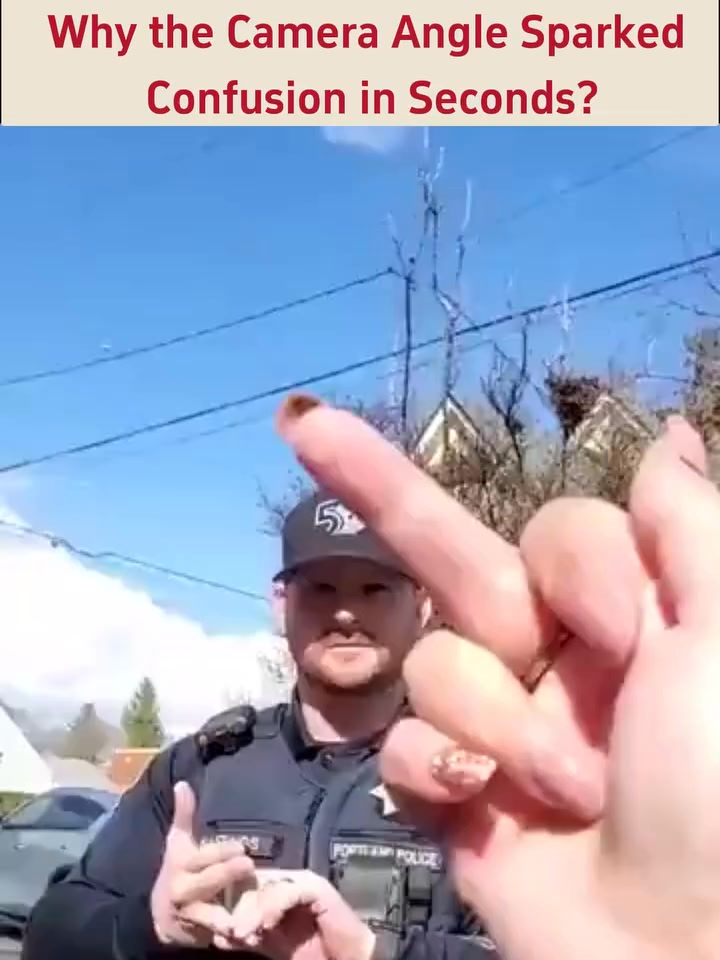
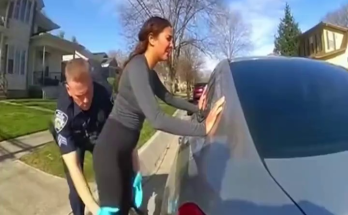
The bodycam footage opens in the middle of a tense interaction, already close enough that every movement feels amplified. An officer steps forward to secure a suspect, positioning herself where training dictates, and the camera follows her line of sight. Almost immediately, viewers notice the angle and start asking questions that overshadow what is actually happening.
From the outside, the framing looks uncomfortable. The camera appears fixed low and close as the officer moves in, creating the impression that attention is focused somewhere it should not be. Online, the clip circulates fast, and the caption writes itself before the context ever catches up.
What the video does not explain in its first few seconds is why bodycam angles shift the way they do. Cameras are mounted on the chest, not the eyes, and they move with every step, turn, and lean. When officers close distance during a hands-on moment, the lens naturally points downward as posture changes.
In this case, the officer is transitioning from conversation to control. The suspect’s hands drop out of view, and that alone raises risk. Training emphasizes watching the waistline and hands, the areas where sudden movements can change everything.
The camera follows that focus. As the officer lowers her stance to maintain balance and control, the angle follows her torso, not her intention. To viewers unfamiliar with this dynamic, the result looks jarring.
The footage continues, showing the officer issuing clear instructions while positioning herself to prevent resistance. Her attention remains fixed on keeping the suspect still and compliant. The camera angle stays low because that is where the action is, not because of what is being recorded.
Within moments, additional officers step in, and the scene widens. The angle shifts again, pulling attention away from the moment that triggered so much speculation. What remains is a controlled arrest, completed quickly and without unnecessary escalation.
The viral clip, however, rarely includes those later seconds. It loops the most awkward angle, freezes it, and pairs it with captions that imply intent rather than circumstance. The narrative forms before the full footage ever plays.
This is how misunderstandings gain traction. A single frame, stripped of movement and context, becomes the entire story. The bodycam, meant to provide clarity, instead becomes a source of confusion when selectively viewed.
In reality, officers are trained to maintain visual control over areas that matter most for safety. The waistline is one of them. It is where hands return to after brief compliance, where objects can be concealed, and where sudden motion can signal danger.
Bodycam placement complicates this further. Mounted high on the chest, the camera exaggerates downward angles whenever an officer bends, braces, or leans in. What looks intentional to a viewer is often just physics.
As the incident unfolds in full, the officer’s focus never wavers from procedure. Commands are consistent, movements are measured, and the situation resolves quickly. There is no deviation, no pause, no behavior suggesting anything beyond professional duty.
Investigators reviewing the footage later focus on timing and positioning, not the angle that sparked online commentary. They see the same thing they always do: an officer controlling a suspect’s movement while maintaining awareness of hands and balance.
Public reaction, however, rarely waits for that review. Clips circulate faster than explanations, and questions turn into accusations before answers arrive. The bodycam becomes evidence for a claim it was never meant to support.
Departments are increasingly aware of this problem. Many now release longer, unedited footage when confusion arises, allowing viewers to see how moments connect. In full context, the angle that seemed strange becomes unremarkable.
The officer’s actions remain consistent throughout. There is no lingering focus, no unnecessary contact, and no behavior that suggests intent beyond control and safety. The moment passes as quickly as it appears.
What remains is a lesson in how perception works in the age of short clips. Viewers react to what feels uncomfortable, even when discomfort comes from misunderstanding rather than misconduct.
Bodycams capture reality, but they do not explain it. Without understanding how they move, where they are mounted, and why officers position themselves the way they do, it is easy to misread what the lens records.
The question that spreads online, why is she recording there, reflects that gap in understanding. The answer is less dramatic than the speculation suggests. The camera is recording what the officer is doing, not what she intends to show.
As the clip fades and the arrest concludes, the scene returns to routine. Paperwork begins, communication with dispatch continues, and the bodycam keeps rolling, documenting a standard outcome to a tense moment.
The controversy lingers longer than the event itself. Comments pile up, theories spread, and the original context gets buried beneath reactions. This is the cost of viewing fragments instead of sequences.
In the end, the footage does what it always does when seen in full. It shows a brief, awkward angle created by movement and proximity, followed by a controlled resolution. Nothing more, nothing less.
The bodycam does not tell jokes or make judgments. It records motion. When that motion is isolated and replayed without explanation, meaning can be assigned where none exists.
For viewers willing to watch beyond the first few seconds, the confusion dissolves. The angle changes, the situation resolves, and the question answers itself through continuity.
What looks strange in a freeze-frame becomes ordinary in motion. The lesson is simple but often ignored. Context is not optional, especially when a camera never stops recording.