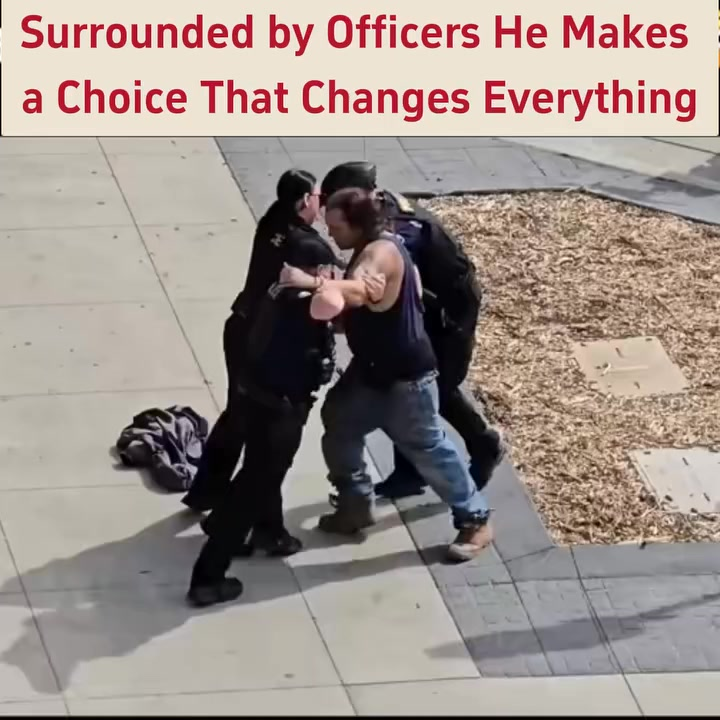
The bodycam footage begins with a tense but controlled standoff in a confined public space. Three officers position themselves carefully around a man who appears agitated, his movements restless and his attention constantly shifting as he scans his surroundings.
From the start, officers maintain distance and clear lines of sight. Their posture is firm but measured, signaling authority without rushing the moment. The environment is quiet enough that every footstep and breath feels amplified on camera.
The man at the center of the scene seems overwhelmed rather than cornered. His body language shows indecision, hands moving unpredictably, shoulders tight, as if weighing options that narrow by the second.
Officers speak calmly, using short, deliberate instructions designed to slow the pace. The bodycam captures repeated attempts to de-escalate, offering the man space and time rather than pressure.
For a brief moment, it appears the situation may resolve peacefully. The man pauses, glancing from one officer to another, as though considering compliance and an end to the encounter.
Then the atmosphere shifts. Without clear warning, he makes a sudden move toward one of the officers, transforming the dynamic instantly from negotiation to reaction.
The bodycam records the rapid adjustment. Officers step in with coordinated movements, focused on control rather than chaos. Their actions are swift, practiced, and clearly aimed at preventing the situation from spreading beyond the immediate area.
What stands out is how quickly calm turns into intensity. Seconds earlier, voices were steady and slow. Now, the frame fills with motion as officers work together to regain control.
Despite the struggle, there is no sense of panic. The footage shows communication continuing even as movements become physical, reinforcing how training guides responses under pressure.
The man resists, twisting and pulling away, his choices narrowing with every attempt to break free. The bodycam captures the strain on faces, the effort required to maintain balance and positioning.
Officers avoid unnecessary force, focusing instead on leverage and teamwork. Each movement appears calculated, aimed at ending resistance rather than escalating it.
Bystanders remain at a distance, their presence adding urgency but not distraction. Officers remain aware of the wider environment, ensuring no one else becomes involved.
Within moments, control is restored. The man is guided to the ground in a controlled manner, resistance fading as officers secure the situation.
Breathing is heavy on both sides. The bodycam captures a brief pause, a reset, as officers reassess and ensure everyone is safe.
The tone shifts again, moving from confrontation to procedure. Officers check the man’s condition, speak clearly, and begin the next steps without raised voices.
What could have spiraled further instead stabilizes quickly. The footage highlights how coordination and restraint shape outcomes, even when a subject chooses resistance.
As the man is brought to his feet, his earlier tension gives way to visible fatigue. The camera records the human cost of a decision made in seconds.
Officers maintain professionalism, documenting the encounter while remaining alert. Their posture reflects readiness without aggression, a balance reinforced throughout the video.
The surrounding area returns to stillness. What felt explosive moments earlier now appears controlled, almost quiet, emphasizing how quickly scenes can shift.
For viewers, the footage raises unavoidable questions. Why did the man choose to fight when surrounded, and what outcome did he expect in that moment.
The bodycam does not answer those questions directly. Instead, it presents the reality of choices and consequences unfolding without narration or judgment.
What makes the video compelling is not spectacle, but clarity. It shows how options disappear rapidly when cooperation gives way to confrontation.
The encounter also highlights the importance of teamwork. No single officer dominates the scene; control comes from coordination and shared awareness.
As the recording continues, officers complete their duties with methodical precision. The earlier intensity lingers, but the risk has passed.
Viewers are left reflecting on how quickly moments escalate. A situation that began with calm conversation shifted in seconds due to one decision.
The footage reinforces a familiar truth in bodycam videos. Encounters often hinge on choice, and those choices shape outcomes immediately and decisively.
In the end, the scene resolves without further incident. Sirens remain silent, voices lower, and normalcy slowly returns to the space.
The camera keeps rolling, capturing the quiet aftermath that often goes unseen. These moments reveal more than the struggle itself.
This video stands as a reminder that being surrounded does not remove agency. It only sharpens the consequences of the choice that follows.
For those watching, the lesson is clear without being spoken. Escalation is fast, control is fragile, and decisions matter more than strength.
The bodycam shows it all plainly. One man, three officers, and a choice that turned a tense moment into a defining one.