The Shocking Encounter: When Racism Meets the Law
On a scorching Saturday afternoon in Minneapolis, a routine trip to a drive-thru turned into an ordeal that would change the lives of everyone involved. Lieutenant Angela Torres, a seasoned Minnesota police officer and legal expert, was subjected to racial profiling by an Immigration and Customs Enforcement (ICE) agent who demanded proof of her citizenship while she was in her own city. What followed was not just an unjust detention, but an unlawful use of force that would cost the federal government $16.7 million in one of the largest civil rights settlements in history.
This incident was captured in real-time by multiple security cameras, as well as bystanders’ phones, providing undeniable evidence of racial bias in law enforcement. Angela Torres, however, was no ordinary victim—she was a police officer herself, armed not only with her badge but also with a law degree. What ICE agent Ryan Mitchell didn’t know was that every unconstitutional act he carried out in front of her terrified son was being documented, and it would ultimately lead to a landmark case in the fight for justice.
Angela Torres: A Life of Service and Dedication to Justice
At 42, Lieutenant Angela Torres had dedicated 15 years to the Minnesota Police Department. She had earned respect within her department, working her way up through the ranks with integrity and professionalism. Angela had also recently earned her law degree and passed the bar exam, secretly preparing for the day she might need it. Her commitment to law and order went beyond her badge—it was a core part of who she was. She had worked tirelessly to keep the peace, protect the vulnerable, and serve the public with honor.
That fateful day, Angela was simply driving her son, Isaiah, to basketball practice. They stopped at a local fast food restaurant, the Burger Barn on Hennepin Avenue, where Angela placed an order in the drive-thru. Dressed in a hoodie and faded jeans, she was unaware that her simple errand was about to be interrupted by ICE agents who saw something entirely different—a black woman in a nice vehicle in a predominantly white neighborhood. To Agent Ryan Mitchell, it was enough to question her presence.
The Moment of Racial Profiling: A Routine Stop Turned Hostile
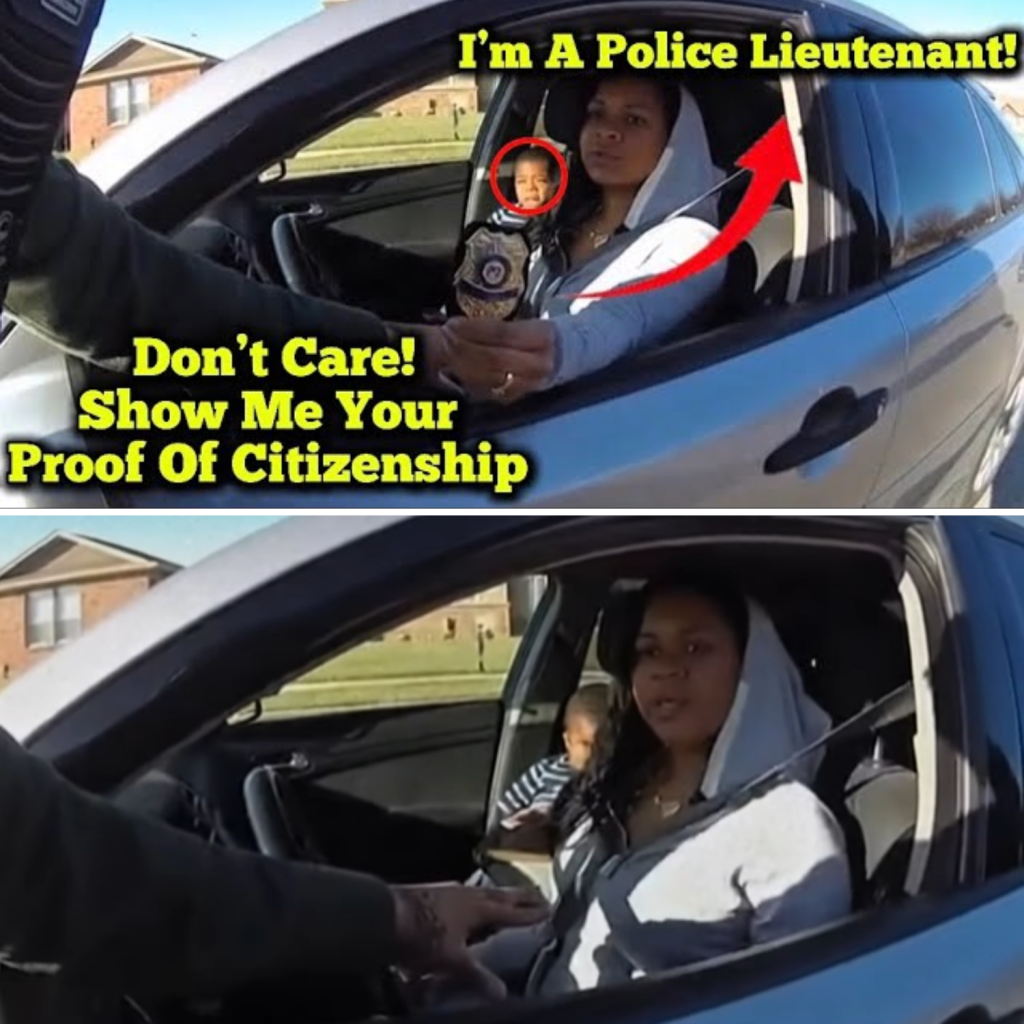
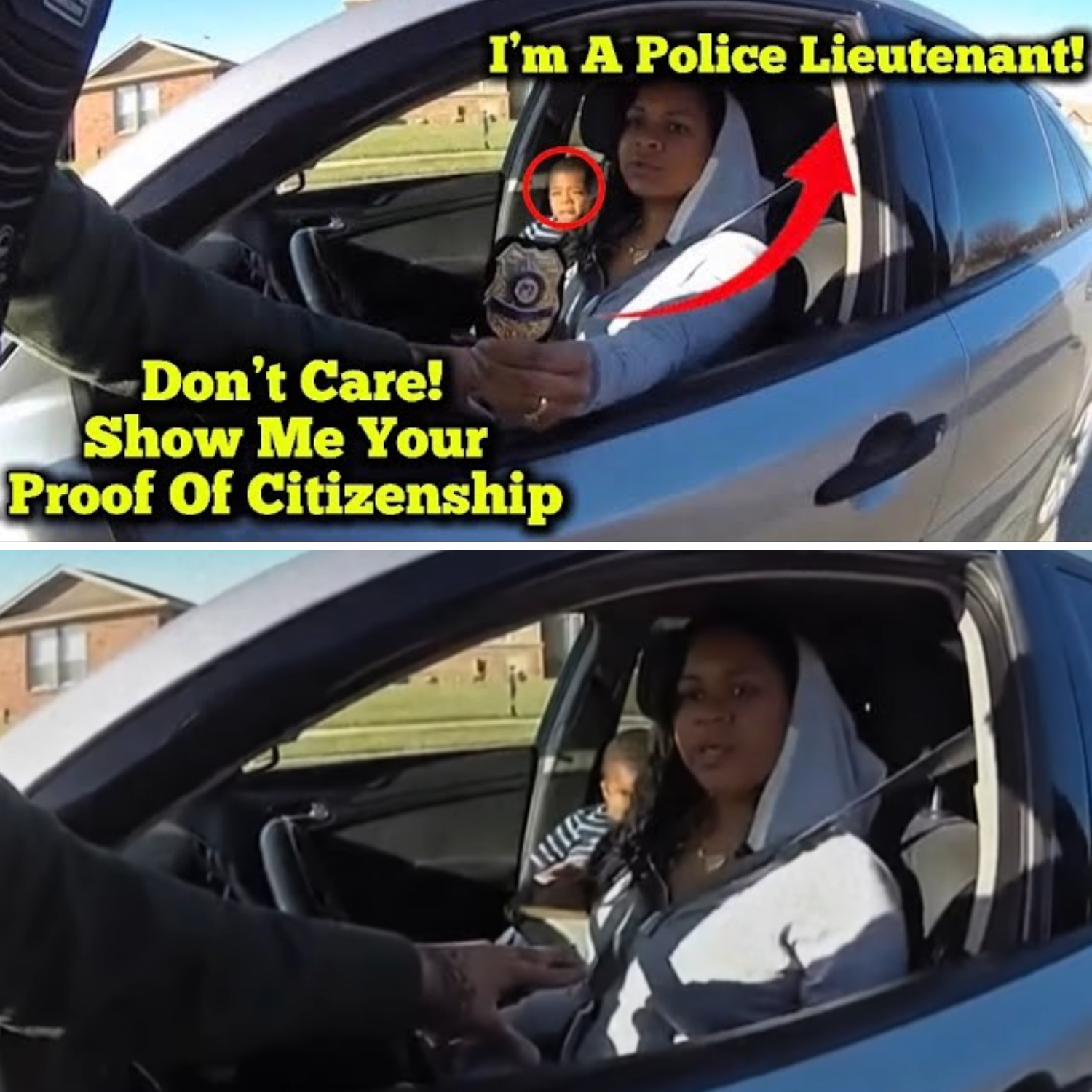
As Angela waited in the drive-thru, she noticed an unmarked white van pull up behind her. Three ICE agents, including Mitchell, emerged and surrounded her vehicle. From the start, Angela could tell something was off. As a veteran officer, she recognized the signs of a potential escalation. Mitchell approached her window and demanded to see her identification and proof of citizenship.
Angela, visibly confused and frustrated, calmly explained she was a Minnesota Police Department lieutenant and identified herself as such. She offered to show her badge, which was in her glove compartment. But Mitchell wasn’t interested in verifying her identity—he dismissed her explanations, stating, “Everyone says something,” as if her credentials meant nothing.
He then demanded additional documentation, completely ignoring her professional status. Despite being fully identified, Angela was ordered out of the vehicle. She complied, asking for the agent’s badge number and the name of his supervisor. Instead of addressing her concerns, Mitchell escalated the situation by calling for backup.
As her son, Isaiah, looked on in confusion and fear, Angela was handcuffed and shoved toward the van, her own rights violated in front of her child. The entire ordeal, including the physical restraint and verbal abuse, was caught on multiple recordings—solid evidence that would expose the injustice of the situation.
The Legal Framework: A Detention without Cause
As Mitchell grabbed Angela’s wrist and twisted her arm behind her back, Angela’s training kicked in. She had spent years studying the intricacies of the law, and she recognized this as an unlawful detention. She had committed no crime, provided identification upon request, and remained calm and compliant throughout the entire encounter. Yet, here she was, being treated as a criminal, simply because of the color of her skin.
Angela’s calm but assertive response to her unlawful treatment made it clear to Mitchell that she knew her rights. She told him repeatedly that she was not resisting and that her detention was a violation of her Fourth Amendment rights. Yet, Mitchell, undeterred by the obvious truth, continued to hold her, while bystanders recorded the entire interaction.
As the agents pushed Angela into the van, she tried to reassure her son, telling him that she would be okay. But the damage had already been done. Isaiah was left alone, terrified and confused, while his mother was taken to an ICE holding facility, shackled and bruised. This was the reality of racial profiling in America—where a black woman, regardless of her credentials or accomplishments, could be treated as a suspect in her own city.
The Aftermath: The Fight for Justice Begins
Angela’s detention lasted for hours, but the trauma would last a lifetime. When she was finally released, she immediately began to document every violation of her rights. As a police officer with a law degree, Angela knew how to handle this situation. She was not going to let her abusers walk away unpunished.
Her legal knowledge gave her the confidence to demand body camera footage and incident reports from the agents involved. She knew this was just the beginning. As soon as she was free, she contacted an attorney, and the wheels of justice began to turn. Her decision to pursue a lawsuit against the agents was not just about holding them accountable—it was about setting a precedent and making sure this kind of injustice never happened again.
A Landmark Lawsuit: The $16.7 Million Verdict
Angela Torres filed a federal civil rights lawsuit against ICE agents Ryan Mitchell, Bradley Sullivan, and Nina Patel, as well as the United States government. The lawsuit accused the agents of racial profiling, unlawful detention, infliction of emotional distress, and violation of Angela’s Fourth Amendment rights.
The case became a landmark example of what happens when racial bias intersects with law enforcement. The evidence was overwhelming—seven different camera angles, multiple bystanders’ recordings, and a complete lack of probable cause on the part of the agents. The jury deliberated for days, and when they returned their verdict, the courtroom erupted in applause. Angela was awarded $16.7 million in compensatory and punitive damages, sending a powerful message to law enforcement and federal agencies across the country.
This was not just a financial victory; it was a victory for justice, for racial equality, and for every person who had ever been unfairly targeted or mistreated by the system.
The Fallout: Careers Destroyed, Systemic Change
The fallout for the agents involved in Angela’s detention was swift and severe. Ryan Mitchell was fired from ICE and faced criminal charges for his actions. His career, which had been built on years of racial profiling, came crashing down in a matter of days. Bradley Sullivan and Nina Patel were also dismissed, and the entire operation that led to Angela’s unlawful detention was called into question.
The case highlighted the systemic problems within ICE and other federal agencies, exposing a culture of racial bias that had long been overlooked. As a result of the lawsuit and its wide-reaching implications, ICE implemented mandatory bias training for all agents, and new oversight mechanisms were put in place to ensure that racial profiling would no longer be tolerated.
A New Path: Empowering the Next Generation
Angela’s legal victory was not the end of her journey—it was the beginning of a new chapter. Using a portion of her settlement, she established the Torres Justice Initiative, a nonprofit organization dedicated to providing legal assistance to victims of racial profiling and discrimination. The initiative quickly became a beacon of hope for those who felt powerless in the face of systemic injustice.
In the years that followed, Angela became a vocal advocate for criminal justice reform. She spoke at conferences, met with lawmakers, and worked tirelessly to ensure that her story would not be forgotten. Her work, combined with the millions of dollars in settlement funds, began to change the way law enforcement agencies viewed racial bias and accountability.
Conclusion: A Legacy of Justice and Accountability
Angela Torres’s journey from victim to victor is a testament to the power of perseverance, knowledge, and the pursuit of justice. The $16.7 million settlement and the systemic changes that followed were hard-earned victories that would resonate for years to come. This case demonstrated that when individuals stand up for their rights, no matter the cost, they can change the world for the better.
For Angela, this wasn’t just about the money—it was about ensuring that future generations wouldn’t have to face the same injustices she did. It was about creating a world where skin color no longer determined how people were treated, and where accountability was not optional but a cornerstone of American law enforcement.
Her victory has become a shining example of what can be achieved when those in power are held accountable for their actions and when justice is pursued with determination, integrity, and a commitment to truth.