The Tunnel Beneath the Mansion
No one expected the ground to answer back.
The mansion sat on a hillside outside San Diego, white stone glowing faintly under floodlights, palm trees motionless in the early-morning air. From the outside, it looked like every other luxury property owned by someone who never wanted to be noticed. No guards. No cameras visible from the street. No signs of panic.
Special Agent Daniel Mercer stood near the perimeter, coffee untouched in his hand, watching as a team of engineers unloaded equipment that didn’t belong in a simple financial investigation.
Originally, this case wasn’t even supposed to involve the FBI.
It had started with paperwork.
A routine audit. A nonprofit filing that didn’t quite align. Donations routed through shell entities. Legal defenses too polished, too fast. The kind of work that belonged to white-collar units and quiet subpoenas.
Until one junior analyst noticed something strange.
Every property owned by Hassan Abdi, a high-profile attorney with deep political ties and a reputation for defending the undefendable, showed normal utility usage—except this one.
Water consumption spiked underground.
That anomaly changed everything.
By the time ICE was looped in, then Homeland Security, then a quiet call placed to military mapping specialists, the case had already grown teeth.
Still, Mercer hadn’t expected this.
A ground-penetrating radar truck rolled into position. The operator adjusted the screen.
The first scan came back messy. Concrete. Reinforcement bars. Something wide.
Too wide.
“Run it again,” Mercer said.
The second pass was clearer.
A tunnel.
Not a basement. Not a storm drain.
A tunnel that extended beyond the property line.
Someone had gone to great lengths to hide it.
And someone had succeeded—until now.
A Man with Too Many Clean Records
Hassan Abdi was not supposed to be a villain.
He was photographed smiling with city officials. Quoted in law journals. Featured on panels discussing justice reform. His public persona was flawless—immigration advocate, civil rights defender, philanthropist.
Mercer had read his file three times and still couldn’t reconcile it with the image on the screen.
“No criminal record,” an analyst had said earlier. “Not even a parking ticket.”
That bothered Mercer more than a long rap sheet ever could.
People like Abdi didn’t stay clean by accident.
They stayed clean by controlling the story.
The warrant came through at 2:42 a.m.
No press. No local police. Minimal footprint.
By 3:00, agents were inside the house.
The interior was immaculate. Marble floors. Art on the walls—tasteful, expensive, untraceable. Bedrooms untouched. No panic room. No hidden safes.
Almost disappointing.
Then one of the engineers tapped the floor near the wine cellar.
“Hollow,” he said.
The switch was concealed behind a climate control panel.
The floor slid back silently.
Cold air rushed up.
And with it, the smell of earth and oil.
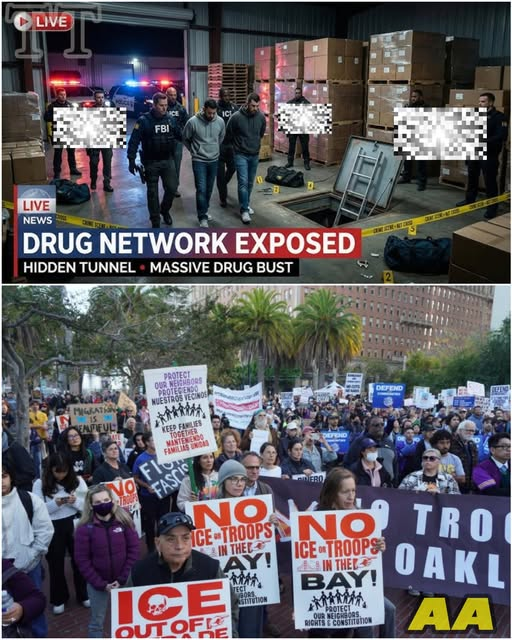
The tunnel yawned open beneath them.
Down Where the Rules Don’t Apply
Mercer descended first.
The ladder was reinforced steel. Newer than the house itself. Whoever built this hadn’t spared a dollar—or a risk.
The tunnel walls were lined with concrete panels, smooth and curved, designed to deflect sound. LED lights flickered on as motion sensors activated.
This wasn’t improvised.
It was engineered.
The tunnel sloped downward, then leveled out, extending farther than the radar scan had shown.
“Jesus,” one agent muttered. “This goes on forever.”
Mercer checked his watch.
3:26 a.m.
Every minute down here was a minute Abdi could be somewhere else.
They advanced.
Along the walls were junction boxes, fiber-optic lines, ventilation ducts. Military-grade construction disguised beneath civilian luxury.
Then they reached the first chamber.
Crates.
Hundreds of them.
Some marked with chemical symbols. Others unmarked entirely.
ICE agents opened one.
Inside: bricks wrapped in plastic.
Field tests came back positive.
Narcotics. High purity. Industrial scale.
Another crate revealed something worse.
False passports. Dozens. Hundreds. Different countries. Different names. Same biometric printer.
This wasn’t just trafficking.
It was identity manufacturing.
Mercer felt the case shifting beneath his feet.
This tunnel wasn’t about drugs.
It was about access.
The Name That Shouldn’t Exist
They found the office at the tunnel’s midpoint.
A glass-walled room underground, humming with servers.
On a desk sat a ledger—paper, not digital.
That alone was a red flag.
Mercer flipped it open.
Names. Dates. Routes.
Then one entry stopped him cold.
A name he recognized.
A man officially deceased.
Someone Mercer had personally watched get buried—figuratively and politically—years ago during an intelligence scandal that had been quietly sealed.
“Get command on the line,” Mercer said.
“This just went federal-federal.”
The implication was clear.
This tunnel wasn’t hidden from law enforcement.
It had been protected by it.
The Arrest That Didn’t Happen
They expected to find Abdi at the end of the tunnel.
They didn’t.
Instead, the exit opened into an abandoned industrial complex miles away, beneath a defunct cold-storage warehouse slated for demolition.
Fresh tire tracks marked the floor.
He’d been warned.
Someone always was.
By dawn, Abdi’s name was locked down. Travel flags raised. Accounts frozen.
Publicly, nothing happened.
No headlines. No alerts.
Just silence.
That silence was intentional.
Because within twelve hours, Mercer’s phone rang.
A blocked number.
A calm voice.
“You’re standing on something bigger than you think,” the voice said. “And you’re not the only one standing there.”
The call ended.
That night, one of the analysts assigned to the case resigned.
The next morning, the ledger went missing—from a secured evidence room.
No signs of forced entry.
No alarms triggered.
Someone had keys.
The Cost of Knowing
Mercer stopped sleeping.
Every name he trusted came under scrutiny.
Briefings grew smaller. Files were compartmentalized until no one had the full picture.
And still, the tunnel kept appearing.
Satellite images flagged similar structures near other properties.
Not all owned by criminals.
Some owned by donors.
Some by consultants.
Some by people who wrote policy.
The pattern was undeniable.
This wasn’t a network.
It was an infrastructure.
And Abdi was just one node.
The Message in the Concrete
Two weeks later, construction crews were ordered to seal the tunnel.
Before they could, Mercer returned one last time.
He walked the length alone.
At the far wall of the first chamber, he noticed something new.
A phrase etched into the concrete.
Fresh.
Deliberate.
“You only found this because we let you.”
Mercer stood there a long time.
Above him, the mansion was already being sold.
Below him, the ground held secrets that didn’t want daylight.
And somewhere, Hassan Abdi was still free.
Watching.
Waiting.
Because the tunnel wasn’t an escape route.
It was an invitation.
OPEN END — LEAD-IN TO PART 2
As Mercer climbed back to the surface, his phone vibrated once.
A new message.
No sender.
Just coordinates.
And three words:
“Phase Two begins.”
He looked back at the sealed entrance.
And realized the most dangerous part of the investigation hadn’t been underground at all.
It had been believing the tunnel was the end.